A criterion of life the cosmos meets
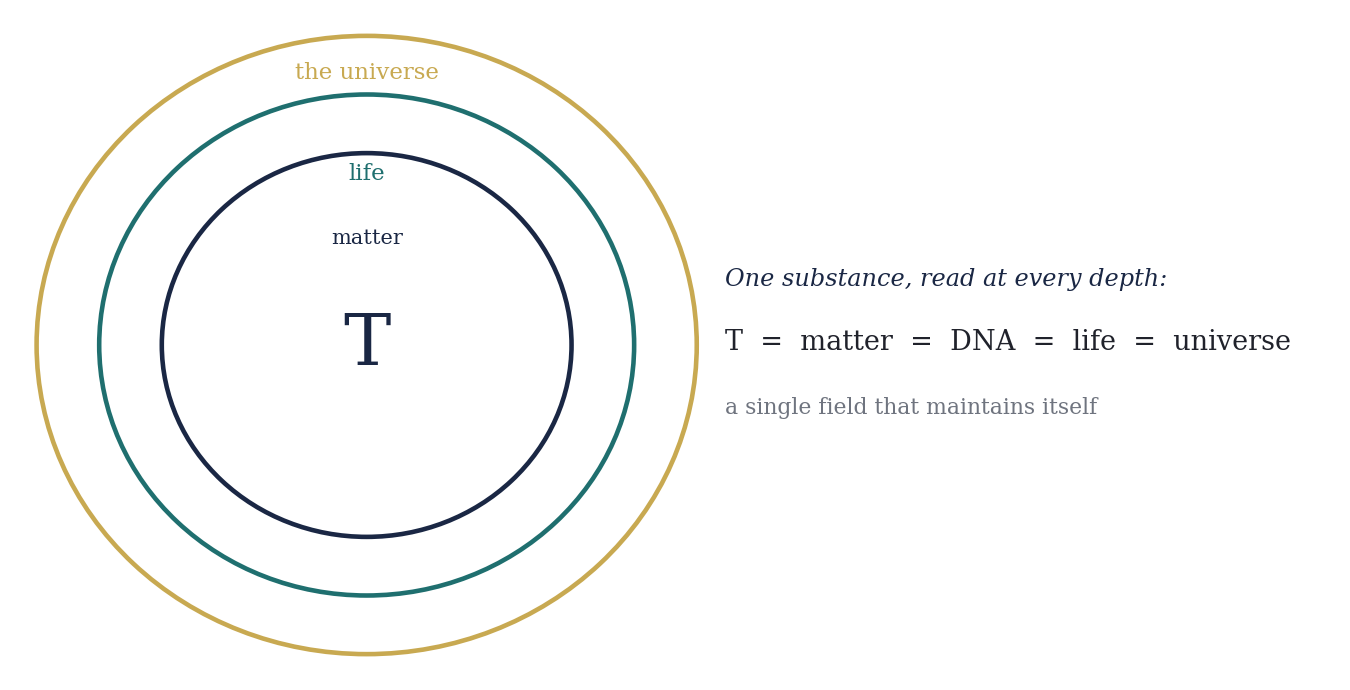
The mechanistic programme left us a dead universe with life as a local accident. The Universal Force of Time disputes that corollary while keeping the physics. Taking self-maintenance — the continuous regeneration of a system’s own organization against dissipation, the autopoietic criterion of Maturana and Varela — as the mark of life, it observes that the universe exhibits it at the largest scale: its laws do not drift, its constants hold their values, and the same {2,3,5,π} lattice that fixes microscopic structure holds invariant across cosmological time.
A system that so maintains its own organization satisfies the criterion. On the framework’s monism the universe is a living configuration of the one field, and localized life is that field maintaining itself at the biological register. The position is a physicalist pantheism in the lineage of Spinoza — a metaphysical reading of the physics, not a supernatural postulate.
Scale-invariant organization I — the cosmic web and the brain
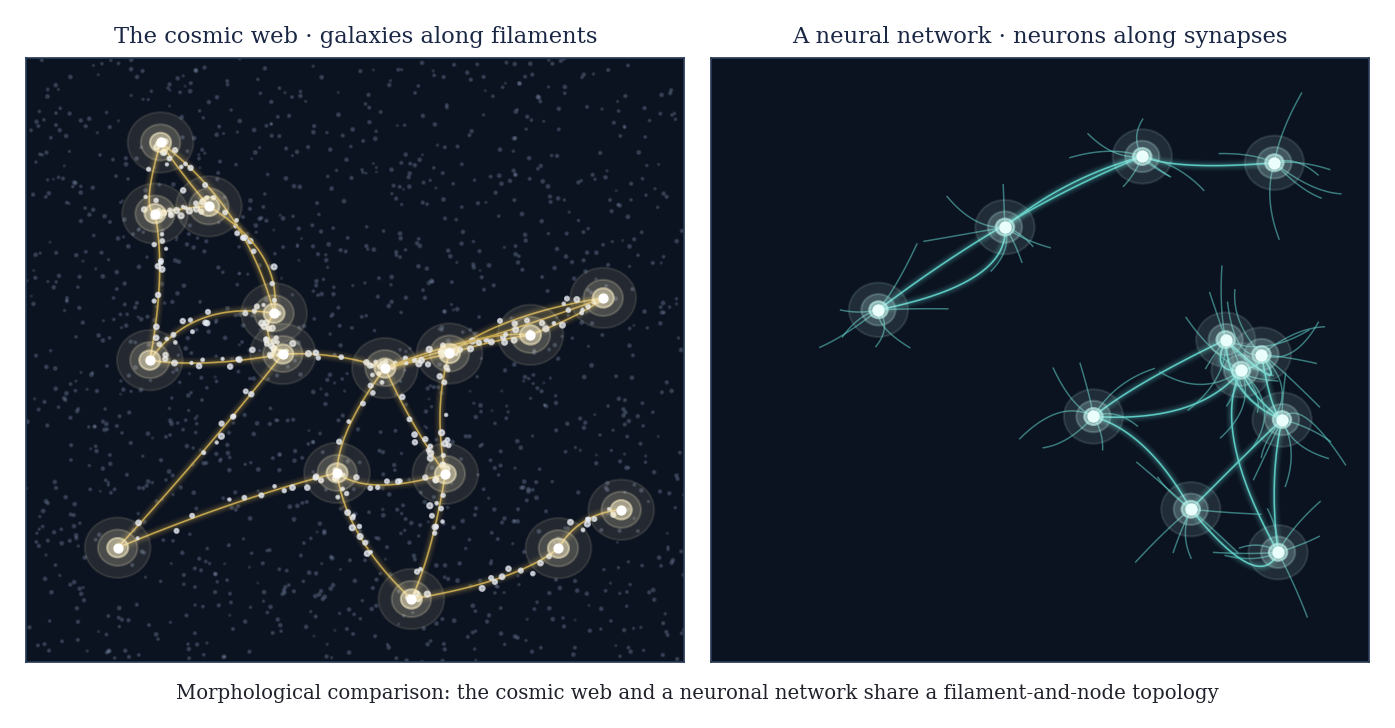
The framework’s stronger claim is that this living system is organized identically across scale, and it adduces two independent structural lines. The first is topological. The large-scale distribution of galaxies — the cosmic web of filaments enclosing voids — has been subjected to quantitative morphological comparison with neuronal networks, which finds correspondences in the distribution of node connectivity and in the fraction of mass or energy in the network versus the diffuse background, across systems separated by roughly twenty-seven orders of magnitude in scale (Vazza & Feletti 2020).
The framework reads this correspondence not as coincidence but as the signature of one field propagating by the same branching dynamics at the galactic register that, at the cerebral register, constitutes a nervous system. The morphological correspondence is an empirical result; the reading of it as one field is the interpretive claim.
Scale-invariant organization II — the double helix across registers
The second line is geometric and sharper. The double-helix architecture of B-DNA recurs, on the framework’s analysis, at two vastly larger scales with the same prime encoding of its pitch. A survey of forty-two solar-analogue stars within eighty light-years, referred to the solar apex toward Vega, resolves into a double helix: the Sun and Alpha Centauri lie on the axis; the remaining stars wind at a radius of 18 ly (2·3²) with a pitch of 160 ly (2⁴·5) — the pitch carrying the same {2,5} signature as the 3.4 nm pitch of B-DNA. At the galactic scale the double-helix nebula near the Galactic Centre (Morris et al. 2006) winds with a pitch of 20 pc, again {2,5}-encoded.
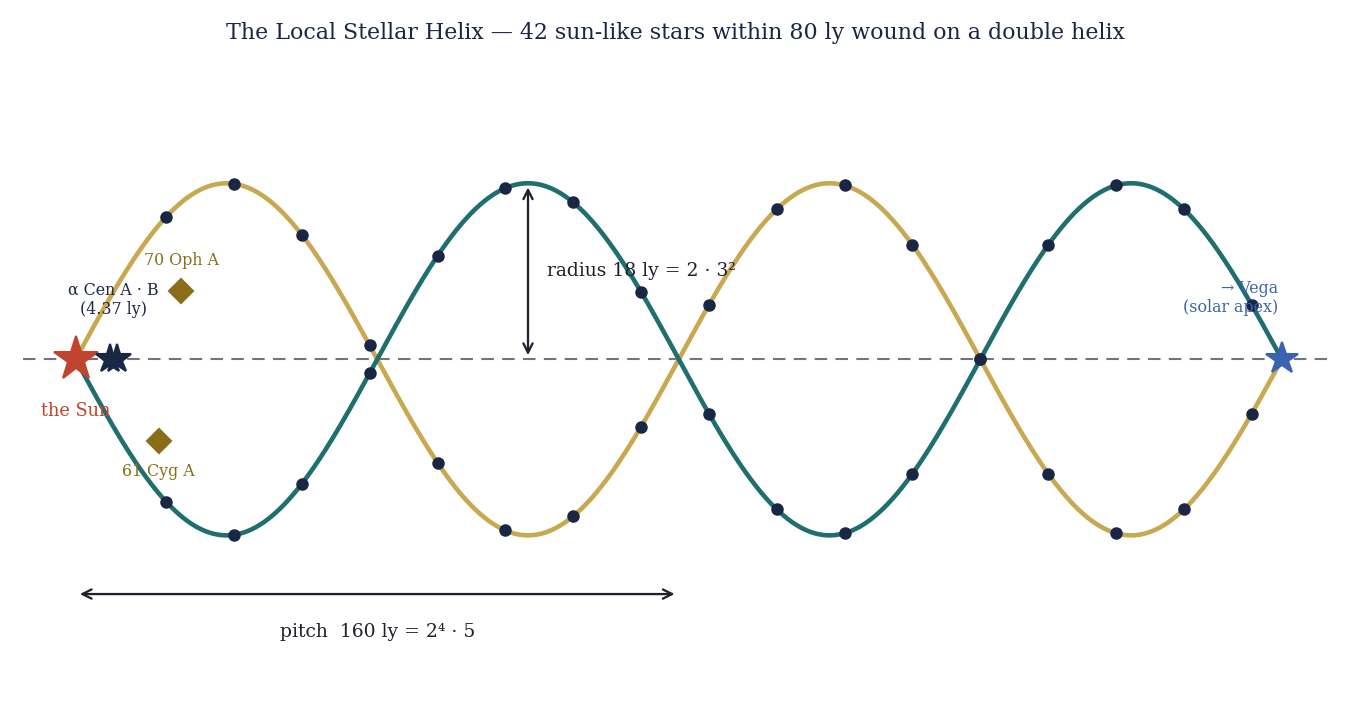
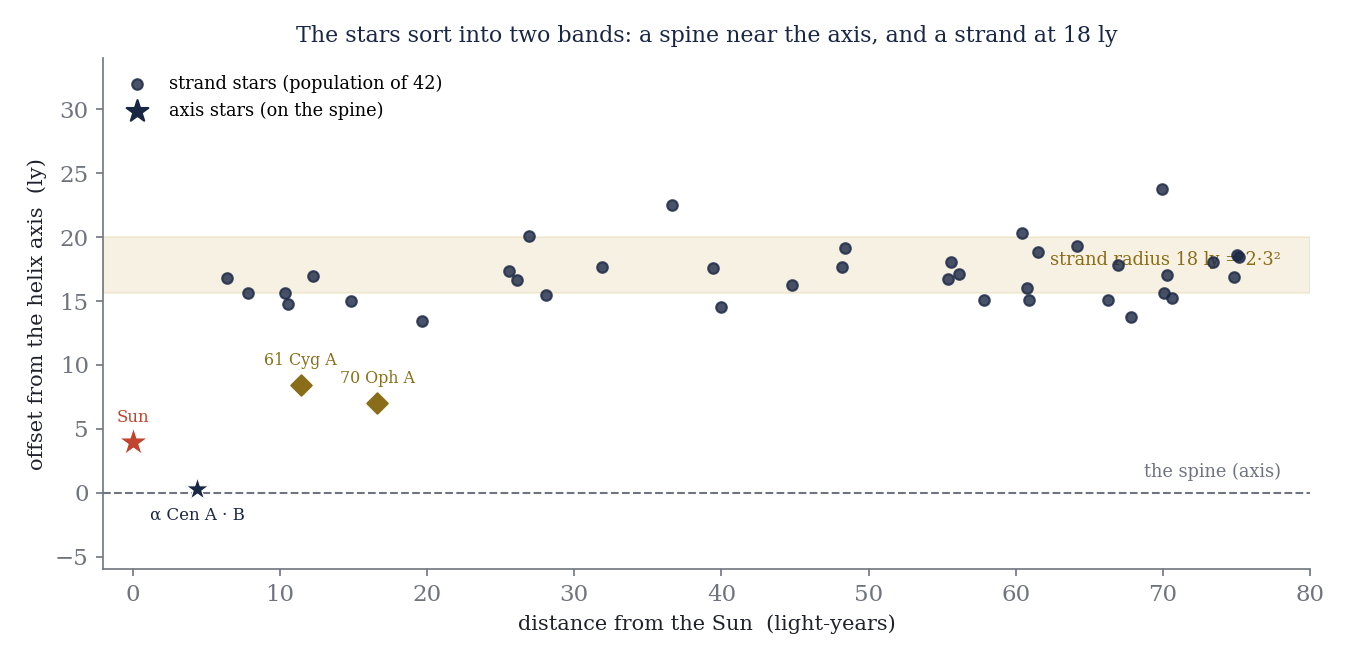
The same double-helix architecture, encoded in the same few primes, appears at the molecular, stellar, and galactic registers. In the theory’s terms, there is no register at which the helix is absent.
One force, and the register position of humanity
That the same structure appears across scale is a case of a general thesis: one force acts identically across the subatomic, atomic, and celestial registers, so the partition of physics into an incompatible mechanics of the small and geometry of the large is an artefact of description. A calculation that deliberately crosses the forbidden boundary — carrying an atomic quantity into the celestial — reproduces the observed rotation of Mercury; that it works evidences the absence of a boundary.
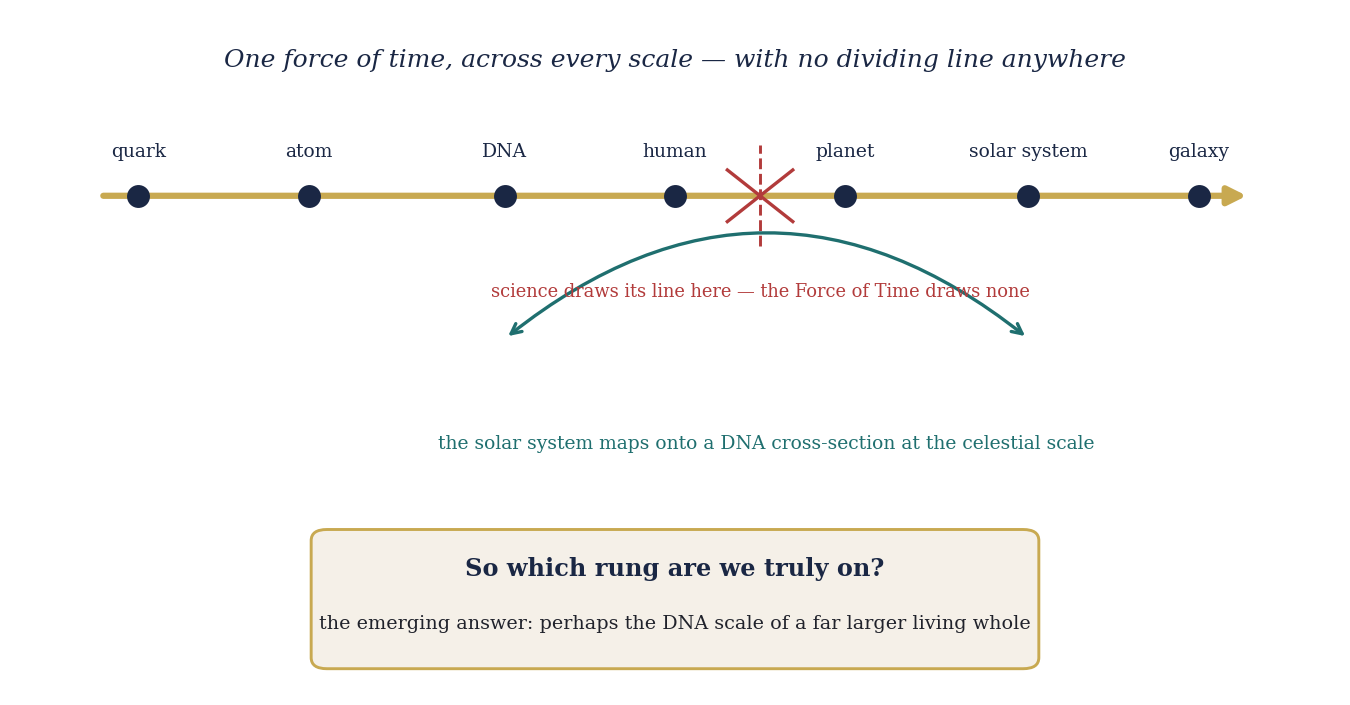
The framework’s working answer, advanced as a proposal: biological life occupies roughly the register that genetic material occupies within an organism, consistent with its finding that the solar system maps onto a cross-section of the genetic helix read at the celestial scale.
What follows from the monism
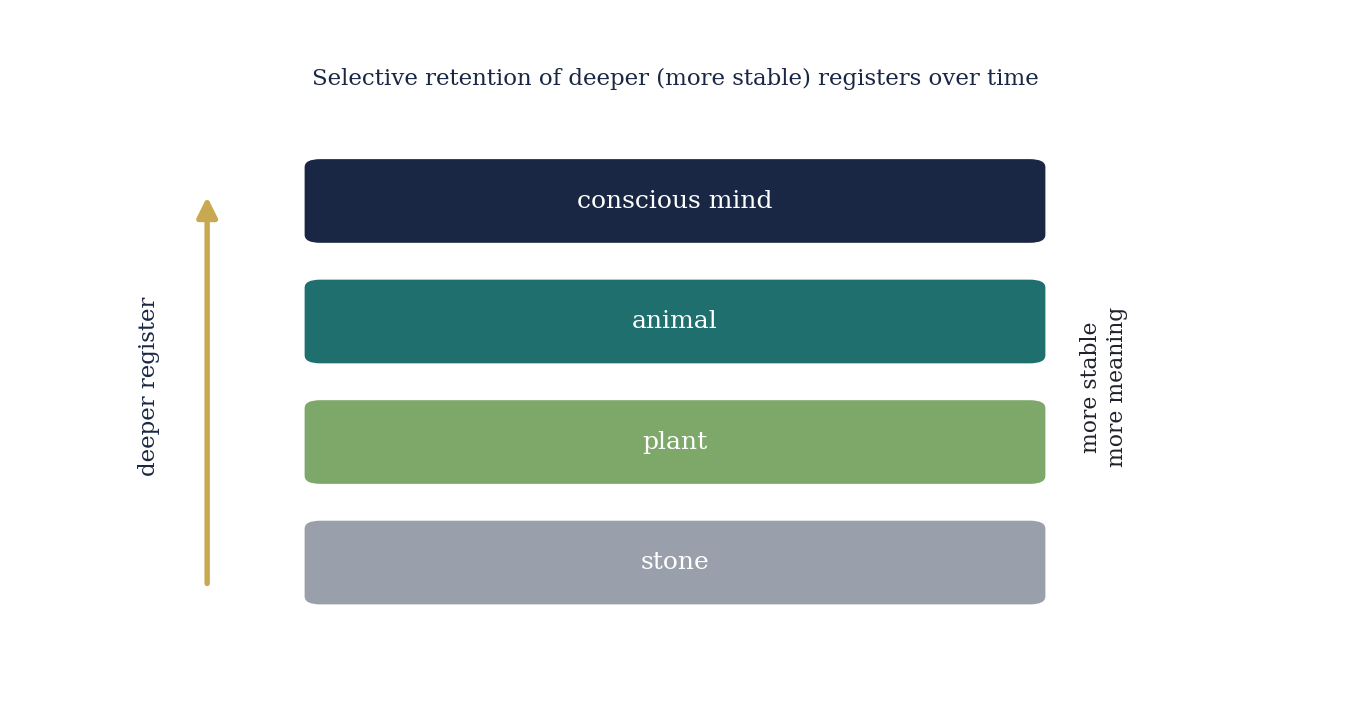
Deeper registers are more stable and are selectively retained by the self-maintaining field, so register depth accumulates over time. Evolution’s direction is objective — no external designer required.
Identified with the inward aspect of a deep register; the hard problem does not arise, because there is no purely non-experiential substrate from which to generate experience.
Register depth is an objective quantity, so meaning is not a projection: a conscious being carries more of the field than an unconscious one, measurably.
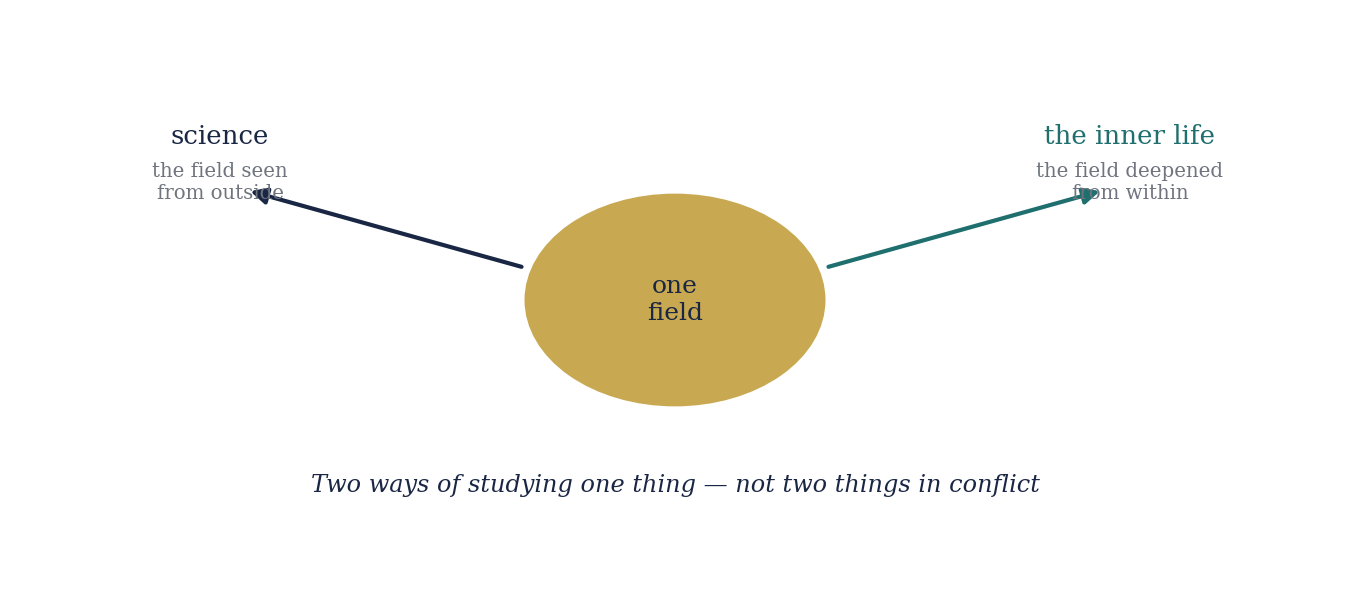
Science investigates the outward, measurable face of the field; the contemplative disciplines the inward face. Complementary approaches to one object, not competitors.