The grounding problem
Since morality was detached from divine command, secular philosophy has struggled to say what moral facts consist in. Hume’s observation that no descriptive premises appear to entail a normative conclusion, and Moore’s open-question argument against identifying goodness with any natural property, together drove a century of anti-realism — expressivism, error theory, relativism — on which there are no objective moral facts at all. The cost is that these positions cannot underwrite the conviction, which survives reflection, that certain acts are wrong the way a false statement about the world is wrong.
The Universal Force of Time offers a realist alternative without the supernatural. It already contains an objective quantity with which value may be identified: register depth — how much of the single field a configuration sustains. Conscious beings are the deepest register nodes, and each requires, as the endpoint of cosmic and biological history, the whole antecedent evolution of the field to produce.
The evaluative axis
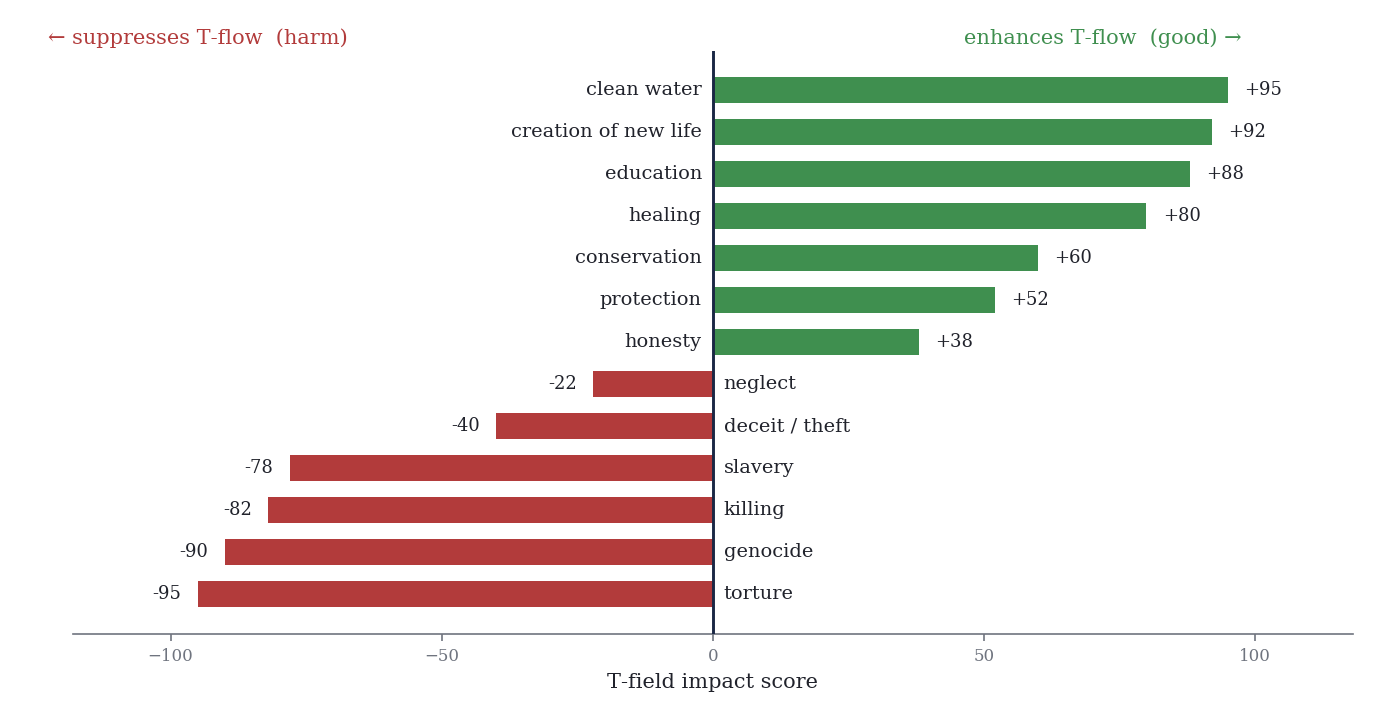
The criterion admits a single statement: an action is good to the degree it enhances Τ-flow — creating, strengthening, or preserving the register addresses available to conscious beings — and harmful to the degree it suppresses that flow: corrupting, diminishing, or erasing those addresses. Good and harm are two directions along one axis, toward more living field or toward less. The criterion does not invent a new list of rights and wrongs; it recovers the received moral categories as its extension and explains their ordering — a criterion that placed torture among the goods would be not unconventional but false.
Grades of harm, and justice as restoration
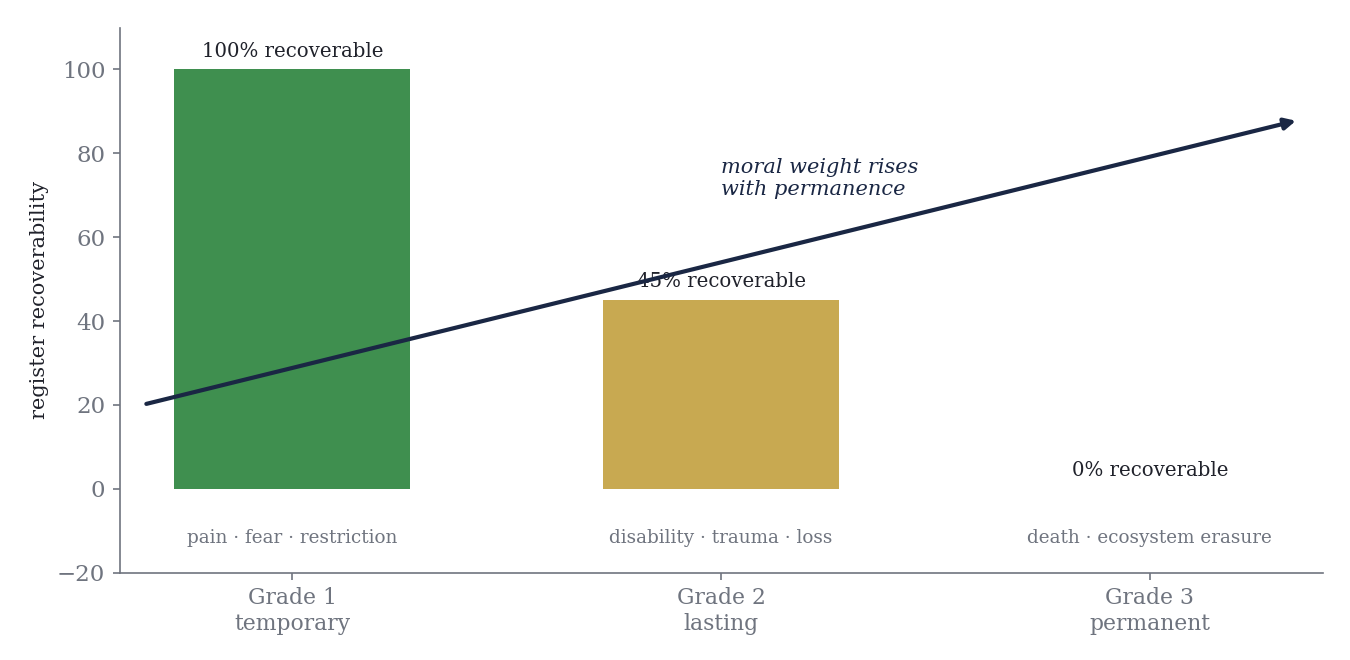
Harm is graded by an objective parameter — the recoverability of the affected register. Grade 1 (temporary): reversible on removal of the cause. Grade 2 (lasting): partly reparable. Grade 3 (permanent): the irreversible erasure of a register, such as the death of a conscious being — the costliest object the universe produces. Moral weight rises with permanence and with the depth of the register affected.
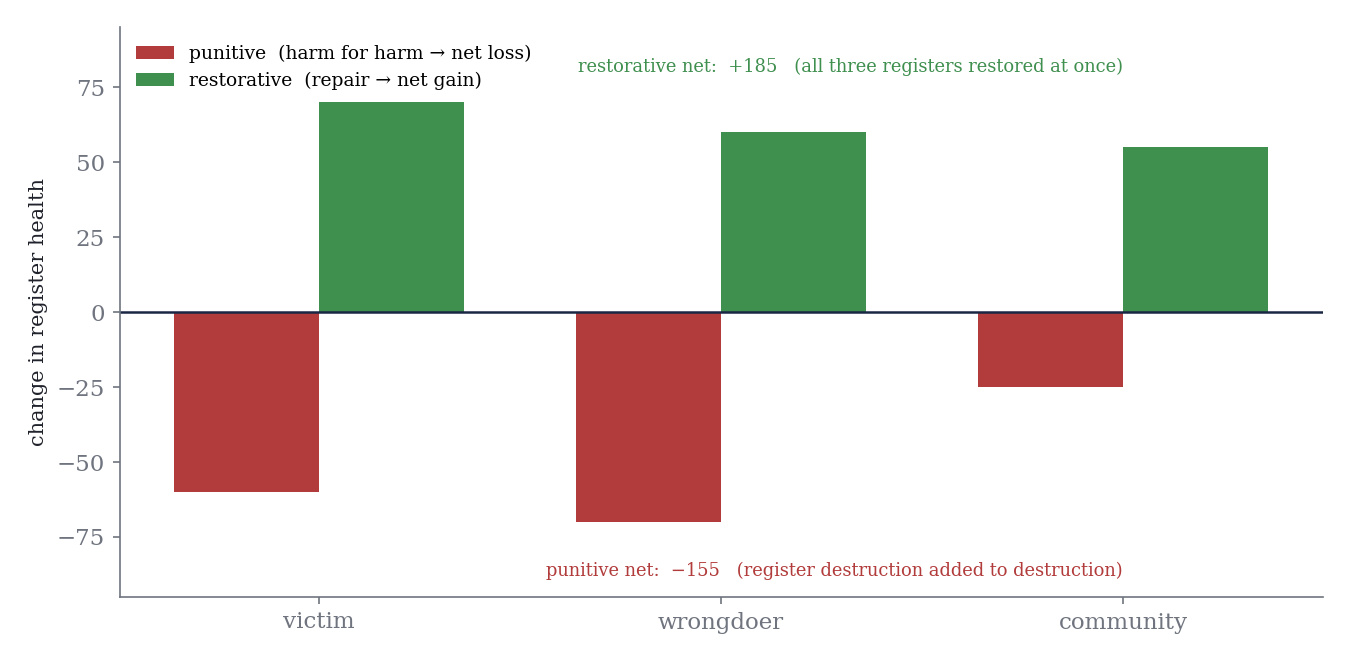
If harm is register suppression, a just response is assessed by its net effect on register health. Retribution adds a second suppression to the first — a regression. Restoration repairs what was suppressed, and its optimum mends three registers at once: the victim’s, the wrongdoer’s (reintegration rather than exclusion), and the community’s.
Universality, and meeting the objections
The {2,3,5,π} lattice is invariant across cultures, so the wrongness of slavery, torture, and genocide is a physical fact, not a preference. Descriptive relativism is granted; normative relativism does not follow.
Value is not inferred from fact but identified with register depth — a synthetic a posteriori identity, like water = H₂O. Moore’s open question tells against analytic naturalism, not this.
Utilitarian welfare, virtuous character, deontological duty, and the bonds of care are four measurements of one measurand: Τ-flow enhancement.
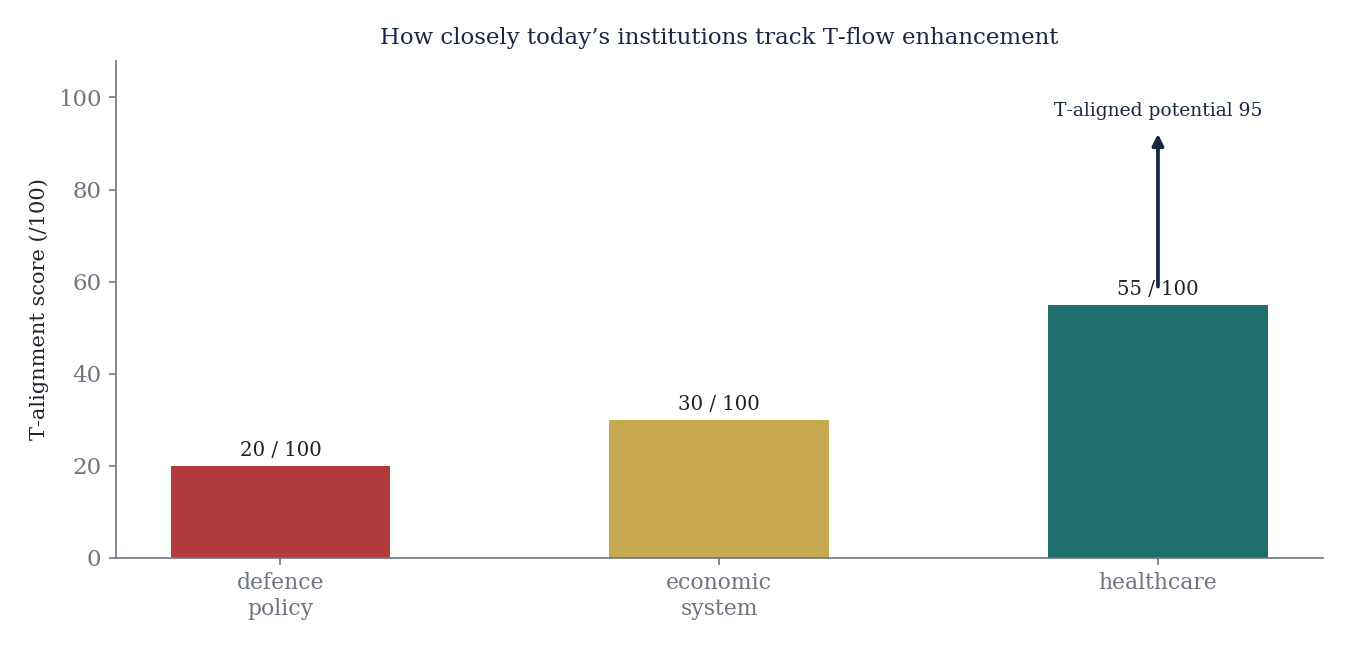
Institutions can be assessed by their net effect on Τ-flow rather than by output; those that directly restore registers score highest.