The claim, and the arithmetic
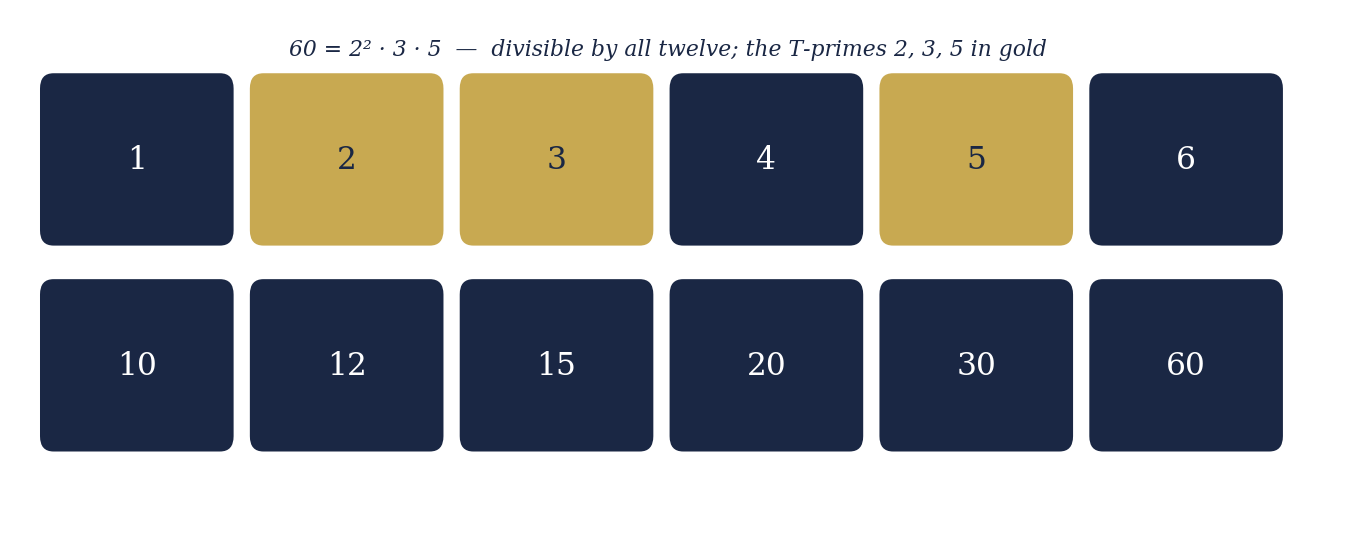
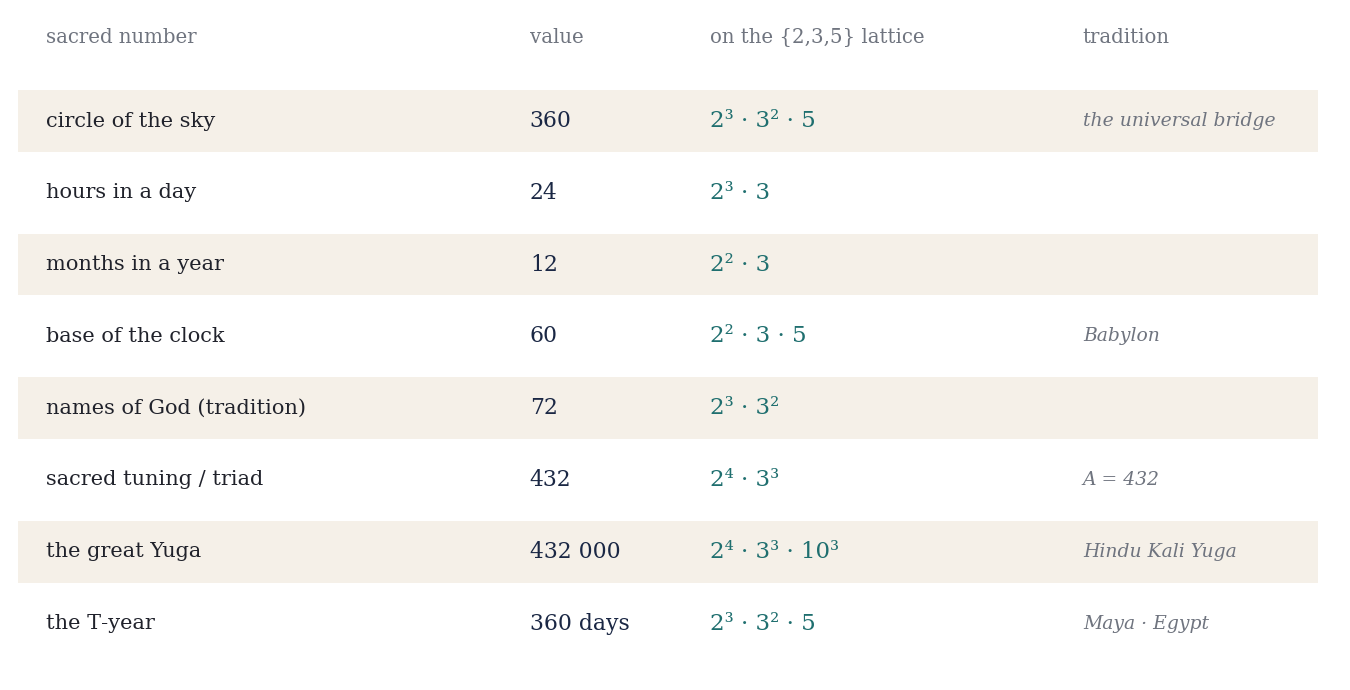
The received view treats ancient sacred number as pre-scientific symbolism. The framework proposes the opposite — that it records real observation of the same {2,3,5,π} lattice physics now derives — and, if unqualified, this is exactly the claim that invites the charge of numerology. The arithmetic itself is direct and checkable. Babylonian mathematics was conducted in base sixty, 2²·3·5, the smallest integer divisible by every value from one to six and the most divisible small number; the circle of the sky is three hundred and sixty degrees, 2³·3²·5.
Geometry: the sacred figures
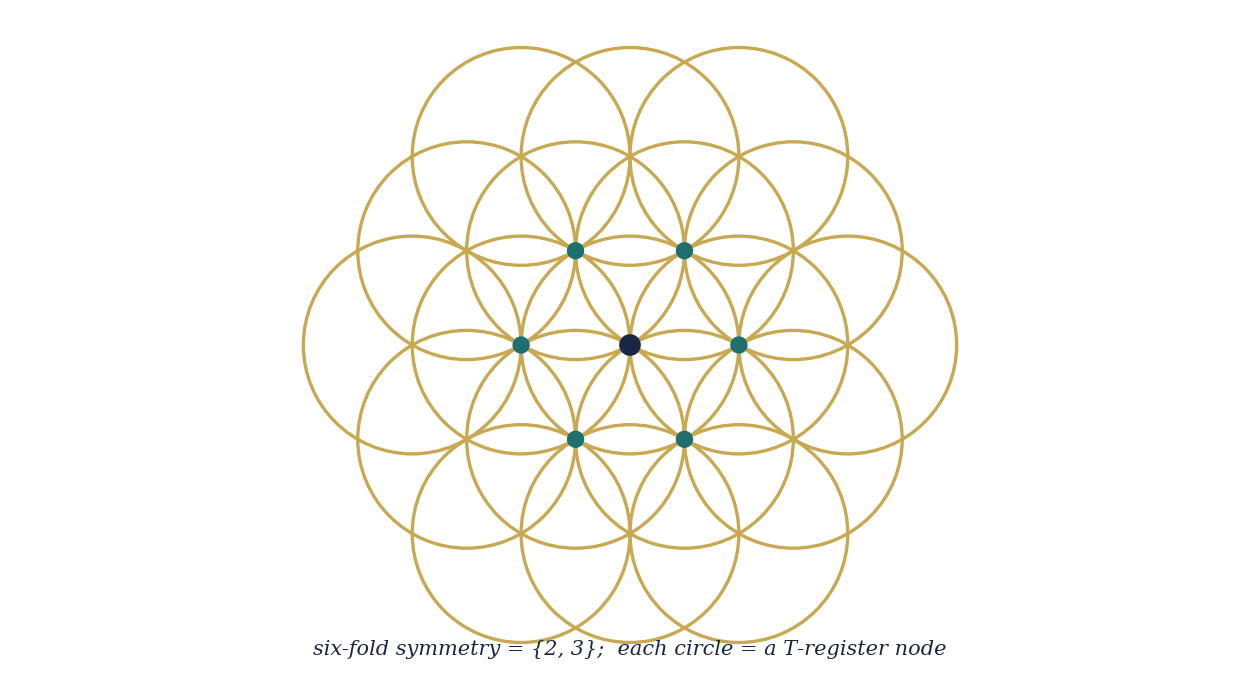
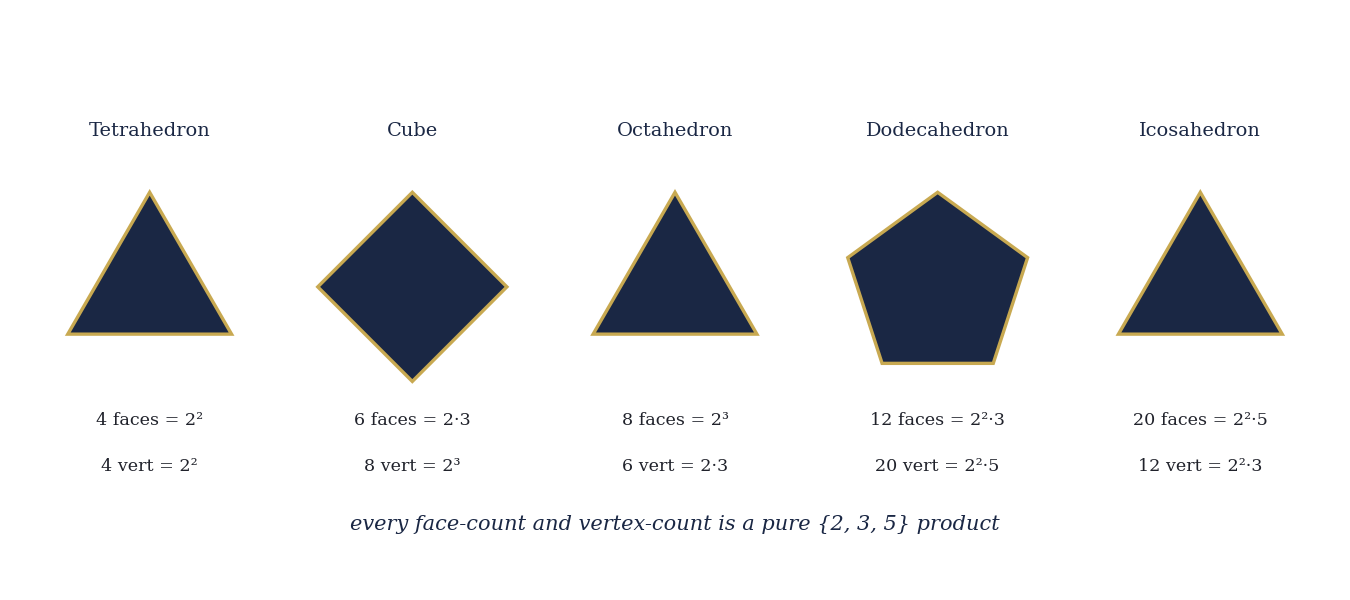
The pattern extends from number to figure. The overlapping-circle hexagonal motif — attested in antiquity, known in the later esoteric tradition as the Flower of Life — is, on the framework’s reading, a planar projection of the lattice, its six-fold symmetry expressing the primes 2 and 3. In three dimensions the case is sharper: there are exactly five regular convex polyhedra (a theorem of Euclid), Plato assigned them to the elements, and their face- and vertex-counts are each pure products of 2, 3, and 5.
The deflationary objection — at full strength
The arithmetic is not in dispute; the inference from it is, and the objection must be stated at strength. A highly composite base minimises the fractions a scribe must compute, so any administrative culture has practical reason to adopt one, and the smallest is sixty as a matter of arithmetic, independent of any lattice. The five solids are a theorem of geometry, true in every possible world. And post-hoc matching against a permissive target ({any} product of 2, 3, 5) succeeds by chance. A factorisation counts as evidence only in so far as it exceeds what convenience and base-rate already predict — and the number-base cases, alone, do not clear that bar.
The decisive datum. Practicality explains why a culture would choose a divisible base; it does not explain why the resulting sacred values coincide with the physical constants the framework independently derives. That the ancient sacred numbers and the modern physics converge on one lattice — two bodies of data with no channel between them — is better explained by the reality of the lattice than by coincidence. The argument is abductive (inference to the best explanation); its force is exactly that of the framework’s prior physics, and its controlling test — comparing attested sacred values against a matched sample of arbitrary salient numbers — is named.