The address, not the matter
An organism persists through the wholesale turnover of its material constituents, so its identity cannot be material continuity. Psychological-continuity theories (Locke, Parfit) locate it in the connectedness of mental states; the framework locates it in a register address — a coordinate inscribed in the organism’s genetic structure, with the large non-coding fraction of the genome read as this address space. A life is the reading-out of that address across a determinate span.
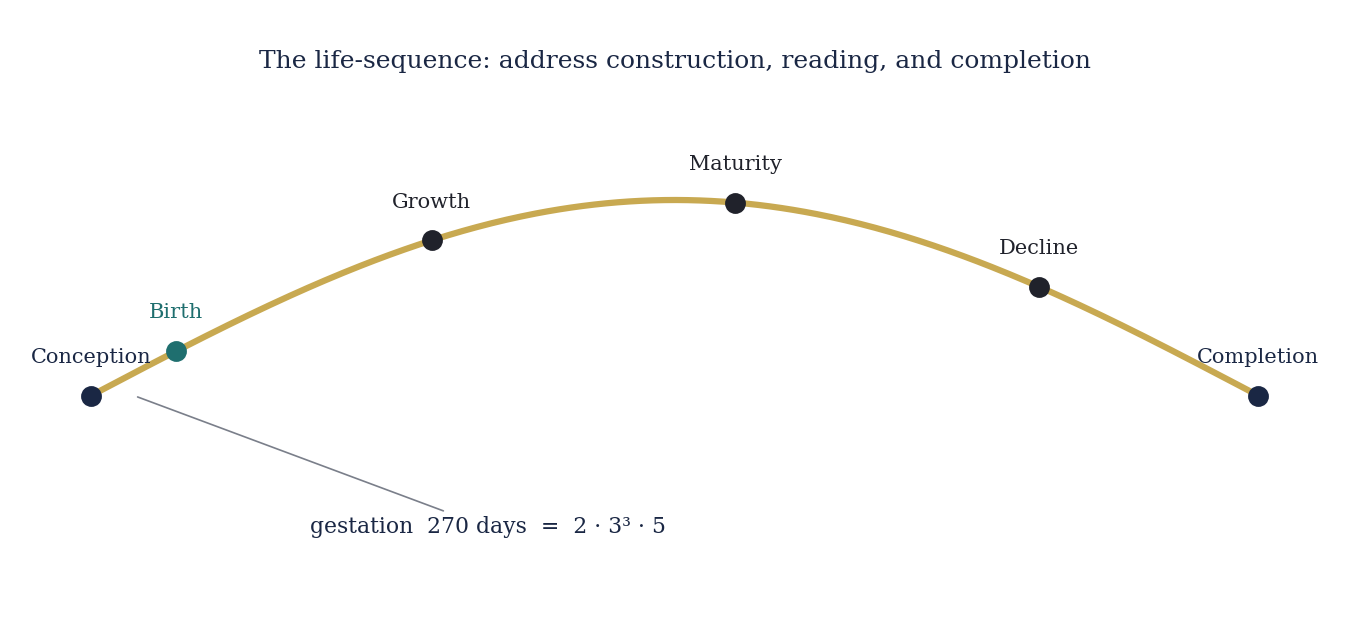
The sequence: construction, settings, and span
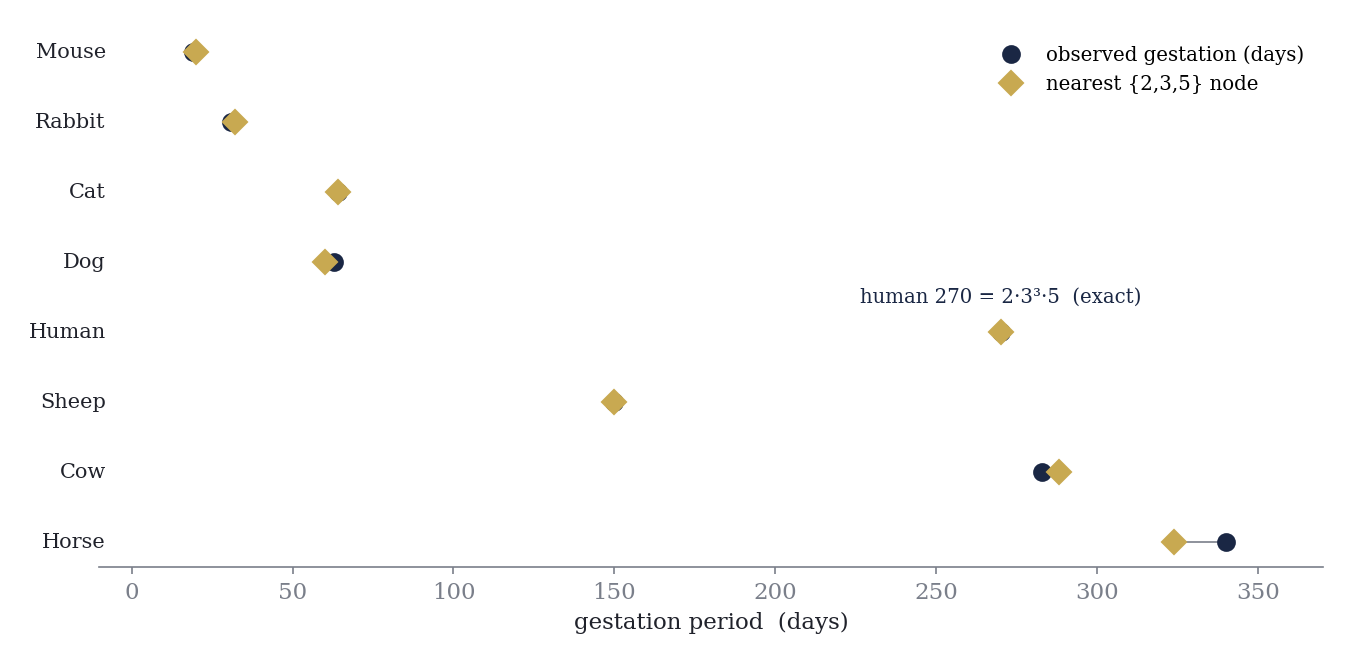
The framework assigns lattice values to the principal intervals. Gestation, during which the address is constructed from the genetic template, is 270 days — 2·3³·5, on the lattice rather than approximating it. The living register is held to fixed settings throughout: a body temperature of 36.864 °C and a coherence rhythm near 40 Hz, clocking the organism to the planetary register. A long human life reads an address of order 27,375 days = 3³·10³ + 3·5³.
Death as completion — and its distinction from curtailment
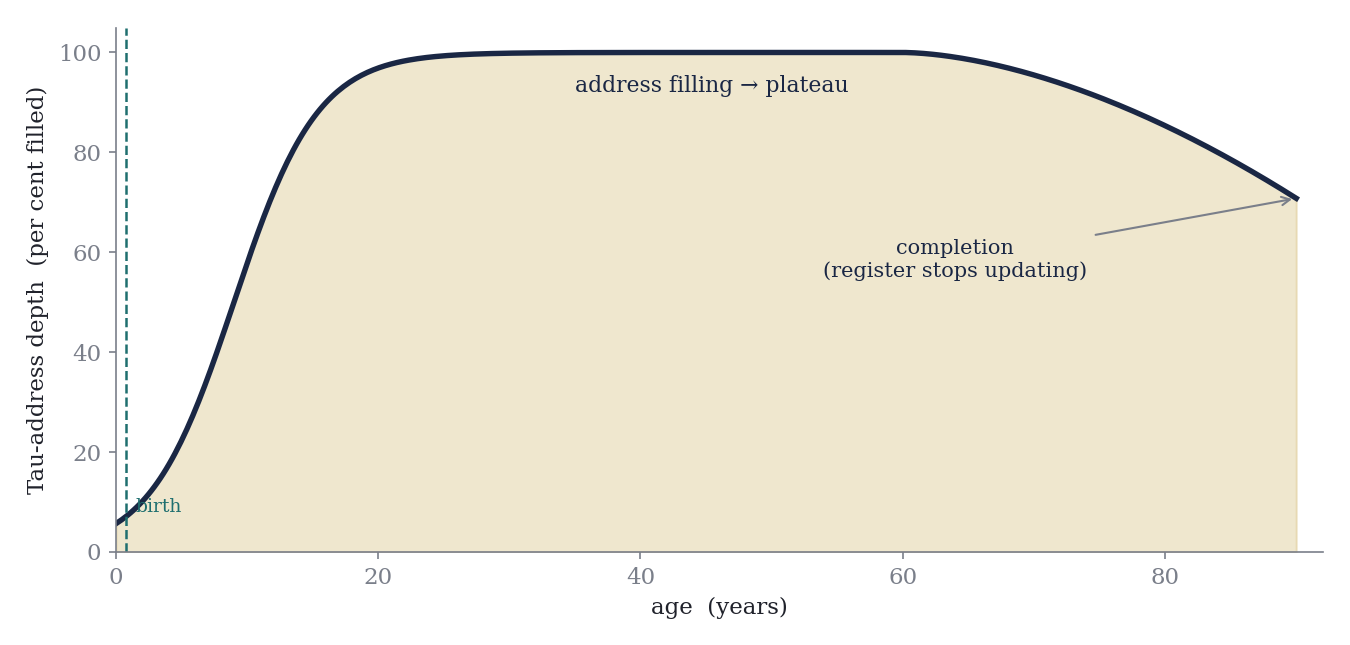
Death is the completion of the address sequence: the point at which the register ceases to update, having reached the end of the address it was reading. The cessation of homeostasis and the disaggregation of the organism are consequences of this completion, not its constituents. The account is neutral between damage and programmed theories of ageing — its claim is at the informational level — committing only to an intrinsic address length. It distinguishes completion from curtailment by disease or injury (a reading interrupted with address unread), which it locates as the proper domain of medicine.
On persistence — a bounded claim. By dΣΤ = 0, information is redistributed rather than destroyed, so the completed address persists as a conserved imprint in the deeper register — in the sense that the cosmic microwave background persists as the imprint of a completed event. The claim is of conserved information, not of a continuing conscious subject; the framework does not assert the latter and does not require it.