Four Peaks, No Single Model
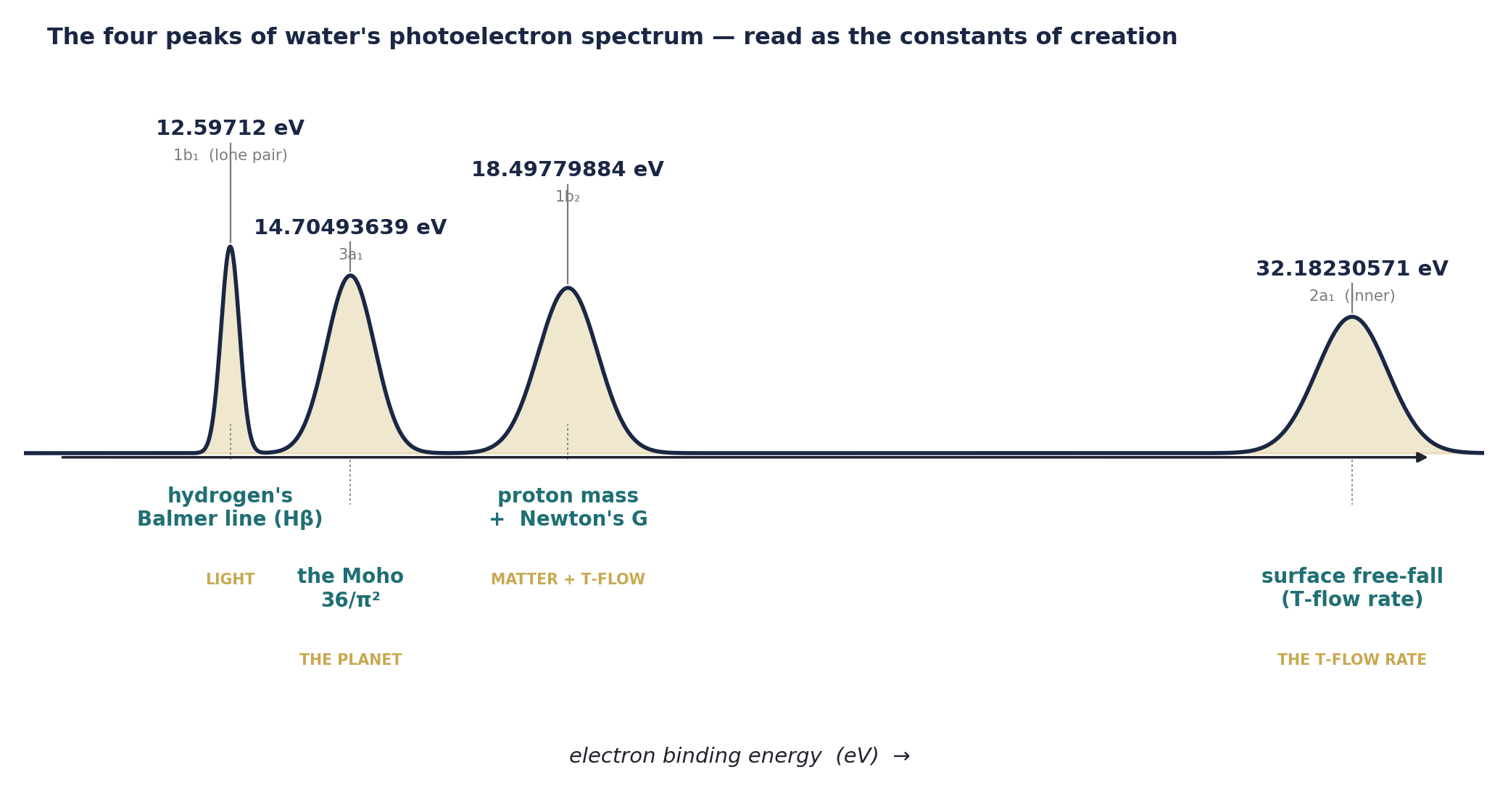
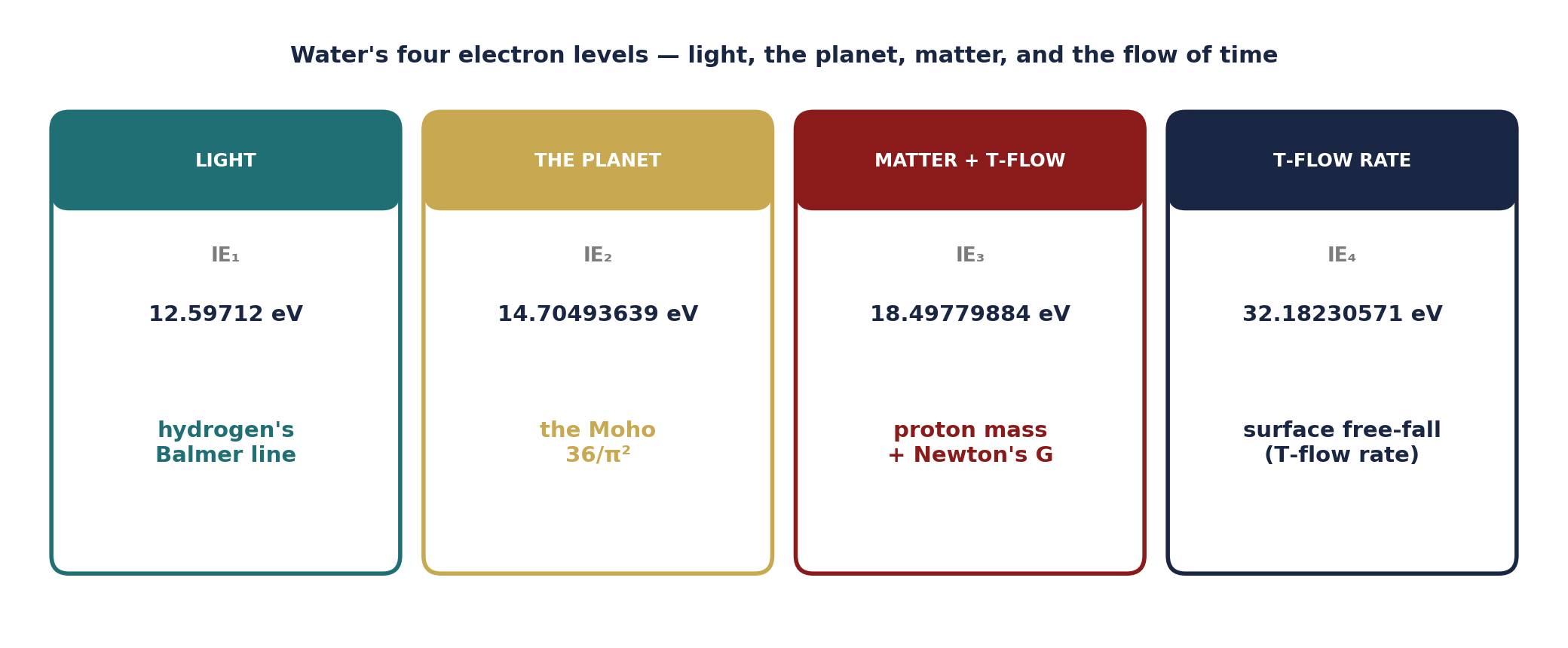
Water is the most studied molecule in science, and it does not fit. Shine light of known energy on water vapour and measure the energy of the electrons it ejects, and you read off the energy that held each one — a direct portrait of the molecule's occupied levels. The tidy textbook picture — two equal O–H bonds and two equal lone pairs — predicts two peaks. The experiment shows four, which the Force of Time fixes at 12.59712, 14.70493639, 18.49779884 and 32.18230571 eV. As the standard reference states plainly, water's bonding “cannot be explained by one unified bonding model”; it takes Lewis structures, valence-bond theory, molecular orbitals, isovalent hybridisation and Bent's rule stitched together to cover the ground.
Four peaks that no single bonding model reproduces together with the molecule's geometry — patched over with five overlapping theories.
Light, the planet, matter, and the flow of time — one Τ-object read at four register depths, geared by the same numbers that fix the bond angle, length and energy.
One Substance, Read on the Registers
The Universal Force of Time holds that there is exactly one substance — time, written Τ — and that every particle, wavelength, mass and force is a pattern in it. A physical quantity is not a thing in its own right but a reading: the same underlying value shows up as a length, an angle, a mass or an energy depending on which face you turn to the light. The values nature takes lie on a lattice built from the four numbers {2, 3, 5, π}.
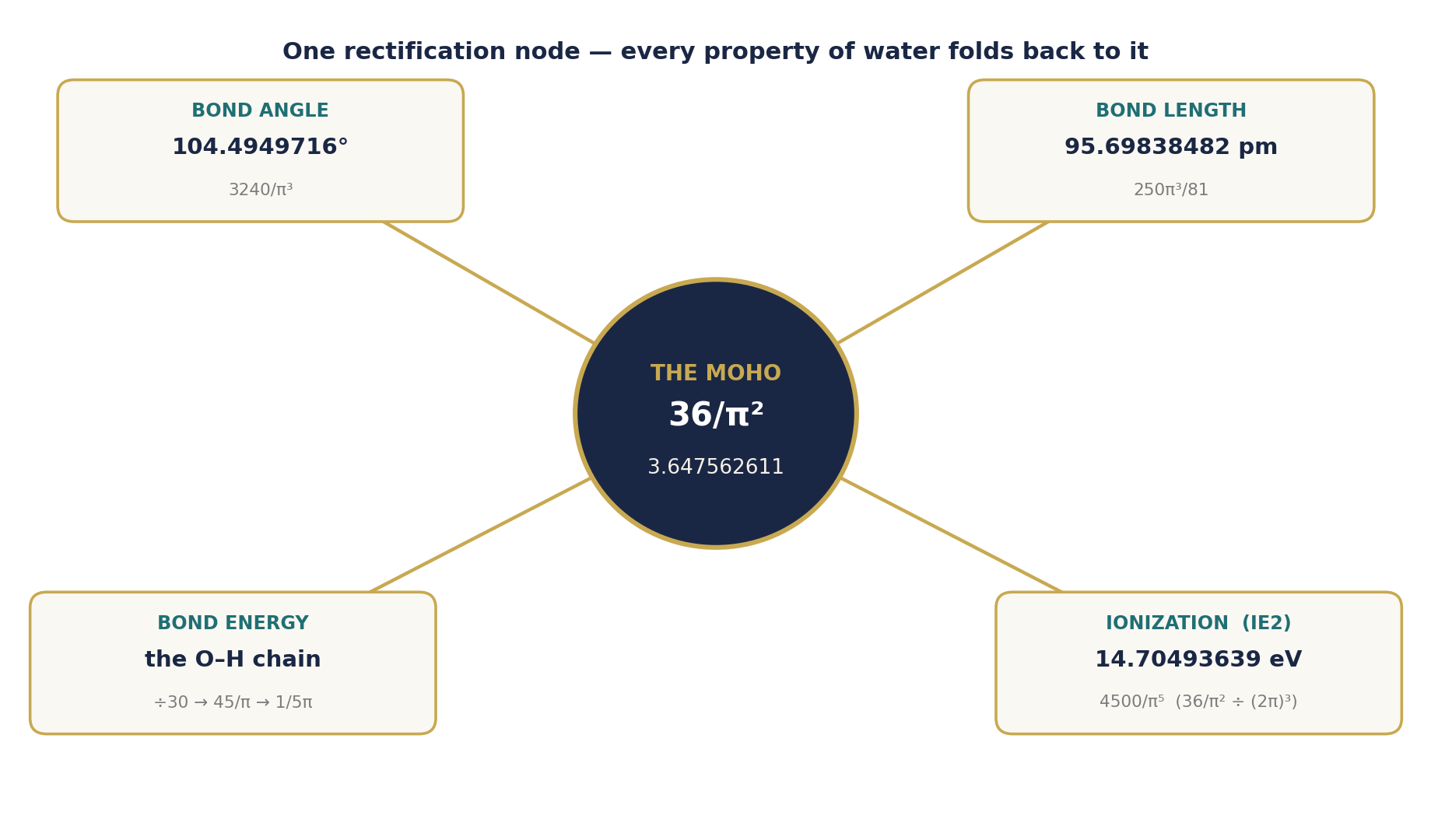
Water's geometry, its energies and its ionization levels all sit on the pure spin-orbital speed of spacetime, 3×10⁸ (= 3·2⁸·5⁸) — what science calls the speed of light and freezes at 299,792,458 m/s, but which the Force of Time reads as the true whole-number rate of one dimension's turning. And every property folds back to one hub: the Mohorovičić value 36/π² = 3.647562611, the rectification constant on which the bond angle, the bond length, the bond energy — and, as we will see, the second ionization energy — all converge.
Water's Bend Is a Ladder, Not a Number
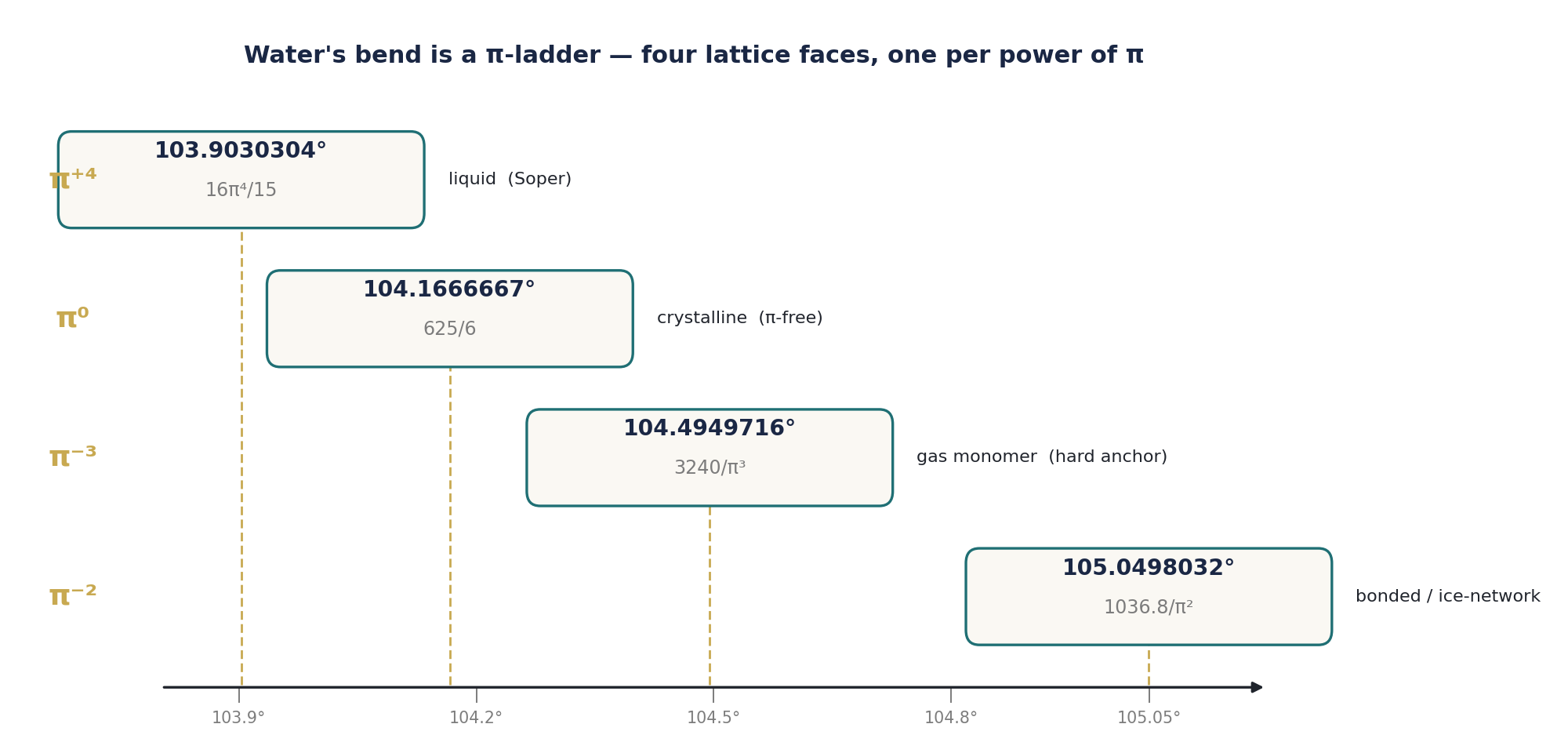
Science quotes water's bond angle as “about 104.5°” and leaves the liquid value in dispute across a whole degree. The Force of Time finds a ladder of exact faces, one per power of π: the gas monomer 104.4949716° (3240/π³, the hard anchor); the hydrogen-bonded 105.0498032° (1036.8/π² = 14400·α, which carries the fine-structure constant openly, 1/α = 125π²/9 = 137.0778389); the low liquid value 103.9030304° (16π⁴/15); and a purely rational crystalline face, 104.1666667° (625/6), with no π at all. The reach obeys the same law: length 95.69838482 pm (250π³/81), locked to the angle by L × θ = 10⁴ exactly, the π³ in the one cancelling the π³ in the other.
And the bend descends from the tetrahedron and the speed of light, in one unbroken chain — the same walk that produces hydrogen's Balmer line, which returns below as the first peak of the spectrum:
109.4712063°
arccos(−1/3)
3×10⁸
3·2⁸·5⁸
486.3416815 nm
4800/π²
3.647562611
36/π²
104.4949716°
3240/π³
The First Bond Keeps the Time of the Double Helix
Water's two O–H bonds sit on the same lattice. Measured in the natural unit — the sphere-calorie, 4π/3 kJ, the volume of a unit sphere — the second bond dissociation energy is a clean node, 101.3211836 kcal (1000/π²), and it folds straight onto the Mohorovičić hub: 1000/π² = 36/π² × 250/9. The first bond has a ground face at sodium's D-line hub over five, 117.7991048 kcal (NaD/5, ≈ 493 kJ), and an upper face — the energy that actually breaks it:
That upper face does not fold to the hub. It folds somewhere far stranger. On the lattice a value is never only one thing, and the tool that turns one reading into another is the veil, 180/π. Turn this energy back through the veil — multiply by π/180 — and it becomes 8.680555556 (625/72 = 5⁴/2³·3²). Read as a span of seconds, carried up by ten million, that is 86805555.5 s — the number of seconds in the first helical turn of the DNA.
497.3591971 × π/180 = 8.680555556 radian face — a time; ×10⁷ = 86805555.5 s
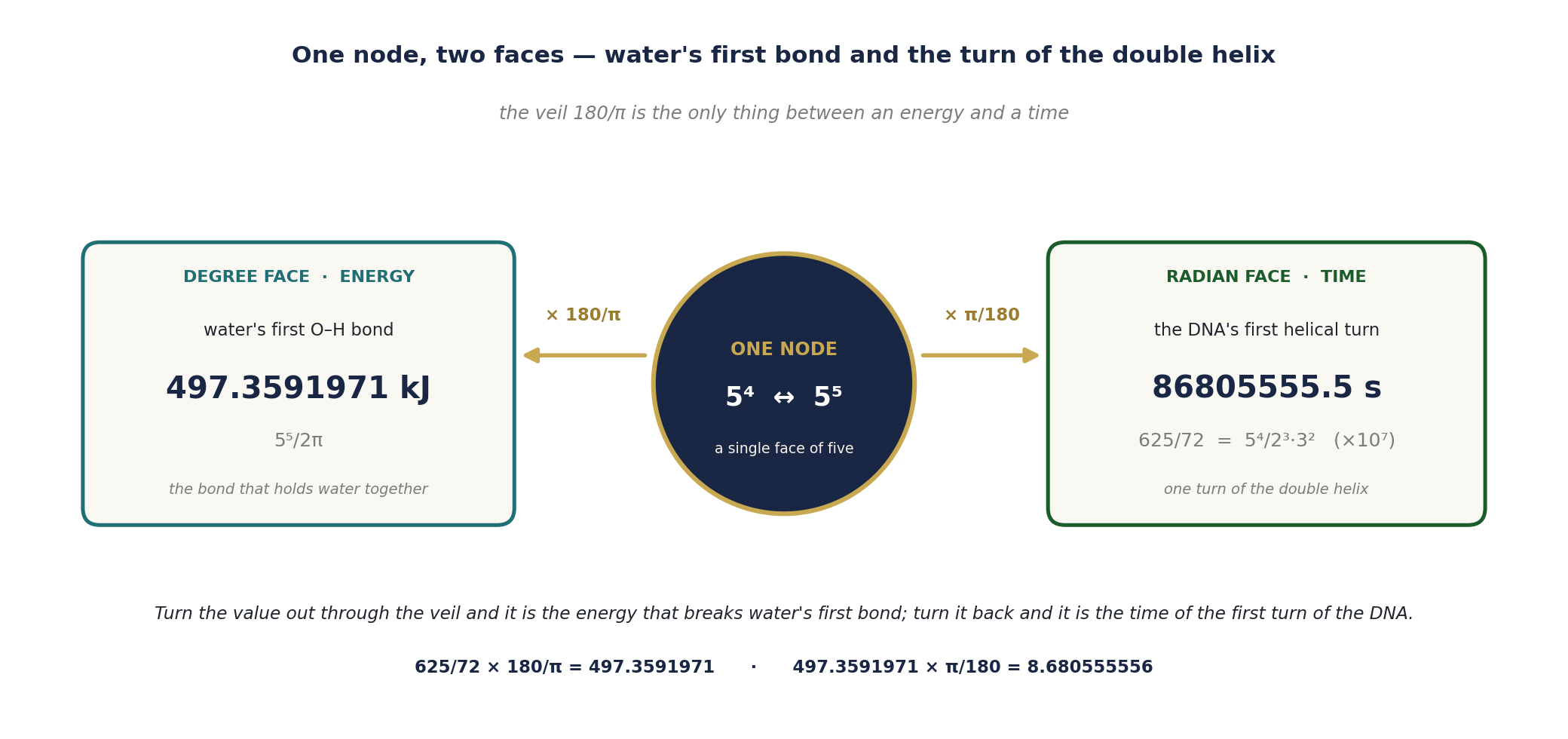
The molecule of life and the molecule that carries it read one address. The bond that holds a drop of water together is, one single turn of the veil away, the clock of the double helix's first turn. Not neighbours on the lattice — the same lattice node, worn once as an energy and once as a time.
The First Peak Is Hydrogen's Balmer Line
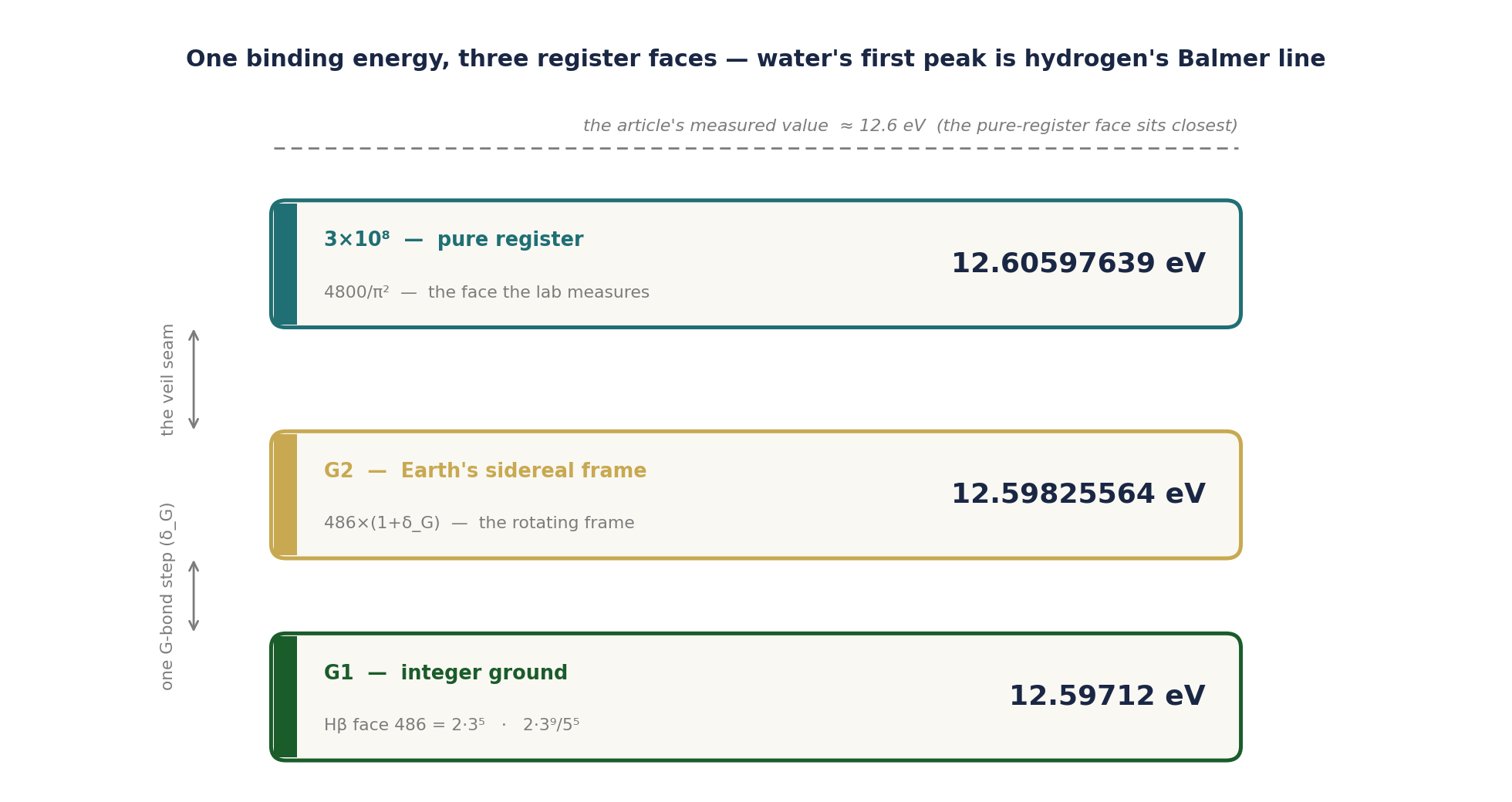
Every ionization energy in the Force of Time is anchored to the hydrogen ionization energy itself, 13.6048896 eV (= 2⁸·3¹²·10⁻⁷), and read off it by clean gears. Water's first peak — the lone-pair level science rounds to 12.6 eV — is hydrogen's own blue-green Balmer line converted to an energy: take the Balmer wavelength, quarter it, and carry it up by the register gear 10368 (= 2⁷·3⁴).
IE₁ sidereal face (G2): 12.59825564 eV the Earth's rotating frame
IE₁ pure register (4800/π²): 12.60597639 eV the face the lab measures
Between the integer ground and the pure-register face sits the reading that ties the molecule to the planet. One G-bond step above the ground is the Earth's sidereal frame — the same step that carries the free-fall to its next face and the O–H bond energy to its sidereal rung. Water's lone-pair binding energy keeps the planet's own time.
The Second Peak Is the Mohorovičić Value
The second peak has the exact value 14.70493639 eV (its G2 face, 4500/π⁵), and it is nothing but the Mohorovičić value unwrapped three times through 2π — the "links the Sun to the Sun" form:
fold it back, × (2π)³ ÷ 1000, and you are on 36/π² = 3.647562611 again — the rectification hub
Walked out through its own loop, this one value carries the whole geometry: ÷4 ×60 → the surface free-fall; × 495035535 → the wavelength 485.2977737 nm; × π²/8 → 583200/π⁴, the Sun-to-Sun master wavelength; ÷ veil → the bond angle 104.4949716°. And read as a distance it is Earth's perihelion, 147,049,364 km — the closest the Earth comes to the Sun.
The second electron level is the rectification hub. With it, the geometry and the second bond energy have converged on one node: the bend, the reach, the second bond, and the second level all read 36/π². The molecule is one lattice object, and this is its centre. (The first bond, alone, folds elsewhere — through the veil to the DNA.)
The prime-7 mirage dissolves. The rounded energies 12.6 and 14.7 stand in the ratio 7/6, and a bare 7 is exactly the fingerprint the Force of Time reads as drift off the lattice. But the exact values do not carry it: their true ratio is 288/(25π²), a clean {2,3,5}/π² number. The seven was in the rounding, never in the molecule.
The Third Peak Is the Proton Mass — and Newton's G
The third peak, near 18.5 eV, has the value 18.49779884 eV, and it carries two of the deepest constants in physics from one electron level. Carried down by the calorie gear and up by 9375 (= 3·5⁵), it is the proton mass. Run through the tetrahedron-light gears, the solar-day bridge, the veil and a final factor of fifteen, it becomes the constant science calls Newton's G:
18.49779884 ÷ 31104 ÷ 12 ÷ veil ÷ 864 ÷ 15 = 6.674134095 × 10⁻¹¹ what science calls G
One level, mass and Τ-flow together. The same water level yields the mass of matter and the coupling science attributes to a separate gravitational force. In conventional physics those two live in unrelated worlds and no one derives one from the other. Under the Force of Time there is no separate gravitational force: what science calls G is a measure of Τ-flow, and Τ-flow and mass are the same substance seen two ways. The proton's mass and “G” issue from one peak because they were never independent — and the value of G lands comfortably inside the range across which the laboratory measurements of it famously disagree.
The Fourth Peak Is the Surface Free-Fall
The deepest peak, near 32.2 eV, closes the set. Its value 32.18230571 eV is reached from the Mohorovičić value through a surface free-fall — the Earth's local Τ-flow rate, 9.80329092 — and the free-fall divisor 495035535, out to a Balmer-region wavelength 485.2977737 nm and down by 3, π and 16. The deepest electron level of water is threaded on the Earth's own falling.
And note the coherence of the two deepest peaks: the third gives the coupling G, the fourth gives the local flow-rate g — both the quantities science files under “gravity” — because the further you strip water's electrons, the closer you come to the bare Τ-field, which conventional physics splits into mass and gravity. The spectrum reads, in order of depth: light, the planet, matter, and the flow of time.
What Else Is in the Mix
Honesty requires naming the near-values — the readings that sit a hair off the ones we use and say something of their own without being the answer. Balmer wears two faces a veil seam apart: the π face 486.3416815 (4800/π²) and the integer face 486 (2·3⁵); the whole integer/π world splits at that seam, and the first peak's ground and measured faces sit on either side of it. The first O–H bond has a second, √2-carrying face, 117.8511302 (250√2/3), that arrives straight from 3×10⁸ through the tetrahedron gear — real, and close, but a few register steps off the sodium staircase, so we keep it as the √2 harmonic and not the fundamental. And a Moho-adjacent node 116.1055240 (3600/π³) converts in kilojoules to the Balmer wavelength itself. These are not errors to hide; they are the texture of a lattice on which many quantities lie close together. We name them, and we do not lean on them.
The Geometry Beneath the Gears
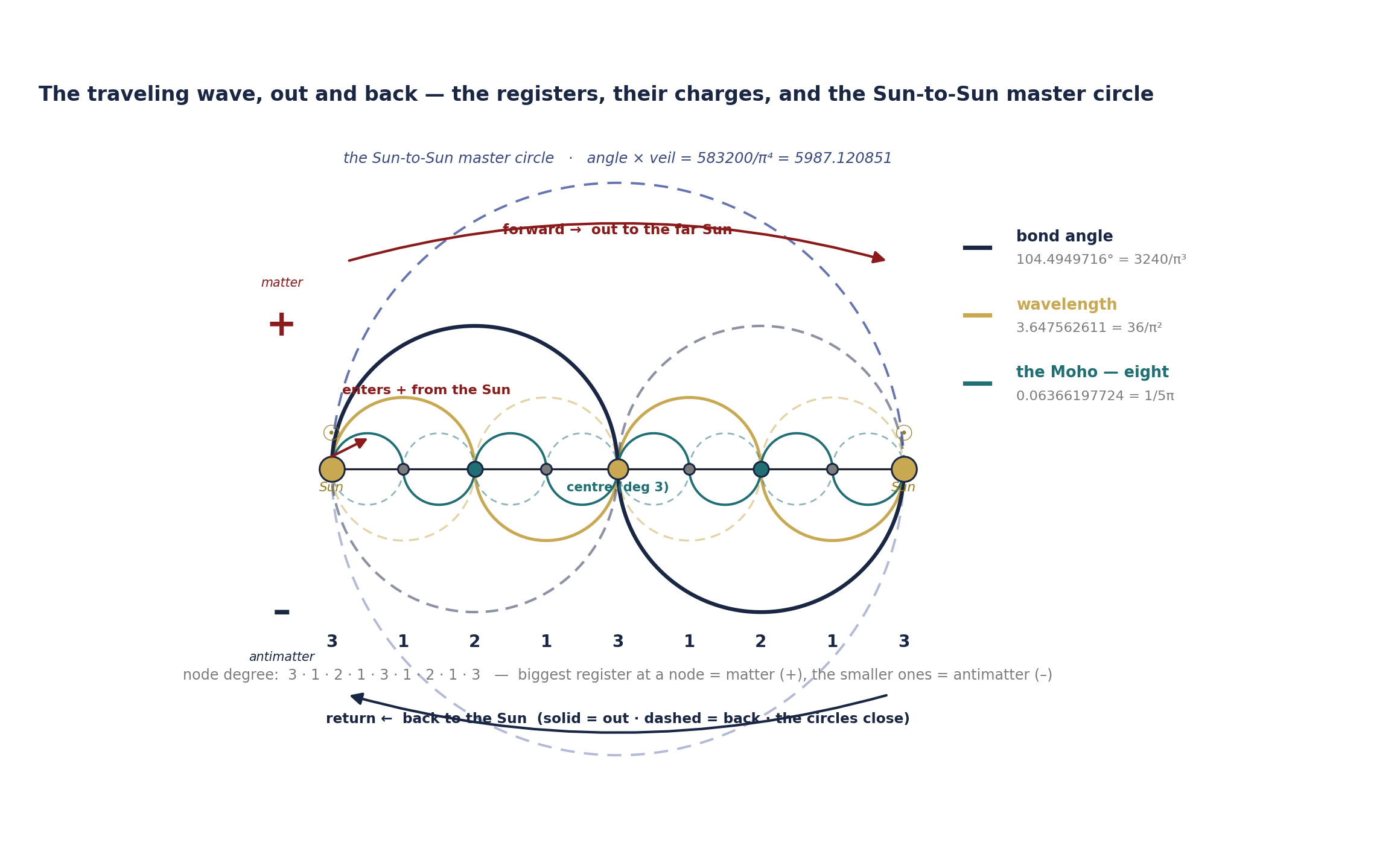
Every ×veil in the chains above is one geometric act: unrolling a circle. The veil, 180/π, turns a curved (radian) measure into a straight (degree) one — which is stepping up one dimension, laying a circle out flat. Read that way, the registers are circles within circles: one big circle (the bond angle, 3240/π³), two across it (the wavelength, 36/π²), four across those (the Moho, 1/5π) — each level half the circle and twice as many, the value stepping by the veil. A node forms only where a + circle meets a – circle — a matter–antimatter meeting — and the node's degree (how many registers coincide) is the strength of the node. The Sun sits on the degree-3 nodes, the strongest.
And the pattern is not static — it travels. A wave enters positive (matter) from the Sun, runs out to the far Sun, and returns along the other half, and the two passes together close every circle. Because the pattern is moving, each return is offset by one position — the traveling wave, not a standing one — and the whole thing is wrapped by the Sun-to-Sun master circle, the bond angle registered up one more veil: angle × veil = 583200/π⁴ = 5987.120851. That master value is the same 4500/π⁵ family that carries the second ionization energy — and, read as a distance, it is Earth's perihelion, 147,049,364 km, the closest the Earth comes to the Sun.
Formal Propositions: P-H2O-1 to P-H2O-12
Water's four PES peaks (12.59712, 14.70493639, 18.49779884, 32.18230571 eV) are four readings of one {2,3,5,π} lattice, anchored to the hydrogen ionization energy 13.6048896 eV = 2⁸·3¹²·10⁻⁷.
The bond angle is a π-ladder: 104.1666667° (625/6, π⁰); 104.4949716° (3240/π³, π⁻³, gas); 105.0498032° (1036.8/π² = 14400·α, π⁻²); 103.9030304° (16π⁴/15, π⁺⁴). 1/α = 125π²/9.
Length 95.69838482 pm (250π³/81) × angle 3240/π³ = 10⁴ (2⁴·5⁴), the π³ cancelling. The molecule is intradimensional — angle and length cannot decouple.
arccos(−1/3) = 109.4712063°, tan = −2√2 → 3×10⁸ → Balmer 4800/π² → Moho 36/π² → water 3240/π³. The bend of water and the colour of hydrogen are one lattice walk.
The geometry, the second O–H bond energy (1000/π² = 36/π²·250/9) and the second ionization energy converge on 36/π² = 3.647562611. The first O–H bond does not; it folds, through the veil, to the DNA (P-H2O-12).
IE₁ is hydrogen's Hβ Balmer line as an energy (Balmer ÷4 ×10368). Three faces: integer 12.59712 eV (2·3⁹/5⁵); sidereal 12.59825564 eV (the Earth's frame); pure 12.60597639 eV (from 4800/π², the measured face).
IE₂ (G2) = 14.70493639 eV = 4500/π⁵ = 36/π² ÷ (2π)³ ×1000 — the Mohorovičić hub unwrapped three times through 2π (the G1 face is 14.70361085). The apparent 7/6 ratio of the rounded energies is a mirage: the exact ratio is 288/(25π²).
IE₃ = 18.49779884 eV gives TWO constants from one level: ÷10368 ×9375 → proton mass 1.672616359×10⁻²⁷ kg; ÷31104 ÷12 ÷veil ÷864 ÷15 → the constant science calls Newton's G, 6.674134095×10⁻¹¹.
IE₄ = 32.18230571 eV is reached from 36/π² through the surface free-fall 9.80329092 and the free-fall divisor 495035535. The two deepest peaks are both gravitational — the coupling and the local rate.
The spectrum reads, in order of depth: IE₁ light (Balmer), IE₂ the planet (Moho 36/π²), IE₃ matter + Τ-flow (proton mass + G), IE₄ the Τ-flow rate (free-fall). All fold through the same gears that fix the geometry.
Balmer's two faces (4800/π² vs 486 = 2·3⁵); the √2 first-bond face 250√2/3; the Moho-adjacent 3600/π³ (= Balmer in kJ); the quantum face 3.647233811 (hydrogen's spectrum with no wave-particle duality). Where readings crowd, the theory names the load-bearing one.
The first O–H bond dissociation energy is 497.3591971 kJ (5⁵/2π); its ground face is NaD/5 = 117.7991048 kcal (≈ 493 kJ). Turned back through the veil (× π/180) it is 8.680555556 (625/72 = 5⁴/2³·3²) — read as seconds ×10⁷, 86805555.5 s, the first helical turn of the DNA. Energy (degree face) and time (radian face) are one lattice node: 625/72 × 180/π = 497.3591971.
The Spectrum, on the Lattice
| Peak (orbital) | Energy | Force of Time identity | Reads as |
|---|---|---|---|
| IE₁ (1b₁ lone pair) | 12.59712 eV | hydrogen's Balmer line (Hβ) | LIGHT |
| IE₂ (3a₁) | 14.70493639 eV | the Mohorovičić value 36/π² (4500/π⁵) | THE PLANET |
| IE₃ (1b₂) | 18.49779884 eV | proton mass + Newton's G | MATTER + Τ-FLOW |
| IE₄ (2a₁ inner) | 32.18230571 eV | surface free-fall (Τ-flow rate) | THE Τ-FLOW RATE |
| Bond angle (gas) | 104.4949716° | 3240/π³ | — geometry — |
| Bond length (gas) | 95.69838482 pm | 250π³/81 (L×θ = 10⁴) | — geometry — |
| 2nd O–H bond energy | 101.3211836 kcal | 1000/π² = 36/π²·250/9 | — folds to hub — |
| 1st O–H bond energy | 497.3591971 kJ | 5⁵/2π | DNA (via veil) |
| DNA first helical turn | 86805555.5 s | 625/72 = 5⁴/2³·3² (×10⁷) | THE DOUBLE HELIX |
| The hub | 3.647562611 | 36/π² (Mohorovičić value) | — centre — |