In which geochemistry — the science of what the Earth is made of, and why — is opened not as a catalogue of rocks and reactions but as the reading of a single register: the Earth as a node of the one substance, its interior boundaries, its elements, and its very heat all sitting, to the last digit, on the lattice of {2, 3, 5, π}; and in which the tools of the coming chapters are named, and the journey inward — from the atom to the core — begun.
Introduction — Through the Force of Time
The chapter that follows is, in the conventional telling, an introduction to geochemistry — the atom, the periodic table, the chemical bond, and a tour of the book’s toolbox. Read through the Universal Force of Time it is something more: the opening claim that the Earth is a node of the field, that its chemistry is the reading of an address written in {2, 3, 5, π}, and that every question geochemistry asks — why the mantle is layered as it is, why the elements lie where they lie, why the planet holds the heat it holds — has an answer in the theory, not a coincidence.
Geochemistry is usually introduced as the chemistry of the Earth: the study of which elements are where, in what amounts, and by what reactions they move between the rock, the ocean, the air and the living world. Everything in the coming chapters — thermodynamics, kinetics, the behaviour of trace elements, the clocks of the isotopes, the make-up of the mantle and the crust and the sea — is, in the ordinary telling, a set of tools for answering that question. Not one measured number of that science is disputed here. What changes is the frame.
The Force of Time holds that there is a single substance in the universe, the living fabric of time, written Τ, and that everything which exists is a pattern in it. A planet is a knot of Τ the way a cell is, or a proton is — a place where the field runs denser than the space around it, a node. And the numbers that describe such a node do not fall just anywhere. They sit on a lattice built from the small primes 2, 3 and 5 and the circle-number π — exactly, or within a few parts in a million. This is the claim the whole book will test against the hard measurements of geochemistry: that the Earth’s architecture is not an accident of accretion but an address, and that the address is legible.
So read the coming chapters twice. Once as White wrote them — the standard, glorious science of how the Earth is put together. And once as this book reads them: as the Earth’s register, the coordinate of the planet in the field, spelled out in its layers and its elements and its heat. Where science says ‘this is how much and where,’ the Force of Time asks ‘why exactly this, and why here,’ and finds, again and again, that the answer is the lattice.
The mantle is not layered by chance at 375, 250 and 625 kilometres; those depths are 3×5³, 2×5³ and 5⁴, the ratio 3:2:5, the three prime-domain registers of Τ stacked by density. The Mohorovičić discontinuity does not sit at a rounded-off six and a third thousand kilometres; its radius is 20000/π, and the circumference wrapped on it is 40,000 = 2⁶×5⁴, exact. The core–mantle boundary carries the same 3⁷ that scales the microwave background of the whole sky. None of this is decoration. It is the answer to why the Earth is built as it is, and it is the subject of this book.
What Geochemistry Reads
Hold a stone in your hand. It is, to the eye, an inert and finished thing — but to the geochemist it is a document. Its elements were forged somewhere, sorted somewhere, carried and concentrated and laid down by processes that ran for ages, and the record of all of it is written in the stone’s composition: which atoms it holds, in what proportions, in what minerals, alongside which isotopes. Geochemistry is the reading of that document — the science of what the Earth is made of, where each element sits, and by what reactions it came to be there.
William White’s Geochemistry, which this book follows chapter by chapter, opens by assembling the toolbox for that reading: thermodynamics, to say which reactions can happen; kinetics, to say how fast; aquatic chemistry, for the waters; the behaviour of trace elements, for the fine detail of melting and crystallising; and the isotopes, radioactive and stable, for the clocks and the fingerprints. With those tools in hand, the science then works its way inward and upward through the Earth — the mantle and core, the crust, the surface, the ocean, the air. It is a magnificent edifice, and this book disputes none of its measurements.
But a document can be read at two depths. You can read it for what it says — how much of each element, and where — and geochemistry does this superbly. Or you can read it for what it is: why the amounts are the amounts, why the boundaries fall where they fall, why the planet is put together in just this way and no other. That second reading is the one this book gives, and it has an answer the standard science does not look for. The Earth is a node of the field, and its composition is an address.
The One Substance
Everything in this book rests on a single axiom, and it is worth stating plainly before we go a step further. There is one substance in the universe. It is not matter, not energy, not spacetime — it is time itself, not the ticking of a clock but a real, flowing fabric, written throughout this book with the Greek letter Τ. Every particle is a knot of it; every wave a ripple of it; every planet, ocean and living thing a pattern it is holding for a while.
From that one axiom two things follow that will run through every chapter. The first is a conservation law: Τ is never created or destroyed, only moved — dΣΤ=0. Whatever a reaction does, whatever a planet does, the books must balance, and a great deal of what geochemistry calls equilibrium is this law showing through. The second is that there is no separate force of attraction. What science calls gravity is not a thing pulling; it is Τ flowing from where it is sparse toward where it is dense, inward toward every node. A stone falls, and the Earth holds its shape, for the same reason a cell holds together: the field flows toward its denser places.
The Lattice of {2, 3, 5, π}
If the Earth is a node of one substance, the next question is the one this whole book turns on: are the numbers that describe it arbitrary, or do they fall on some pattern? The Force of Time makes a bold and testable claim — that the true values in nature do not fall just anywhere. They sit on a lattice built from the smallest primes, 2, 3 and 5, and the circle-number π, and they sit there exactly, or within a few parts in a million.
Each of the four builders does a distinct job. The prime 2 is spin — the binary flip, rotational symmetry. The prime 3 is the orbital, the helical turn, angular progression. The prime 5 is space, dimensional breadth. And π is the circle, and with it the veil — the factor 180/π = 57.29577951 that converts between the degrees in which the universe truly runs and the radians in which science measures, and which appears throughout as the ratio hiding the lattice from ordinary view. These four, in combination, are the alphabet in which the Earth’s address is written.
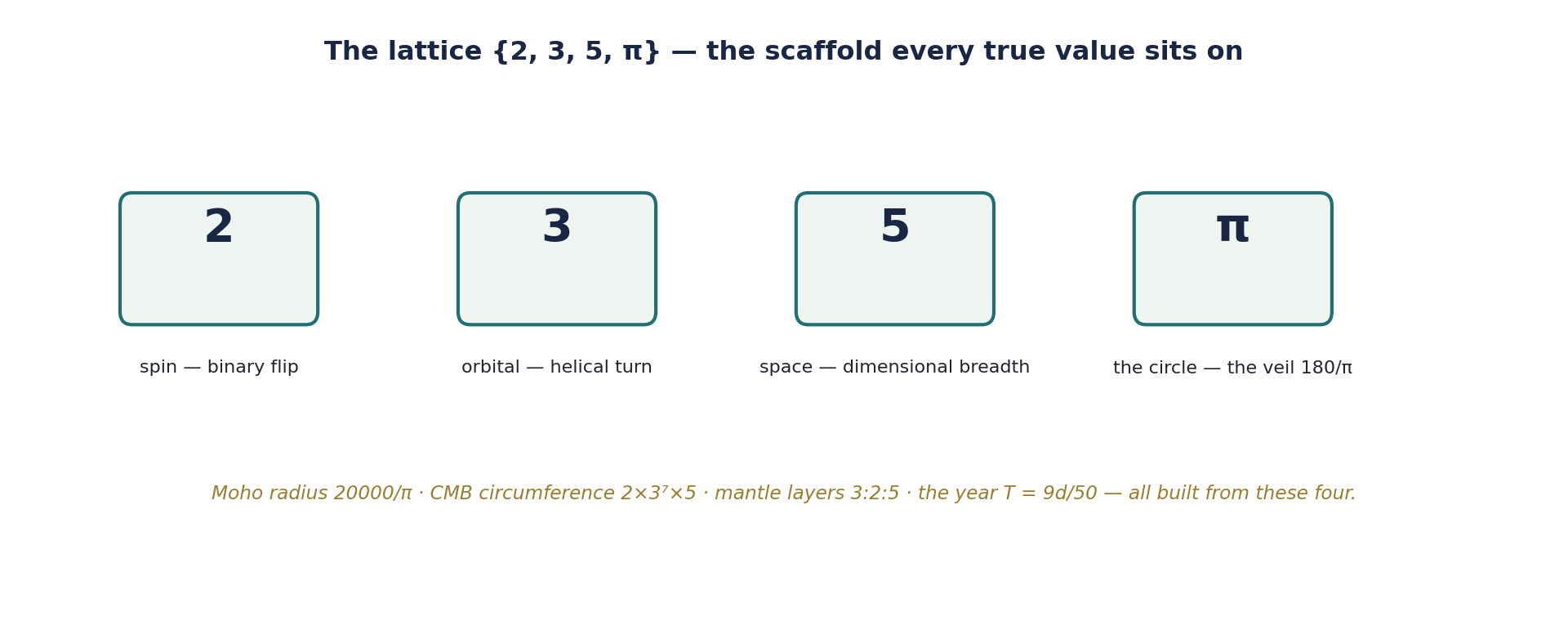
This is not numerology after the fact. It is a claim that constrains what the Earth can be, and the chapters ahead will hold it against the hardest numbers geochemistry has — the radius of a seismic boundary, the composition of the mantle, the temperature of the deep interior — and show them landing on the lattice to the digit. When they do, the meaning is not that the numbers are pretty. It is that the arrangement of the Earth is not a leftover of chance but a structure, and the structure is legible.
The Atom as a Node
Geochemistry begins, as White does, with the atom, because the atom is the unit in which the Earth’s chemistry is written. The standard picture is familiar: a tiny dense nucleus of protons and neutrons, and around it electrons organised by the rules of quantum mechanics into shells, subshells and orbitals, each electron labelled by four quantum numbers, no two alike. The filling of successive shells as protons and electrons are added is what gives the periodic table its rows, and the chemistry of an element its character.
Read through the Force of Time, the atom is itself a node — a knot of Τ at the smallest scale — and its shells are registers, the levels at which the field can hold a standing configuration. The electron does not orbit like a planet; it is a mode of the node, a place the field can sit. And the rules that govern which modes are allowed are the same lattice rules that will govern the Earth. The atom is the Earth’s chemistry in miniature: a node of the one substance, holding its address in the pattern of its filled registers.
The Periodic Table Is Generated, Not Fused
Look at the lengths of the periods — the number of elements in each row of the table — and a pattern jumps out that the standard picture treats as a consequence of orbital arithmetic: 2, then 8, then 8, then 18, then 18, then 32. In the Force of Time these are not incidental. They are the lattice counting its own levels: the registers filling in the counts the primes 2, 3 and 5 allow, the same counting that runs through the rest of the book.
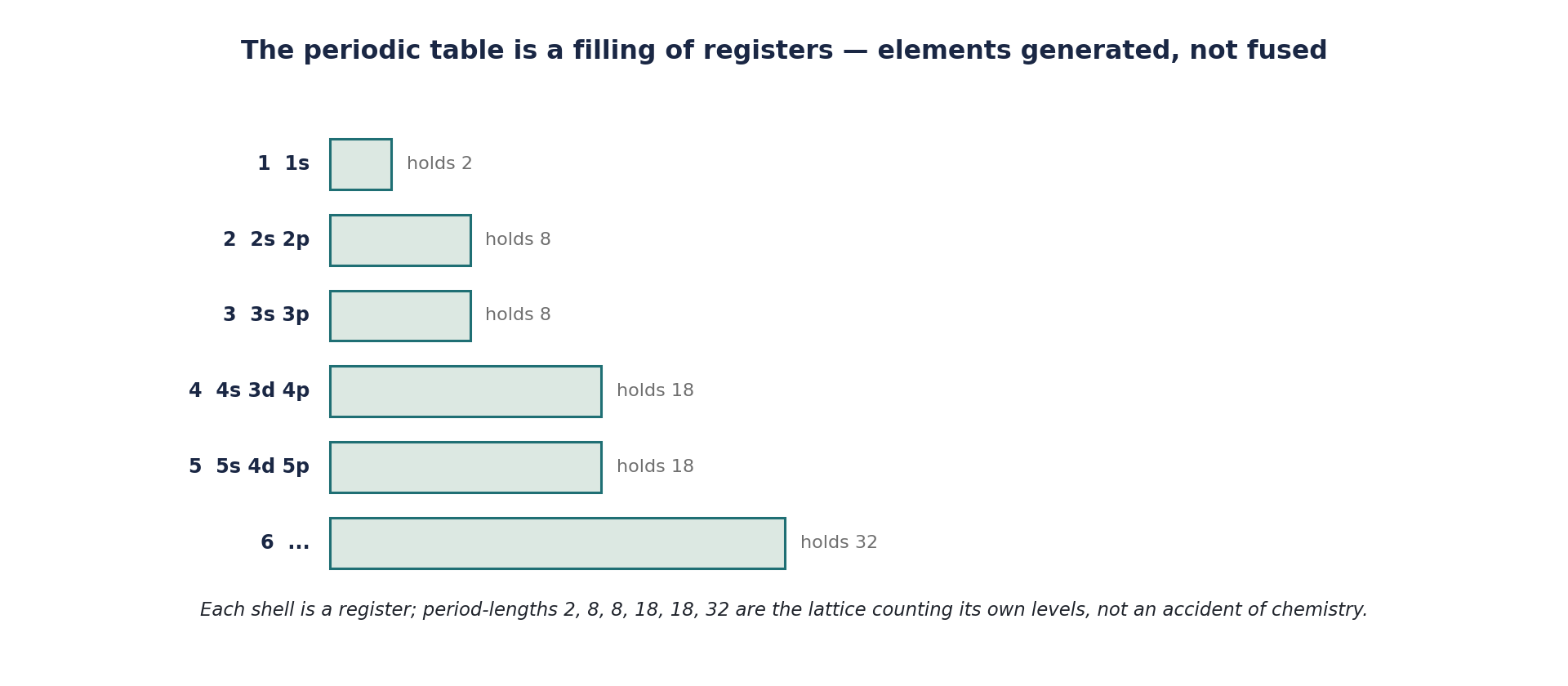
And here the theory parts company with the standard account of where the elements come from. Science holds that the elements beyond hydrogen were built by fusion in the cores of stars and in their deaths — nuclei slammed together against their mutual repulsion. The Force of Time holds instead that the elements are generated — instanced at nodal addresses by rotational time-incrementation, the field stepping from one lattice position to the next — and that only the lightest, the Sun-generated first two groups, are made in the way stars are usually credited with; all the rest are nodal. This is a claim we will return to in the cosmochemistry chapter, but it belongs here at the start, because it changes what an element is: not a scar of stellar violence, but an address on the lattice, occupied.
The Earth as a Node of the Field
Now lift the same idea from the atom to the planet. The Earth, in the reading of this book, is a node of Τ — a region where the fabric of time runs denser than in the space around it, with the field flowing steadily inward toward it. That inward flow is the whole of what we feel as weight, and the whole of what holds the planet in one piece; there is no separate pull, only the field running, as it always does, from the sparse toward the dense.
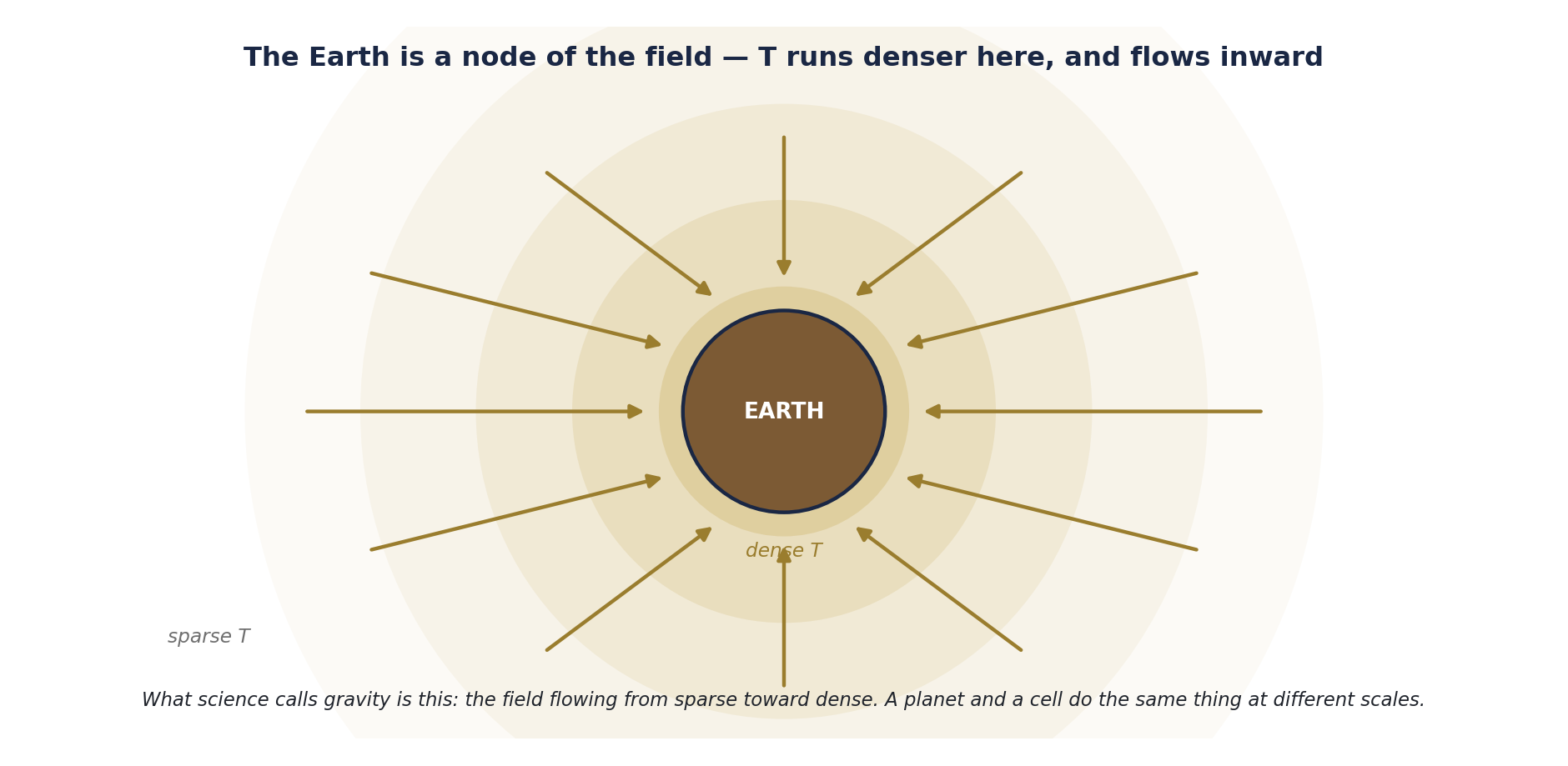
This is not a metaphor dressed as physics; it is meant literally, and it is the reason the planet has an architecture at all. A node of one flowing substance cannot be uniform. As the field runs inward it passes through levels — registers — where the conditions of flow change, and at each such level a boundary forms. The Earth’s interior layers, which geophysics reads from the way earthquake waves bend and bounce, are these register boundaries made physical. To ask why the Earth is layered is to ask where the registers of a Τ-node fall — and that, unlike the accidents of accretion, has an exact answer.
The Registers of the Earth
Consider three of those boundaries, and read their numbers. The Mohorovičić discontinuity — the Moho, where the crust gives way to the mantle — sits at a radius of 20000/π = 6366.197724 kilometres. Wrap a circumference on that radius and the π cancels: 2π × 20000/π = 40,000 kilometres exactly, which is 2⁶×5⁴, a pure {2,5} number. This is the first hint that the Earth’s boundaries are not rounded-off measurements but lattice values.
But the Moho is not merely sitting at a lattice radius; it is doing something, and this is the deepest answer in the chapter. Two space-time waves reach the Earth from the Sun at once: an orbital wave that travels the curved half-circumference path, of length πr, and a linear wave that travels the straight diameter, of length 2r. They arrive at the same nodal point — the Earth’s position on the rim of its orbit — but they arrive carrying different values, πr against 2r, out of step by the amount π−2. Left unreconciled, that mismatch would be a phase distortion, a time-error written into everything the node received.
The Moho is the depth at which the two waves are brought into step. It phase-corrects them — face-corrects the incoming linear and orbital waves — by exactly the factor 1/(5π) = 0.0636619772368, which is nothing other than the Moho’s own radius written small. Above this layer the crust runs in the {2,3,5} register; below it the mantle runs in the {2,3} register, the factor of 5 dropping away as the correction is applied — which is why the seismic shear-wave speed leaps at the Moho to 4.5 = 9/2 kilometres a second, a pure {2,3} value. The Moho is not a chance change of rock; it is the layer where the Earth’s incoming time is corrected.
And it is not a single surface but a thin double one. The Moho has an upper face at 20000/π = 6366.197724 kilometres and a lower face at 2⁹×3⁹×π²/5⁶ = 6365.623859 kilometres — the two one G-bond step apart, with a transition zone between them just 573.865 metres thick, a little over half a kilometre. That lower face is not idle: carried back through the register steps it lands on 1.0077696, the mass of the hydrogen atom itself. The correction layer of the whole planet and the lightest atom within it are written with one number.
Go deeper. The mantle’s three sub-layers fall at 375, 250 and 625 kilometres — that is 3×5³, 2×5³ and 5⁴, and dividing through by 125 leaves the ratio 3:2:5. These are the three prime-domain registers of Τ — orbital (3), spin (2) and space (5) — physically stratified by density. The mantle is not layered by chance; it is the three registers of the field, stacked. Deeper still, the core–mantle boundary has a circumference of 2×3⁷×5 = 21,870 kilometres, carrying the very same 3⁷ = 2187 that scales the wavelength of the cosmic microwave background — the Earth’s deepest boundary and the floor of the whole sky written with one integer.
And there is a clock in it. The Force of Time gives a single formula relating a depth in the Earth to a Τ-year: T = 9d/50 days, with d the depth in kilometres. It is the register-clock of the interior, and it ties the layers together into one timed structure. All of this — the Moho, the mantle’s 3:2:5, the core–mantle 3⁷, the depth-clock — is the answer to a question geophysics can measure but not explain: why is the Earth built in exactly these layers, at exactly these depths? Because that is where the registers of the node fall.
Heat Is Time
One more idea belongs at the start, because it runs under every chapter of thermodynamics and kinetics to come. In the standard picture, heat is the random motion of atoms, and temperature its measure. In the Force of Time, heat is Τ — temperature is nothing but the local density of the fabric of time, and to warm a thing is to lend it a denser flow. The constant that science calls Boltzmann’s, the bridge between temperature and energy, is not a universal handed down from nowhere; it is a value belonging to the Earth’s own register.
This is why the deep Earth is hot, and why reactions run faster when it is: not merely because atoms jostle harder, but because the field runs denser toward the node’s centre, and a denser flow of time is more available to do the work of change. When the thermodynamics chapters give the outcome of a reaction, and the kinetics chapters its rate, the Force of Time reads both as the accountancy of Τ — what the field can redistribute, and how quickly — under the one conservation law dΣΤ=0.
The Journey Inward
The book follows White’s own plan. First the toolbox: the thermodynamics that says what can happen (Chapters 2–4), the kinetics that says how fast (Chapter 5), the aquatic chemistry of the waters (Chapter 6), the trace elements that record melting and crystallising in fine detail (Chapter 7), and the isotopes — radioactive for the clocks, stable for the fingerprints — that date and trace the Earth’s materials (Chapters 8–9).
Then the Earth itself, from the outside of the solar system inward and the inside of the planet out: the cosmochemistry of how the elements and the system came to be (Chapter 10); the mantle and core (Chapter 11); the crust (Chapter 12); the weathering, soils and rivers of the surface (Chapter 13); the organic geochemistry of carbon and life (Chapter 14); and the ocean as a chemical system (Chapter 15). At every station the same double reading applies: the standard science of how much and where, and beneath it the Force of Time’s answer to why exactly this, and why here.
Why This Should Matter to You
It would be easy to take all this for an abstraction — a curious way of talking about rocks. But the claim, if it holds, is not abstract at all. It is that the ground under your feet is not a heap of leftovers from a violent accretion, but a structure — a node of the one substance, layered by the registers of the field, its elements occupying addresses on a lattice that also fixes the water you drink and the light of the stars. The Earth is not random. It is written.
And what is written can be read. That is the promise of this book: that the questions geochemistry has always answered with ‘this is how it is’ — why the mantle is layered so, why the elements lie where they lie, why the planet holds its heat and its water — have deeper answers, and that those answers are numbers, exact and legible, on the lattice of {2, 3, 5, π}. We begin, in the next chapter, with the most fundamental tool of all: the thermodynamics that decides what the Earth is allowed to do.
The Numbers at a Glance
The anchors of the book, established in this introduction and derived in full in the chapters that follow. Every geophysical value is left exactly as measured; the right-hand column notes where it meets the lattice.
| Quantity | Value | On the lattice |
|---|---|---|
| The one substance | Τ — the fabric of time | dΣΤ=0 conserves it; no separate pulling force |
| The lattice | {2, 3, 5, π} | spin · orbital · space · the circle/veil |
| The veil | 180/π = 57.29577951 | degrees (true) ↔ radians (measured) |
| Moho upper face | 6366.197724 km | 20000/π (circumference 40,000 = 2⁶×5⁴) |
| Moho lower face | 6365.623859 km | 2⁹×3⁹×π²/5⁶ (573.865 m below; → H mass) |
| Moho phase factor | 1/(5π) = 0.0636619772368 | corrects orbital (πr) vs linear (2r) at the node |
| Mantle sub-layers | 375 / 250 / 625 km | 3×5³ / 2×5³ / 5⁴ = ratio 3:2:5 |
| Core–mantle circumference | 21,870 km | 2×3⁷×5 (same 3⁷ as the cosmic CMB) |
| Depth clock | T = 9d/50 days | the register-clock of the interior |
| The elements | generated, not fused | occupied addresses on the lattice |
References
- S. Daubney, The Universal Force of Time — Master Compendium v5, The Daubney Foundation (2026).
- W. M. White, Geochemistry, John Wiley & Sons, Chichester (2005; 2013 print ed.).
- S. Daubney, The Universal Force of Time — Master Theory, Volume 3 (Earth-Sciences and Cosmochemistry Sections), The Daubney Foundation (2026).
- S. Daubney, The Force of Time — Where It Departs From Current Science, The Daubney Foundation (2026).
Open the full paper as a PDF ↗
This paper, and any information drawn from it, may be used freely provided the reference attribution to Stephen Daubney and The Daubney Foundation is recognised.