In which the most fundamental tool of geochemistry — thermodynamics, which decides what a reaction is allowed to do — is read as the accountancy of Τ: the First Law revealed as the conservation of the one substance, the Second as its one-way flow from the Sun outward, the Third as the floor no node can fall below; and in which two of the deepest constants in all of chemistry, absolute zero and the gas constant, are shown to be pure lattice values — −3⁷/2³ and 810/π⁴.
Introduction — Through the Force of Time
The chapter that follows is, in the conventional telling, the foundation of geochemistry: the first and second laws, energy and entropy, the state functions that let us predict which reactions can happen. Read through the Universal Force of Time it is the same foundation, but grounded: thermodynamics does not merely describe what Τ does — it is the accountancy of Τ, and its three laws are three plain facts about the one substance. Energy is the measurable face of Τ; entropy is its dispersal; absolute zero is the floor of a field that is everywhere.
Thermodynamics is the tool the rest of geochemistry is built around. Give it a reaction and a set of conditions — a temperature, a pressure, a set of ingredients — and it will tell you which way the reaction will go, and where it will stop. It is what lets a geologist look at a rock and read the temperature and pressure at which it formed; it is what decides which minerals are stable in the deep Earth and which at the surface. White devotes three chapters to it because almost everything else depends on it.
The standard laws are correct in what they describe and silent on what they mean. They say energy is conserved without saying what energy is; they say entropy increases without saying what is really dispersing; they say absolute zero cannot be reached without saying why the floor is there. The Force of Time supplies the missing substance. There is one thing in the universe, Τ, the fabric of time, and thermodynamics is the bookkeeping of how Τ moves and redistributes under the single conservation law dΣΤ=0. What science calls energy is simply the measurable face of Τ as it changes mode — flowing as time, radiating as light, gathering as heat, holding as a bond.
Read the three laws this way and they stop being abstractions and become geometry. The First Law is that Τ is conserved in total: nothing can be created from outside the one substance, and nothing lost into anything other than it. The Second is that Τ flows in one direction — outward from its source, the Sun, to the nodes it feeds — and that this one-way flow is the very thing we experience as the forward passage of time. The Third is that no node can fall to zero, because there is nowhere outside the field to step: the floor is set by the field’s own non-zero density.
And the theory pays its way in the hardest currency there is: exact numbers. The absolute zero of temperature, that science pins at about −273 degrees, is on this reading −3⁷/2³ = −273.375 degrees exactly — a pure {2,3} lattice value. The gas constant R, the bridge between temperature and energy that stands in every thermodynamic equation, is 810/π⁴. Two of the most basic constants in all of chemistry, and both fall on the lattice. That is the promise of this chapter made good.
The Most Fundamental Tool
Of all the tools in the geochemist’s box, thermodynamics is the one the others are built around, and it is worth being clear about what it does. It does not tell you how fast a reaction goes — that is the business of kinetics, the next chapter. It tells you what a reaction is allowed to do: which way it will run if it runs at all, and the state it will settle into when it can change no further. It is the science of the possible and the final, and it is powerful precisely because it does not care about the messy details of the path.
It works by way of state functions — quantities like energy and entropy that depend only on the condition of a system, not on how it got there. That path-independence is what makes thermodynamics predictive: knowing only where a system starts and the conditions it is under, you can say where it must end. In the reading of this book, this is no accident of mathematics. A state function is path-independent because it is a measure of Τ — and Τ, being conserved, keeps the same books however you get from one state to another. The whole apparatus of thermodynamics is the accountancy of a conserved substance.
The First Law Is the Conservation of Τ
The First Law of thermodynamics is usually stated as the conservation of energy: energy can be neither created nor destroyed, only converted from one form to another. Heat and work are equivalent; the change in a system’s energy is independent of the path. It is one of the surest statements in all of science, and it was hard-won — when Joule first proposed the equivalence of heat and work in 1843 he was met, in his own words, with ‘entire incredulity.’
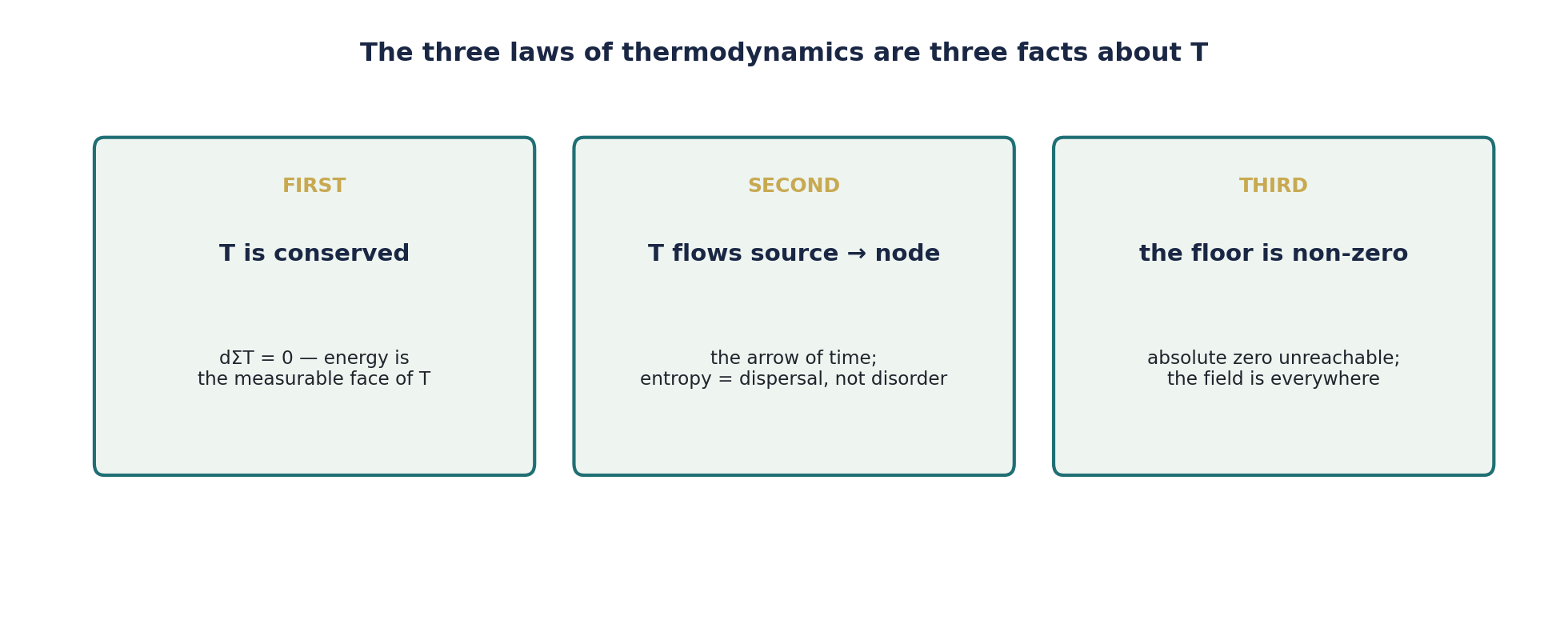
In the Force of Time the law is exactly right and its subject is named. What is conserved is not an abstraction called energy but Τ itself, the one substance — and it is conserved by logical necessity, not as an empirical finding that might one day be revised, because there is nothing outside Τ from which more could come or into which any could vanish. Heat and work are equivalent because both are Τ in different modes; the change of energy is path-independent because Τ keeps its books. What science calls the conservation of energy is, in full, the conservation of Τ: dΣΤ=0.
Heat Is Time
Before the second and third laws, one idea must be made plain, because it runs under every reaction in the Earth. In the standard picture, heat is the random motion of atoms and temperature is its measure. In the Force of Time, heat is Τ: temperature is nothing but the local density of the fabric of time, and to warm a thing is to lend it a denser flow. Boltzmann’s constant, the bridge from temperature to energy, is not a universal handed down from nowhere; it is a value belonging to the Earth’s own register.
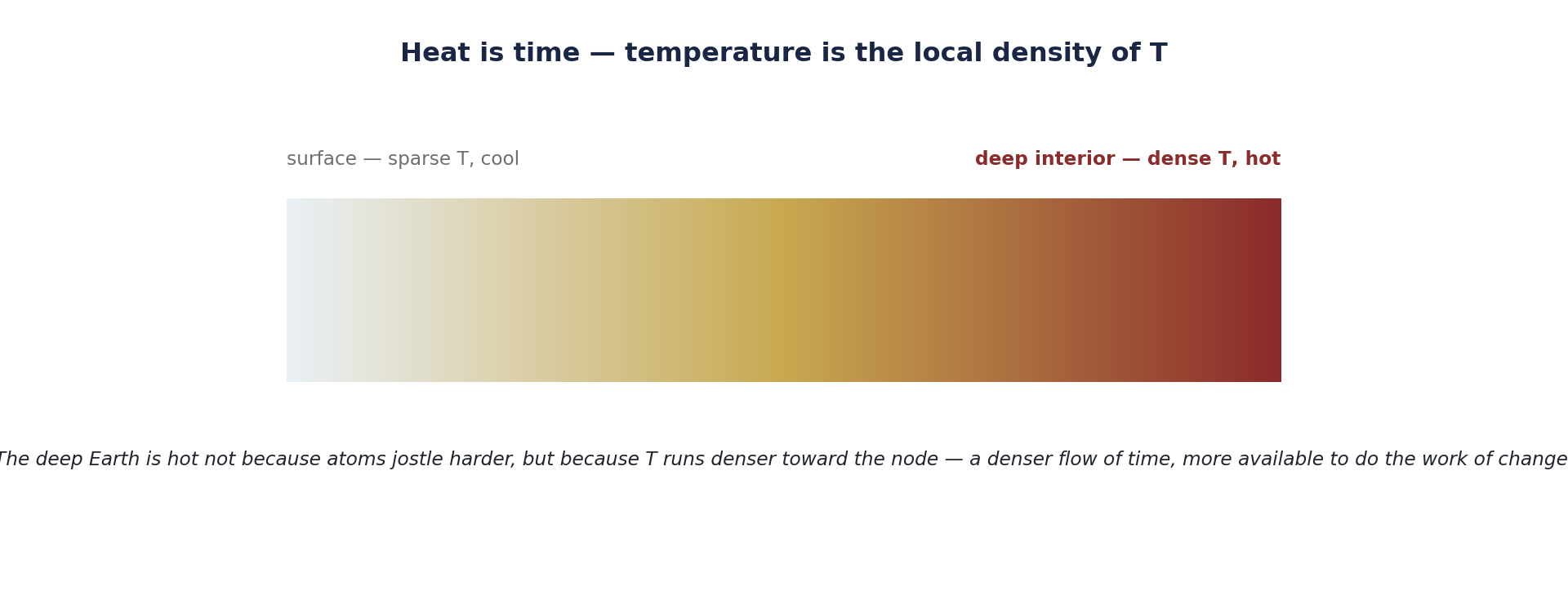
This is why the interior of the Earth is hot, and why reactions run faster where it is hotter: not only because atoms jostle harder, but because Τ runs denser toward the node’s centre, and a denser flow of time is simply more available to drive change. It reframes every thermodynamic quantity in the chapters to come. An enthalpy is a store of Τ held in bonds; a heat of reaction is Τ released or taken up as bonds are made or broken; a temperature is the density of the field in which the reaction sits. Thermodynamics measures the movements of one substance, and heat is that substance in its most familiar disguise.
The Second Law: Τ Flows One Way
The Second Law is the law of direction. Heat flows from hot to cold and never spontaneously the other way; entropy, the measure science attaches to disorder, always increases in an isolated system; and buried in this is the arrow of time itself, the reason the past differs from the future. It is the strangest of the laws, because it introduces a direction into physics that the other laws do not have.
The Force of Time locates that direction in the flow of the one substance. Τ is generated at the Sun — the hydrogen-bond axis of the cosmic structure — and propagates outward through the nodes of the solar system, and it does not run backward. The direction of that flow, from the dense source toward the sparser periphery, is the direction every observer feels as the forward passage of time. What science measures as an increase of entropy is not a growth of disorder but the progressive dispersal of Τ through the nodal lattice, spreading from the source toward its nodes. And the end-state of that dispersal is not chaos; it is nodal equilibrium — every node filled at its own resonant frequency, the field at rest.
The Third Law and the Floor That Cannot Be Reached
The Third Law says that absolute zero — the coldest possible temperature, where all thermal motion ceases — can be approached but never reached. Science treats this as a limitation of process: you can always get closer, but each step costs more, and the last step costs infinitely much. The Force of Time gives a deeper reason, and it is structural, not practical.
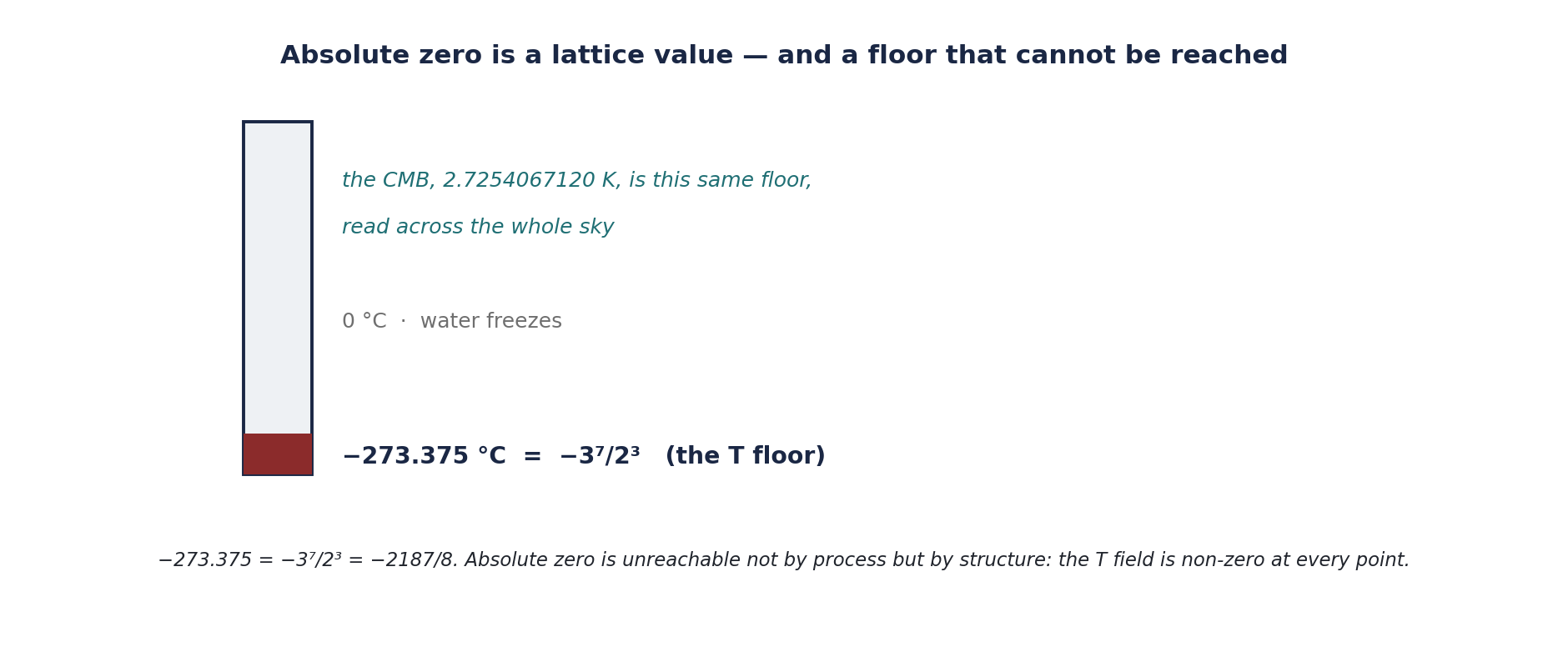
No node can fall to zero Τ, because to do so it would have to step outside the field entirely — and there is nowhere outside the field to step, for the field is the medium of existence itself. The minimum a node can reach is not zero but the Τ-floor of its own address, set by the everywhere-present density of the field. And that floor is a lattice value: absolute zero sits at −3⁷/2³ = −273.375 degrees, a pure {2,3} number, not the rounded −273.15 of the tables. The same floor, read across the whole sky rather than in a laboratory, is the cosmic microwave background at 2.7254067120 kelvin — not the cooling ember of a creation event, but the minimum density of a field that is everywhere and was never made.
The Gas Constant on the Lattice
Turn to the single constant that appears in more thermodynamic equations than any other: R, the gas constant, the number that ties temperature to energy in the ideal-gas law and in the expression for every equilibrium. Science measures it at about 8.314 joules per mole per kelvin and treats it as an empirical bridge, a conversion with no deeper meaning.
In the Force of Time it is a lattice value: R = 810/π⁴ = 8.315445626. The number 810 is 2×3⁴×5, a clean {2,3,5} integer, divided by the fourth power of the circle. That the constant which governs how every gas responds to warming, and how far every reaction proceeds, should be a small lattice number over π⁴ is exactly the claim of this book made concrete: the accountancy of Τ is written in {2,3,5,π}, down to the constant that stands in every equation of the science.
Gibbs, and What the Earth Is Allowed to Do
The working tool the geochemist actually reaches for is the Gibbs free energy, G = H − TS — the balance of a system’s heat content H against its entropy S weighted by temperature T. A reaction proceeds in the direction that lowers G, and stops where G is least. This one quantity decides which minerals form at depth and which at the surface, which reactions run and which are forbidden.
Read as the accountancy of Τ, the Gibbs balance is the field seeking its lowest available configuration: the term H is the Τ held in the bonds, the term TS is the Τ dispersed into the register at that temperature, and the reaction runs in whichever direction lets Τ settle lower, toward the node. Spontaneity is not a mysterious tendency; it is Τ flowing downhill toward equilibrium, as it always does, under dΣΤ=0. When the later chapters use Gibbs energy to say what the Earth’s materials will do — melt or freeze, dissolve or precipitate, hold together or come apart — they are reading where the field can settle lowest.
The Source and the Sink
One structural point closes the chapter, because it will matter for everything from the heat of the interior to the chemistry of the sea. Τ conservation operates at nested levels. The whole is absolutely closed — dΣΤ=0 over the cosmos, by necessity. But within it the Sun is a source, converting the tension of the cosmic structure into Τ that streams outward; the planets are receivers, each sitting at the nodal distance where the solar flow matches its own frequency; and living things are terminal receivers, tapping the planetary flow to run their own clocks.
This is why the Earth is not a closed box that should long ago have run down to a cold equilibrium. It is an open sub-system, continuously fed by the Sun, and its thermodynamics — the heat of its interior, the drive of its surface chemistry, the endless cycling of its water and its elements — is powered by that steady incoming flow. The First Law holds absolutely for the whole; the Earth’s local budget is a receiver’s budget, and the source is the Sun. Every chapter that follows is, in one way or another, the story of what the Earth does with the Τ it receives.
Why This Should Matter to You
Thermodynamics can feel like the driest corner of science — a wall of state functions and sign conventions. But what it really is, in the reading of this book, is the set of rules by which the one substance of the universe is allowed to move, and those rules are why anything happens at all. Every reaction in the rock and the ocean and your own body runs because Τ can settle lower by running it; every reaction that is forbidden is forbidden because it would raise the field instead.
And the rules are legible. The two constants that stand at the base of the whole science — the coldest possible temperature and the bridge between heat and energy — are not arbitrary measurements but numbers on the lattice: −3⁷/2³ and 810/π⁴. That is the shape of the whole book in miniature: the Earth’s deepest rules turn out to be written in the same few numbers as its layers and its elements. With the accountancy of Τ in hand, we can turn, in the next chapters, to what it lets the Earth actually do — beginning with the thermodynamics of solutions and the melting of the deep interior.
The Numbers at a Glance
The constants and laws of this chapter. Every measured value is left exactly as measured; the right-hand column notes where it meets the lattice.
| Quantity | Value / statement | On the lattice |
|---|---|---|
| First Law | Τ conserved: dΣΤ=0 | energy = the measurable face of Τ |
| Second Law | Τ flows source → node | arrow of time; entropy = dispersal, not disorder |
| Third Law | non-zero Τ-floor everywhere | absolute zero unreachable by structure |
| Absolute zero | −273.375 °C | −3⁷/2³ = −2187/8 (pure {2,3}) |
| Cosmic microwave background | 2.7254067120 K | the Τ-floor read across the sky |
| Gas constant R | 8.315445626 J·mol⁻¹·K⁻¹ | 810/π⁴ (810 = 2×3⁴×5) |
| Heat | Τ itself | temperature = local density of Τ |
| Gibbs spontaneity | ΔG < 0 | Τ settling lower toward the node |
References
- S. Daubney, The Universal Force of Time — Master Compendium v5, The Daubney Foundation (2026).
- W. M. White, Geochemistry, John Wiley & Sons, Chichester (2005; 2013 print ed.), Chapter 2.
- S. Daubney, The Universal Force of Time — Master Theory, Volume 3, §117 (The Three Force-of-Time Laws of Thermodynamics), The Daubney Foundation (2026).
- S. Daubney, The Planck and Boltzmann Values Belong to the Earth, The Daubney Foundation (2026).
- S. Daubney, The Force of Time — Where It Departs From Current Science, The Daubney Foundation (2026).
Open the full paper as a PDF ↗
This paper, and any information drawn from it, may be used freely provided the reference attribution to Stephen Daubney and The Daubney Foundation is recognised.