In which the sea — the great receiving register into which every river empties and every cycle of the surface drains — is read as the register of water: its salt composition a lattice balance, the residence times of its elements as register dwell-times set by how well each address fits the water, and the ocean as the buffer, the mixing-vessel and the cradle in which the whole register of the Earth closes upon itself.
Introduction — Through the Force of Time
The chapter that follows is, in the conventional telling, marine geochemistry: the composition of seawater, the residence times of the elements, the ocean as a chemical system in steady state, and its central place in the global cycles. Read through the Universal Force of Time it is the register of water — the sea as the register into which the surface cycle drains, holding its elements in lattice balance, and the vessel in which the whole story of this book comes round.
All the rivers run to the sea, and the sea is not full. That ancient puzzle holds the whole of marine geochemistry: the rivers pour their dissolved load into the ocean without end, yet the ocean’s composition scarcely changes, held for aeons in a steady, salt balance. The sea is the great receiving vessel of the planet — the place every surface cycle drains into — and yet it keeps its measure. To understand the ocean is to understand how the Earth holds its balance.
White’s account gives the chemistry of that balance. Seawater has a nearly constant composition, dominated by a few ions — sodium and chloride above all, then magnesium, sulphate, calcium, potassium. Each element enters from the rivers and the sea floor and leaves into the sediment, and the balance of the two fixes how long, on average, an atom of it stays dissolved: its residence time, ranging from tens of millions of years for the conservative elements down to mere decades for the most reactive. The ocean is treated as a vast reservoir in steady state, mixing, buffering, and cycling the elements of the surface world.
The Force of Time reads the sea as the register of water. Its foundation is the water molecule itself, which — as the chapter on aquatic chemistry showed — does not sit at one angle but on a ladder of exact faces, one per power of π: the gas monomer at 104.4949716° ( = 3240/π³ ), the hydrogen-bonded face that dominates in liquid water at 105.0498032° ( = 14400 α ), and the crystalline and low-liquid faces between — all turning on the Mohorovičić hub 36/π², and reading out, in water’s four photoelectron peaks, light, the planet, matter and the flow of time. It is because this molecule sits so exactly on the Earth’s register that water is the structural register of the planet. The composition of the sea is a lattice balance: the ions it holds in such steady proportion are those whose addresses sit comfortably in the water register, gathered from all the weathering of the land and held in a balance the register keeps. And the residence time of each element is its dwell-time in that register — how long its address is at home in the water before it is removed.
That single idea orders the whole ocean. The conservative elements — sodium, chloride, magnesium — dwell for tens of millions of years because their addresses are on-node in seawater: the register holds them, and they stay. The reactive elements — aluminium, iron, thorium — are gone within decades or centuries because they are off-node, and the register sweeps them out into the sediment almost as fast as they arrive. Residence time is register affinity, told as time. And the ocean, holding its balance, buffering its chemistry, mixing the whole surface world in one vast vessel, is where the register of the Earth closes: every cycle this book has followed — the weathering of rock, the freeing of the elements, the streams that carry them down — ends here, in the register of water, and begins again.
The Register of Water
Water covers most of the Earth and makes it the world it is. The ocean is the largest single feature of the planet’s surface, the reservoir that moderates its climate, the cradle in which life began, and the sink into which every river and every surface cycle finally drains. Any account of the geochemistry of the Earth must end at the sea, because the sea is where it all comes together.
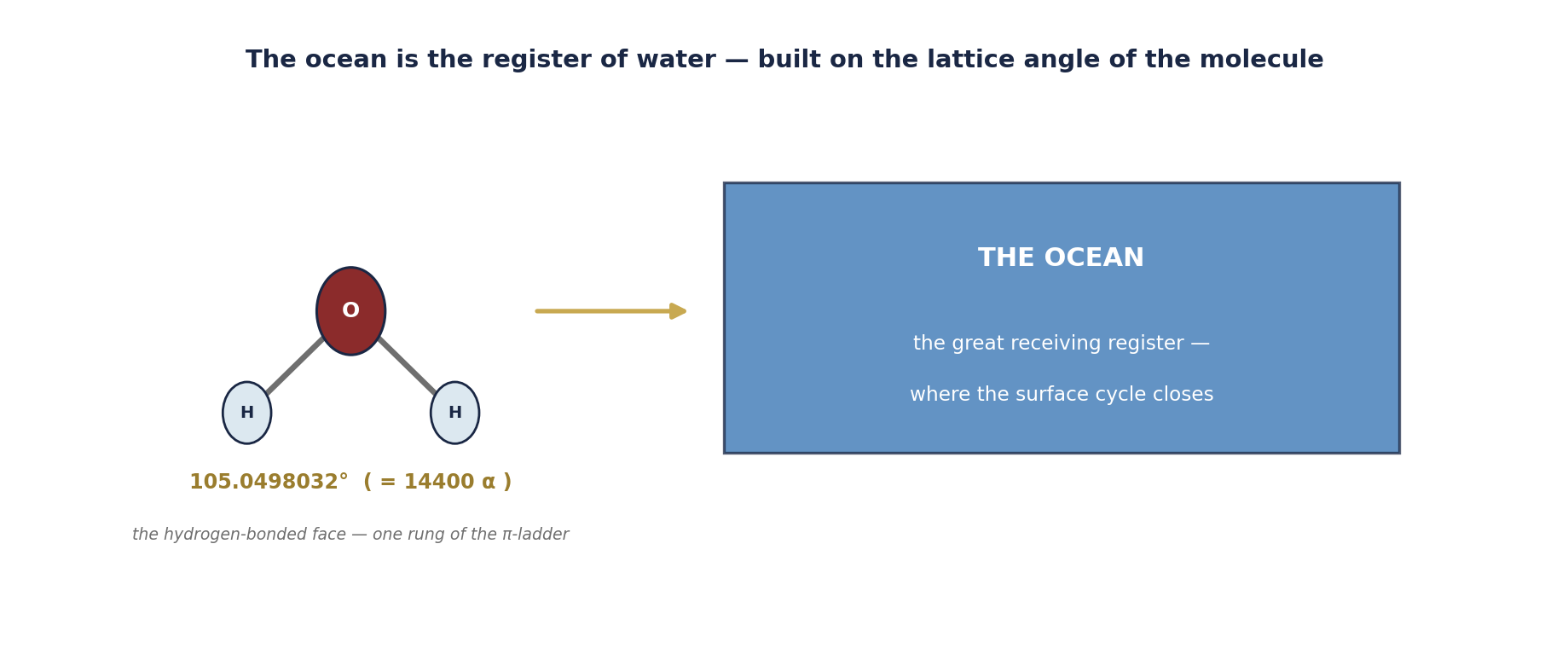
In the Force of Time the sea is the register of water — and water, as the chapter on aquatic chemistry established, is the structural register of the Earth, its molecule bent not to one angle but to a ladder of lattice faces, one per power of π: the gas monomer at 104.4949716° ( = 3240/π³ ), the hydrogen-bonded face at 105.0498032° ( = 14400 α ) that dominates in liquid water, and the crystalline and low-liquid faces between — all folding onto the Mohorovičić hub 36/π². The ocean is that register at planetary scale: the great vessel of water in which the elements of the whole surface are gathered, mixed and held. It is the last and largest of the registers this book has read.
The Composition of the Sea: a Lattice Balance
Seawater is remarkably constant. Wherever it is sampled, the major ions stand in nearly the same proportions — sodium and chloride the great pair, then magnesium, sulphate, calcium, potassium — a composition so steady it is treated as a fixed recipe. This constancy, across all the world’s oceans and across vast spans of time, is one of the central facts of marine chemistry.
In the Force of Time the sea’s composition is a lattice balance. The ions it holds in such steady proportion are those whose addresses are at home in the water register — gathered from all the weathering of the continents and held by the register in a balance it keeps. The constancy is the register holding its own: the sea is not an arbitrary brine but a register in balance, filled with the elements that fit it and holding them in the proportions the lattice allows. The recipe of seawater is the register’s balance, written in salt.
Residence Time: the Register's Dwell-Time
Each element that enters the sea eventually leaves it, into the sediment; the balance of arrival and departure sets its residence time — the average span an atom stays dissolved. These times differ enormously: sodium lingers for something like a hundred million years, while a reactive metal like aluminium or iron is gone within a few hundred. Residence time is one of the master numbers of ocean chemistry.
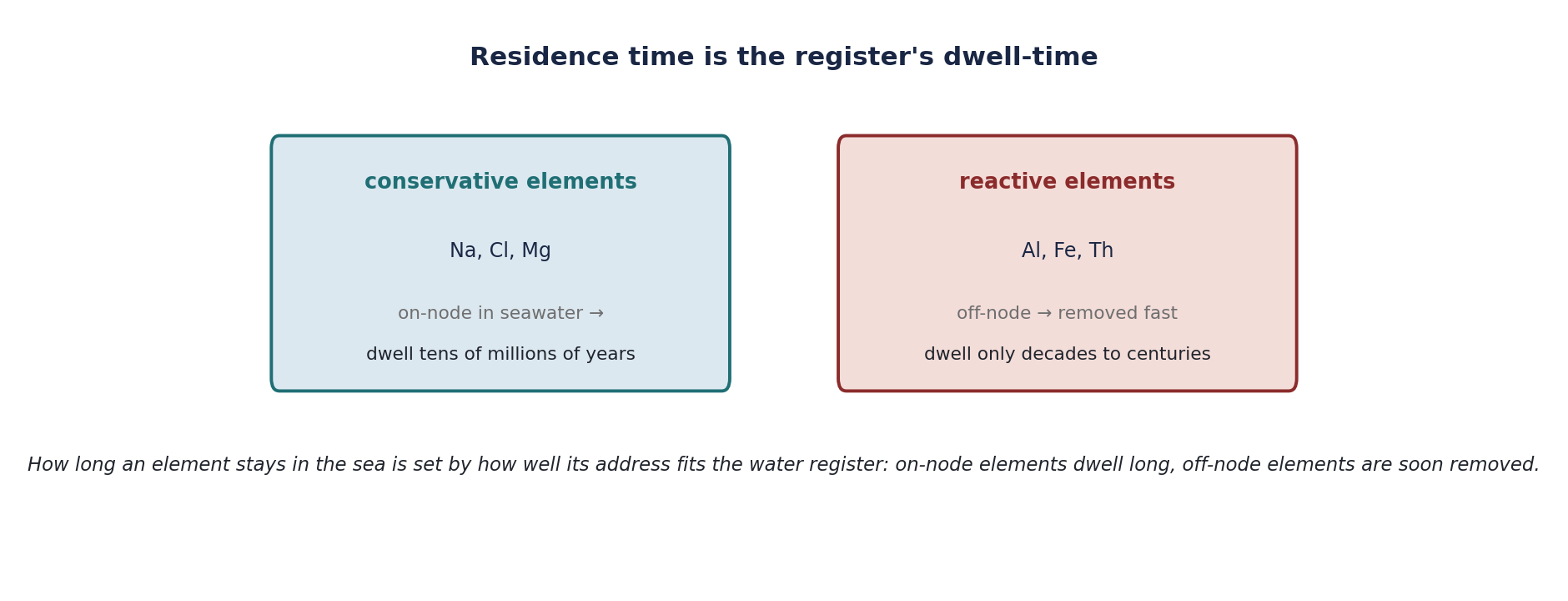
In the Force of Time residence time is register dwell-time — how long an element’s address is at home in the water register before it is removed. The conservative elements dwell long because they are on-node in seawater: the register holds them, and they stay for aeons. The reactive elements are gone quickly because they are off-node: the register cannot hold them, and sweeps them out into the sediment almost as fast as the rivers bring them in. This is the very same affinity that sorted the trace elements between crystal and melt, now sorting the elements between the sea and its floor. Residence time is register affinity, told as time.
The Ocean as the Great Mixing Register
The ocean is never still. Its waters turn over in a slow global circulation — sinking cold at the poles, creeping along the deep floor, rising and returning — that mixes the whole sea over a thousand years or so and carries heat, salt and dissolved gases around the planet. This circulation is the engine of the ocean’s chemistry and a governor of the world’s climate.
In the Force of Time this circulation is the register mixing itself — the great vessel of water stirring its contents until the whole is brought into one balance. It is also the planet’s buffer: the ocean, as the chapter on aquatic chemistry showed, holds its acid–balance nearly fixed through the carbonate system, absorbing shocks that would otherwise swing the surface chemistry wildly. The sea mixes, buffers, and steadies the whole surface world — the register keeping the Earth’s balance by holding the largest store of water in constant, gentle motion.
Where the Cycle Closes
Follow any element through this book and it comes at last to the sea. Lifted from the deep in rock, sieved into the crust, weathered free at the surface, carried down by the streams — it arrives in the ocean, dwells there according to its fit, and is at last taken into the sediment, buried, and returned to the deep to begin the whole journey again. The sea is where the cycle of the Earth closes and reopens.
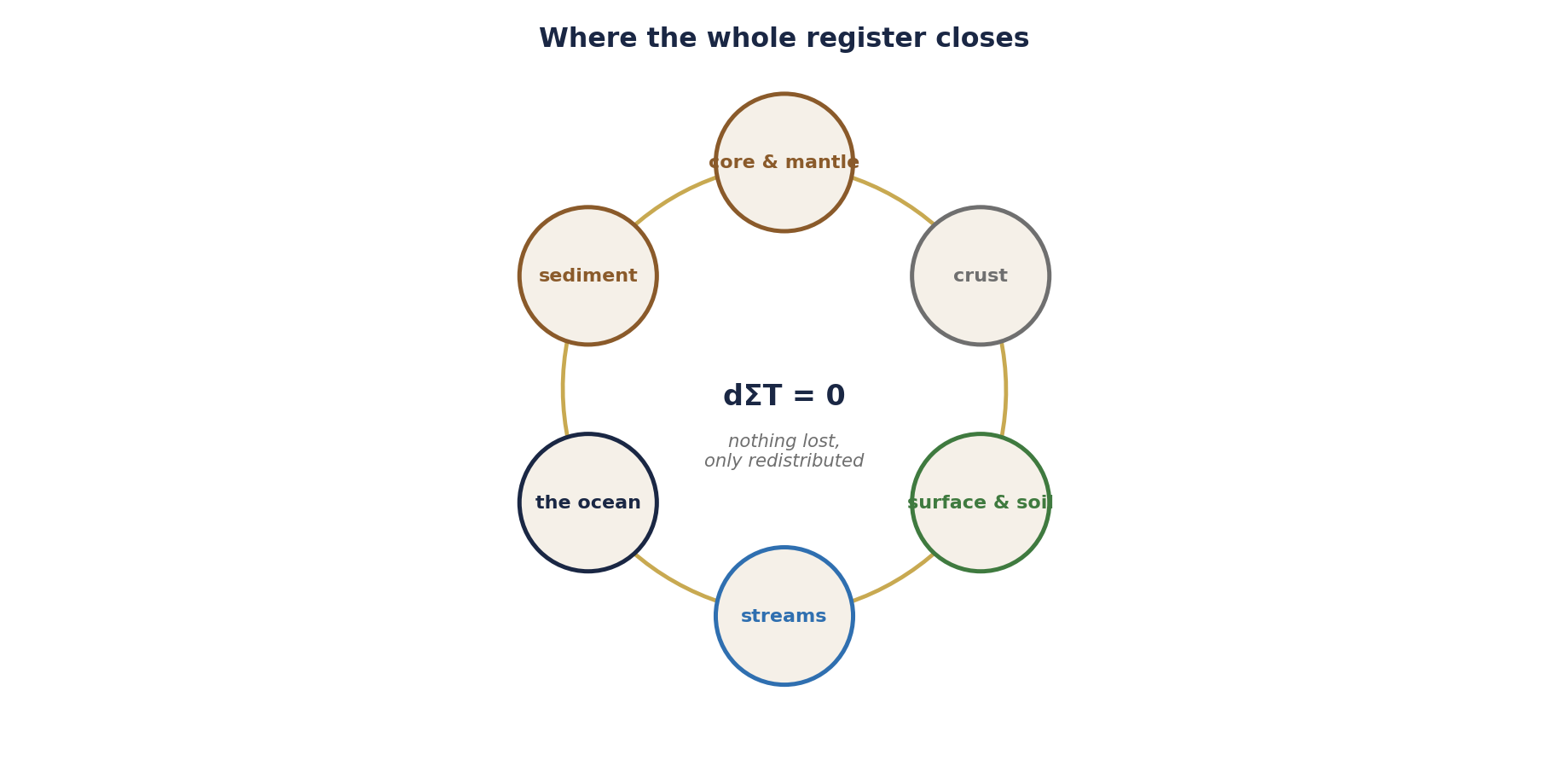
In the Force of Time this closing is the conservation law made visible at the scale of the whole planet: dΣΤ=0, nothing created, nothing destroyed, only redistributed. Every register this book has read — the deep boundaries, the crust, the weathered surface, the streams, the sea — is one turn of a single cycle, and the ocean is where it comes round. The elements are gathered here, held for their span, and passed on into the deep to be made new. The register of the Earth is not a set of separate stories but one great turning, and the sea is its closing and its beginning.
The Cradle of the Living Register
Life began in the sea, and the sea has never let it go. The ocean is still the largest habitat on Earth, the reservoir of the water without which no living thing survives, the buffer that has kept the surface fit for life across billions of years. To read the register of water is, in the end, to read the register of life’s own home.
In the Force of Time this is fitting, for water is the structural register of the Earth and life is a register locked to the Earth’s own. The sea, holding water at planetary scale in steady balance, was the register in which the living patterns first assembled and the register in which they are still most at home. The cradle of life was the register of water because life is a pattern of the same Τ the sea holds and mixes and keeps in balance. We came from the register of water, and we carry it in every cell.
Why This Should Matter to You
The sea made you and sustains you. Its water is in your blood at nearly the salt of the ancient ocean; its circulation sets the climate you live in; its balance, held for aeons, is the balance that keeps the surface world alive. When we load the sea with carbon and acid faster than its register can absorb, we are testing the one buffer that has kept the Earth habitable — and that should give us pause.
This has been the story of the Earth told as one substance. From the core turning at its heart to the ocean closing at its surface, every boundary on the lattice, every element sorted by its address, every cycle a redistribution of the one force of time — the Earth is the register set out in stone and water, and we live within it, made of it, carried by it. The rivers run to the sea and the sea is not full, because the register keeps its balance; and the same register that balances the sea beats in the water of your own body. To know the Earth as the register of time is to know that the distance between you and the deep, between you and the stars, is not empty — it is Τ, flowing, holding you in the same balance it holds the sea. That is where the register of the Earth closes, and where you begin.
The Numbers at a Glance
The quantities of marine geochemistry and their Force-of-Time reading. Measured behaviour is left as measured; the right-hand column gives the register meaning.
| Quantity | What it is | The Force of Time reading |
|---|---|---|
| Water bond angle | a ladder of faces (per power of π) | gas 3240/π³, H-bonded 14400α; hub 36/π² |
| Seawater composition | nearly constant | a lattice balance the register keeps |
| Major ions | Na, Cl, Mg, SO₄, Ca, K | addresses at home in the water register |
| Residence time | mean span dissolved | the register’s dwell-time |
| Conservative elements | Na, Cl — dwell aeons | on-node in seawater; held long |
| Reactive elements | Al, Fe — dwell briefly | off-node; swept out to sediment fast |
| Ocean circulation | global overturning | the register mixing and buffering itself |
| The closing cycle | rivers → sea → sediment → deep | dΣΤ=0 — the register coming round |
References
- S. Daubney, The Universal Force of Time — Master Compendium v5, The Daubney Foundation (2026).
- W. M. White, Geochemistry, John Wiley & Sons, Chichester (2005; 2013 print ed.), Chapter 15.
- S. Daubney, The Photoelectron Spectrum of Water — Four Electron Levels, Four Constants of Creation, The Daubney Foundation, Rev 2 (2026).
- S. Daubney, The Force of Time — Where It Departs From Current Science, The Daubney Foundation (2026).
Open the full paper as a PDF ↗
This paper, and any information drawn from it, may be used freely provided the reference attribution to Stephen Daubney and The Daubney Foundation is recognised.