In which organic geochemistry — the study of the carbon of living things, buried and transformed into kerogen, coal, oil and gas — is read as the register of life caught in the rock: carbon as the element whose two great bonds carry the two addresses of life, the C–H bond the Sun’s reach to the Earth and the C–C bond the Earth’s own node, and the fossil fuels as the Τ-patterns of ancient life re-sorted by the deepening register of burial.
Introduction — Through the Force of Time
The chapter that follows is, in the conventional telling, organic geochemistry: the production and burial of the organic matter of living things, its transformation into kerogen and then into coal, oil and natural gas, the biomarkers that carry the signature of life, and the carbon cycle that moves carbon between the living surface and the buried deep. Read through the Universal Force of Time it is the register of life in the rock — carbon carrying the addresses of life, and the fossil fuels as life’s Τ-patterns pressed into the Earth.
Every living thing is built of carbon, and when it dies a little of that carbon escapes decay, sinks into mud, and is buried. Over ages the buried remains are pressed and warmed into the black substances that have powered the modern world — coal, oil, natural gas — and into the diffuse organic matter that colours the world’s shales. Organic geochemistry is the study of this buried life: how it was made, how it was preserved, and how it was transformed. It is the chemistry of the dead, and of the fuel their death became.
White’s account gives the pathway. Living matter — overwhelmingly the remains of marine plankton and land plants — is buried in sediment; most is destroyed, but a fraction survives and condenses into kerogen, the insoluble organic stuff of sedimentary rock. As burial deepens and temperature rises, the kerogen breaks down in its turn, yielding first oil and then, deeper and hotter, natural gas. Certain molecules — biomarkers — survive the whole journey with their skeletons intact, carrying the fingerprint of the organisms that made them. And the whole traffic of carbon between the living surface and the buried rock is the long, slow arm of the carbon cycle.
The Force of Time reads this as the register of life in the rock, and it rests on a fact this theory has already established: carbon is the element whose bonds carry the addresses of life. Two bonds above all. The carbon–hydrogen bond, at 412.5296124942 ( = 1296/π ), is the Sun’s reach to the Earth — the bond that links carbon to the light hydrogen of the Sun’s register, the reception of the solar address. The carbon–carbon bond, at 347.2222222 ( = 5⁵/3² ), is the within-Earth bond — carbon joined to carbon, building the chains and rings within the Earth’s own node. With these two bonds carbon writes the long molecules of life: the C–H taking in the Sun, the C–C building the frame.
So organic matter is the register of life — the Τ-patterns that living things weave from the Sun’s address and carbon’s frame — and its burial is the beginning of a fossil register. As the dead sink and the burial deepens, the register grows denser with depth, and the organic matter is re-sorted step by step: living tissue to kerogen, kerogen to oil, oil to gas, each a relaxation of life’s patterns onto the nodes of a deeper, hotter register. Coal and oil and gas are not merely the residue of life; they are life’s register, pressed into the Earth and transformed by depth. When we burn them we are releasing the buried patterns of ancient sunlight — the Sun’s old addresses, returned at last to the air.
The Chemistry of Life in the Rock
Not all the carbon of the Earth is in the air and the sea and living things. A vast amount — far more than in all the world’s life — is locked in the rocks as buried organic matter: the disseminated carbon of shales, and the concentrated deposits of coal, oil and gas. This is the domain of organic geochemistry: the fate of the carbon of living things once they die and are buried, and the substances that fate produces.
In the Force of Time this buried carbon is the register of life caught in the rock — the Τ-patterns of once-living things, preserved and transformed in the Earth. To read it we must first understand why carbon, of all the elements, is the one that carries life; and that, this theory has already shown, is written in carbon’s two great bonds.
Carbon: the Element That Carries the Address
Carbon builds the molecules of life because it bonds as no other element does: to hydrogen, and to itself, in endless variety, making the long chains and rings on which all biology is built. In the Force of Time these two bonds are not merely versatile — they are addressed, each carrying a specific value of the lattice, each a specific reach of the register.
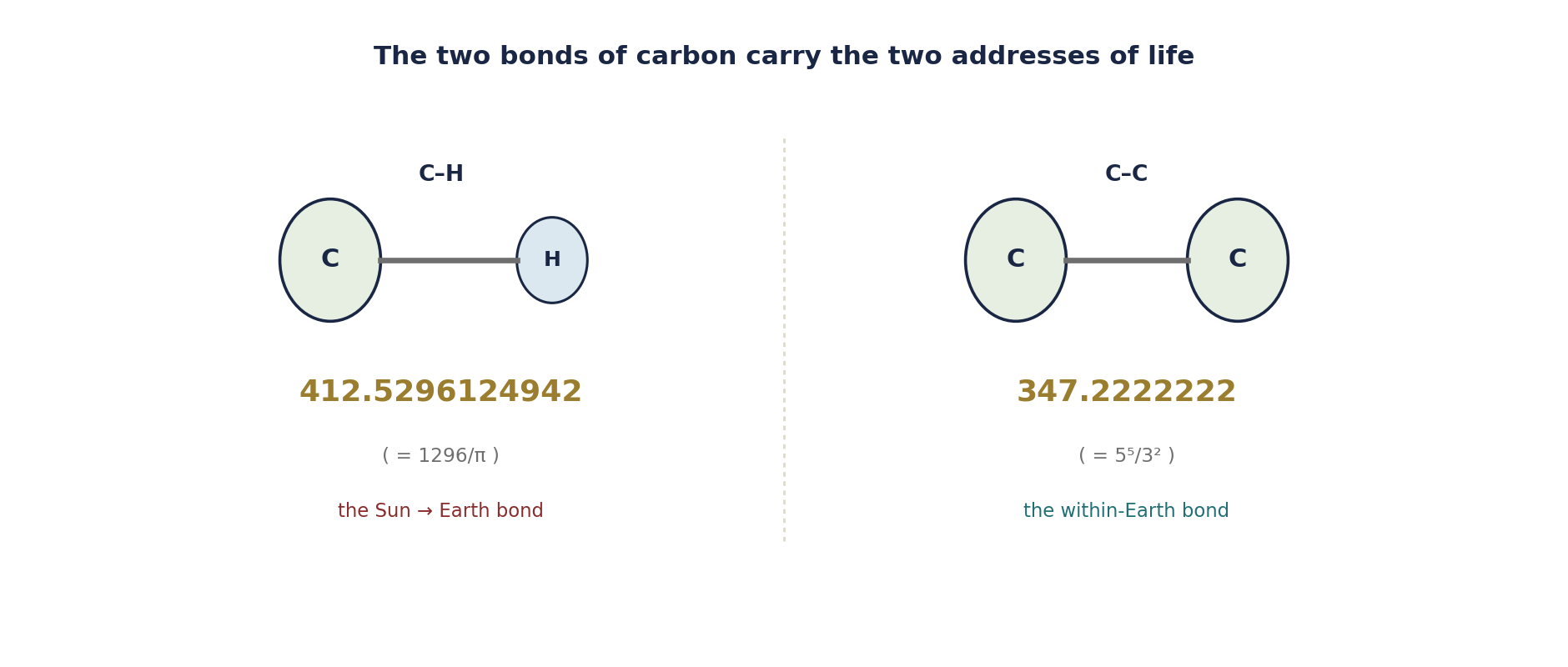
The carbon–hydrogen bond sits at 412.5296124942 ( = 1296/π ), and it is the Sun’s reach to the Earth — carbon joined to the light hydrogen that carries the solar register, the bond by which life takes in the Sun’s address. The carbon–carbon bond sits at 347.2222222 ( = 5⁵/3² ), and it is the within-Earth bond — carbon joined to carbon, building the frame within the Earth’s own node. One bond reaches up to the Sun; the other builds along the Earth. Between them they make every molecule life has ever used, and each is a definite lattice value — the addresses of life, written in the bonds of carbon.
Organic Matter as the Register of Life
When a plant grows or a plankton blooms, it assembles carbon from the air and the sea into the molecules of life, powered by sunlight. Most of that organic matter is recycled almost at once — eaten, respired, returned to the air as carbon dioxide. But a small fraction escapes, sinks, and is buried in sediment before it can be destroyed. That buried fraction, tiny though it is, has built up over the age of the Earth into the great reservoir of fossil carbon.
In the Force of Time organic matter is the register of life — the Τ-patterns that living things weave from the Sun’s address through carbon’s bonds. To bury it is to preserve a piece of the living register in the rock. The organic carbon of a shale, the coal of a seam, the oil of a reservoir — each is a store of life’s patterns, held in the Earth. The buried biosphere is a library of registers, the accumulated Τ-patterns of every age of life that has been laid down and kept.
Burial and Transformation: the Fossil Register
Buried organic matter does not stay as it was. With depth comes pressure and, above all, heat; and under that heat the soft molecules of life are cooked, step by step, into new substances. First the miscellaneous organic matter condenses into kerogen; then, as burial deepens, the kerogen cracks into liquid oil; and deeper and hotter still, the oil itself breaks down into natural gas. This sequence, driven by temperature, is the origin of all the world’s fossil fuels.
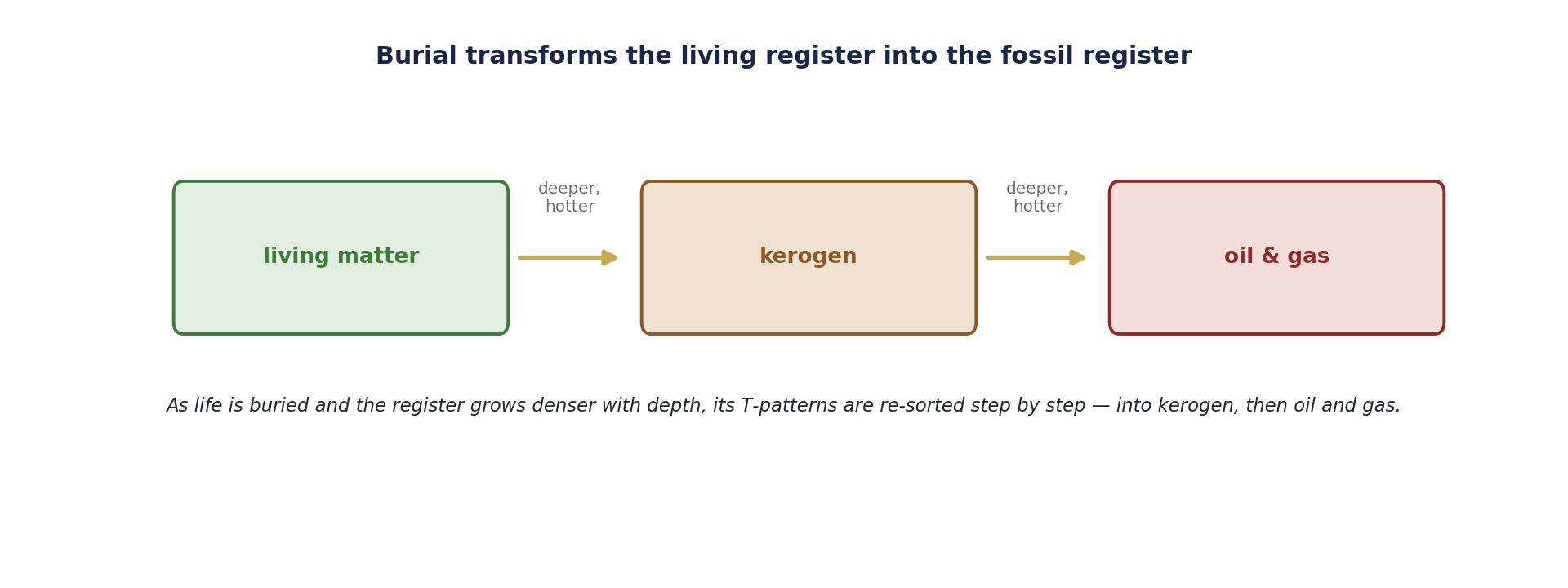
In the Force of Time this is the register re-sorting with depth — the same principle as the weathering of the last chapter, run the other way. There, rock made in the dense deep was re-sorted onto the sparse surface; here, life’s patterns made at the sparse surface are re-sorted, as they are buried, onto the nodes of the ever denser register below. Heat is Τ-density; each step deeper is a denser register, and life’s molecules relax onto its nodes in turn — tissue to kerogen to oil to gas. The fossil fuels are the fossil register: the Τ-patterns of ancient life, pressed by depth onto the deep nodes and held there until we dig them up.
Biomarkers: the Register's Signature
Some molecules survive the whole ordeal of burial with their carbon skeletons nearly intact — the biomarkers. A biomarker is a molecule whose structure points unmistakably to the kind of organism that made it: a particular plankton, a particular plant, even a particular metabolism. Found in an oil or a shale, biomarkers reveal what lived, and sometimes how it lived, hundreds of millions of years ago.
In the Force of Time a biomarker is a piece of the living register that kept its address through the whole transformation — a Τ-pattern robust enough that burial’s re-sorting did not erase it. Its surviving skeleton is a preserved lattice signature, and to read it is to read directly the register of a long-dead organism. The biomarkers are where the fossil register is most legible: not just fuel from life in general, but the recognisable address of a specific life, carried intact out of the deep.
The Carbon Cycle as Register Circulation
All of this is one arm of the great carbon cycle. Carbon moves ceaselessly between the air, the sea, living things, and the rocks: taken up by life, mostly returned quickly to the air, but a trickle buried into the fossil reservoir — and, over far longer times, returned to the surface by weathering, by volcanism, and now by our burning of the buried fuels. It is the master cycle of the surface Earth, and it governs the climate itself.
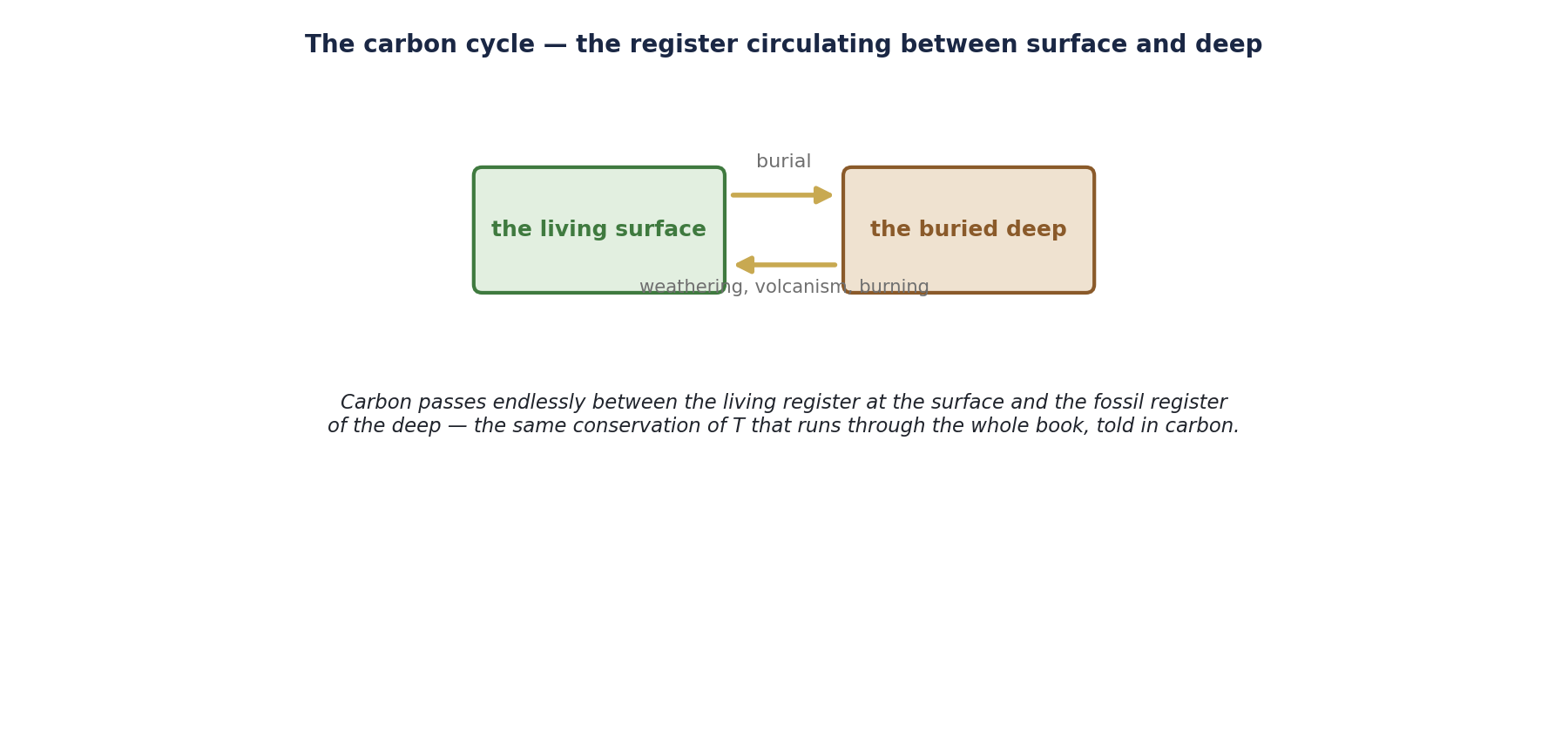
In the Force of Time the carbon cycle is the register of carbon circulating between two great stores: the living register at the surface and the fossil register of the deep. Carbon is buried, re-sorted into the fossil register, and in time returned to the surface to enter life again — nothing created, nothing destroyed, only redistributed, the conservation law dΣΤ=0 told in the one element that carries life. When we burn the fossil fuels we short-circuit the slow arm of that cycle, releasing in a century the buried registers of a hundred million years — the old addresses of ancient sunlight, returned all at once to the air.
The Sugar in the Sky: the Register of Life Arrives from Space
There is a question this chapter has circled without naming: where did life’s first molecules come from? The sugars above all — for a sugar, ribose, is the backbone of RNA and DNA, the physical spine of the living address. The trouble has always been that sugars will not form in useful amounts under the conditions of the early Earth; the laboratory yields are hopelessly thin. In the summer of 2026 the answer arrived from an unexpected quarter: the first sugar ever seen in interstellar space.
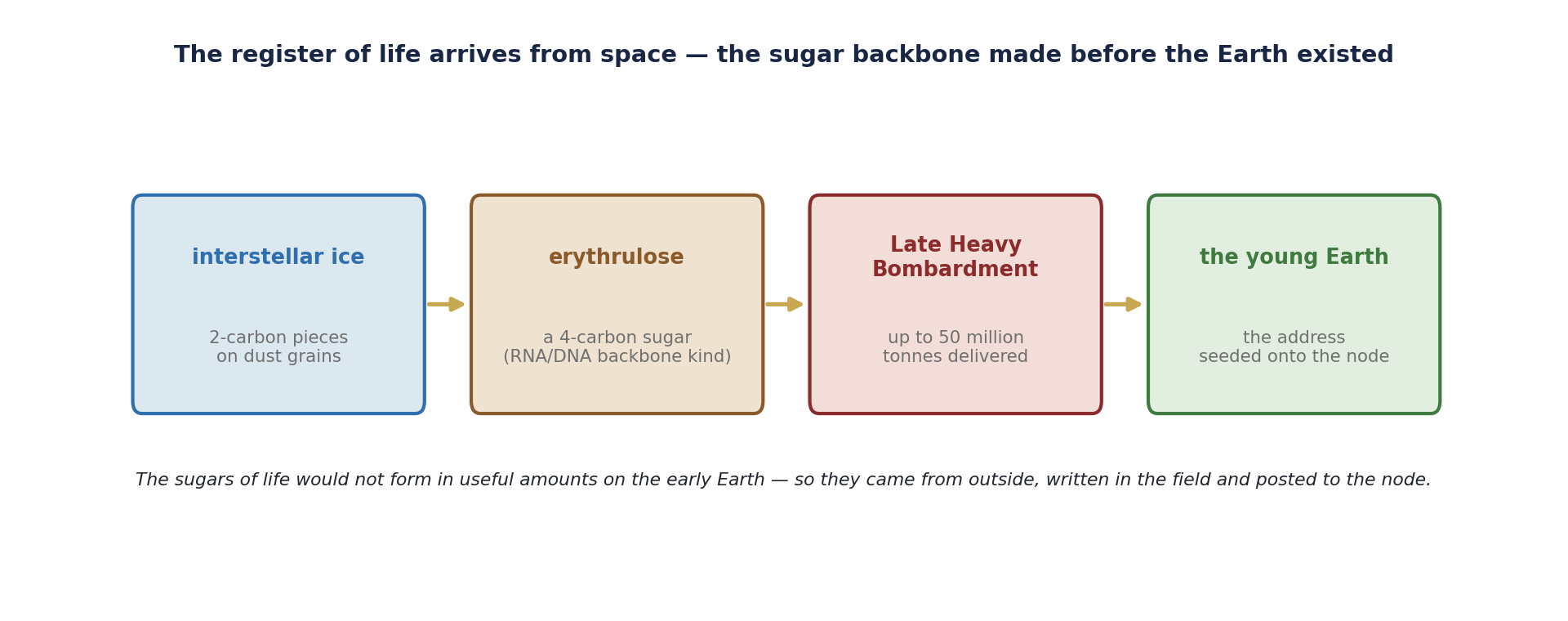
A team observing a molecular cloud near the centre of the Galaxy detected erythrulose, a four-carbon sugar, forming in the ices on interstellar dust grains from simple two-carbon pieces. From its measured abundance they estimate that up to 50 million tonnes of this one sugar could have rained onto the early Earth during the Late Heavy Bombardment, 4.1 to 3.8 billion years ago. The sugars of life, in other words, did not have to be cooked up on Earth at all — they were made in the cold of space, before the Earth existed, and delivered ready-made. This is exactly the picture of the living address: the components of the living register are written into the field at large and seeded onto the node, not improvised locally. Carbon carried its addresses — the Sun’s reach in the C–H bond, the Earth’s frame in the C–C — and wove them into a sugar in an interstellar cloud, and the cloud posted it to Earth. Life did not begin here; it arrived here, with its address already written.
Why This Should Matter to You
The coal and oil and gas that built the modern world are the buried remains of ancient life — sunlight caught by plankton and plants long before us, stored in the Earth, and released again in our engines and furnaces. Every mile you drive, every light you switch on, spends a little of that buried life. And the carbon it returns to the air is reshaping the climate of the only world we have.
In the Force of Time these fuels are the register of life pressed into the rock. Carbon carried the addresses of life — the Sun’s reach in the C–H bond, the Earth’s frame in the C–C — and wove them into the molecules of living things; buried, those Τ-patterns became the fossil register; burned, they return the Sun’s old addresses to the sky. To understand the fossil fuels as buried life, and the carbon cycle as the register circulating between the living and the dead, is to understand what we are really doing when we burn them. With the register of life read, one chapter of the Earth remains — the oceans, the great register of water in which the whole cycle closes.
The Numbers at a Glance
The quantities of organic geochemistry and their Force-of-Time reading. The physical number leads; the lattice form follows in brackets.
| Quantity | The value / what it is | The Force of Time reading |
|---|---|---|
| C–H bond | 412.5296124942 | 1296/π — the Sun’s reach to the Earth |
| C–C bond | 347.2222222 | 5⁵/3² — the within-Earth frame |
| Organic matter | buried remains of life | the register of life caught in the rock |
| Kerogen | insoluble sedimentary organic matter | life’s patterns re-sorted by shallow burial |
| Oil | liquid hydrocarbons | the next re-sort, deeper and hotter |
| Natural gas | the lightest hydrocarbons | the deepest, hottest re-sort |
| Biomarkers | molecules marking their maker | a preserved lattice signature of a life |
| Carbon cycle | carbon surface ↔ deep | the register circulating; dΣΤ=0 in carbon |
| First interstellar sugar (2026) | erythrulose in a galactic cloud | the living register formed in space, before Earth |
| Delivery to Earth | up to 50 million tonnes | the address seeded onto the node (Late Heavy Bombardment) |
References
- S. Daubney, The Universal Force of Time — Master Compendium v5, The Daubney Foundation (2026).
- W. M. White, Geochemistry, John Wiley & Sons, Chichester (2005; 2013 print ed.), Chapter 14.
- I. Jiménez-Serra et al., Detection of a four-carbon sugar in interstellar space, Nature Astronomy (2026), DOI 10.1038/s41550-026-02905-7.
- S. Daubney, The Two Bonds of Life — C–H and C–C on the Lattice, The Daubney Foundation (2026).
- S. Daubney, Organic Chemistry Through the Force of Time, The Daubney Foundation (2026).
- S. Daubney, The Force of Time — Where It Departs From Current Science, The Daubney Foundation (2026).
Open the full paper as a PDF ↗
This paper, and any information drawn from it, may be used freely provided the reference attribution to Stephen Daubney and The Daubney Foundation is recognised.