Abstract
Causation seems to involve more than succession: the cause makes the effect happen. Yet Hume famously found in experience only constant conjunction and temporal succession — never the necessary connection the 'making' seems to require. Two broad programmes have grown from this. Neo-Humeism keeps Hume's parsimony and reduces causation to patterns in the mosaic of events — a regularity theory, or Lewis's counterfactual analysis (had the cause not occurred, the effect would not have). Powerism reverses the priority: things possess real causal powers or dispositions — fragility, charge, solubility — that necessitate their manifestations, and causation is the exercise of such powers. This paper gives the Force of Time's account, which is a powerism grounded in a single conserved substance. Causation is the redistribution of Τ under the conservation law dΣΤ = 0: the necessary connection Hume could not locate among the events is not among them at all but in the substance that flows between them. A causal power is a real tendency of Τ-flow — characteristically, a tendency to flow toward denser nodes — and its manifestation is that flow occurring. Because there are no separate forces in the theory, all causation is one kind: the redistribution of the single substance, node to node, deterministically. This vindicates the powerist's productive necessity while explaining, rather than merely asserting, where it resides. We give the position as numbered propositions.
1. Hume's challenge
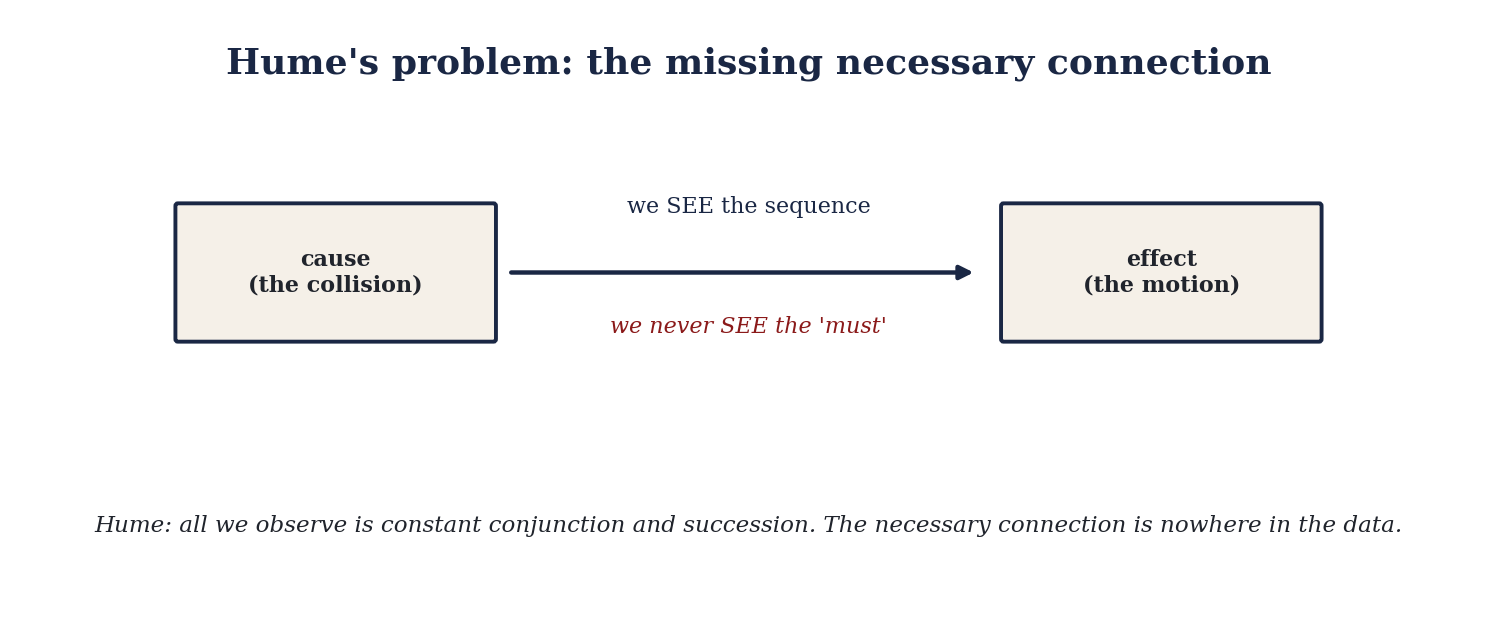
Roll one ball into another and the second moves. We say the first caused the second — that its impact brought the motion about. But what, in the situation, is this bringing-about (Fig. 1)? Hume [1] looked and found three things: the events were contiguous, the cause preceded the effect, and events of the first kind are constantly conjoined with events of the second. He did not find a fourth — a perceivable necessary connection, a visible 'must'. The idea of necessary connection, he concluded, is not read off the world but projected onto it by the mind's habit of expectation. The challenge to any theory of causation is to say what, if anything, the necessary connection is, given that it is not among the observed events.
2. Neo-Humeism and powerism
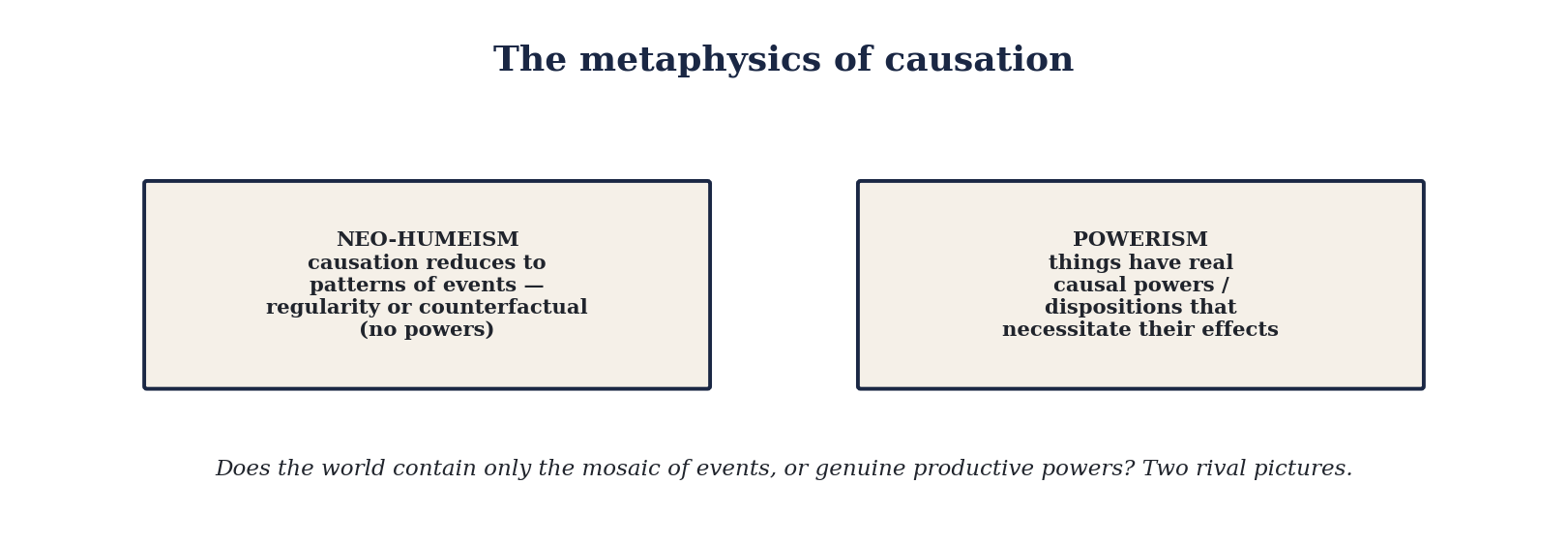
Two responses divide the field (Fig. 2) [3,6]. Neo-Humeism accepts Hume's austere ontology — a mosaic of local, intrinsically unconnected events — and analyses causation as a pattern in that mosaic: on the regularity theory, c causes e when events like c are regularly followed by events like e under a law; on Lewis's counterfactual theory, when e counterfactually depends on c. Powers are eliminated. Powerism takes the opposite view: the world contains genuine dispositions — a real power in the fragile glass to break, in the charged body to attract — and these powers necessitate their manifestations when triggered. Causation is the exercise of a power, and the necessary connection is restored to the world as the modal force of the disposition itself.
3. The Force of Time: causation as Τ-redistribution
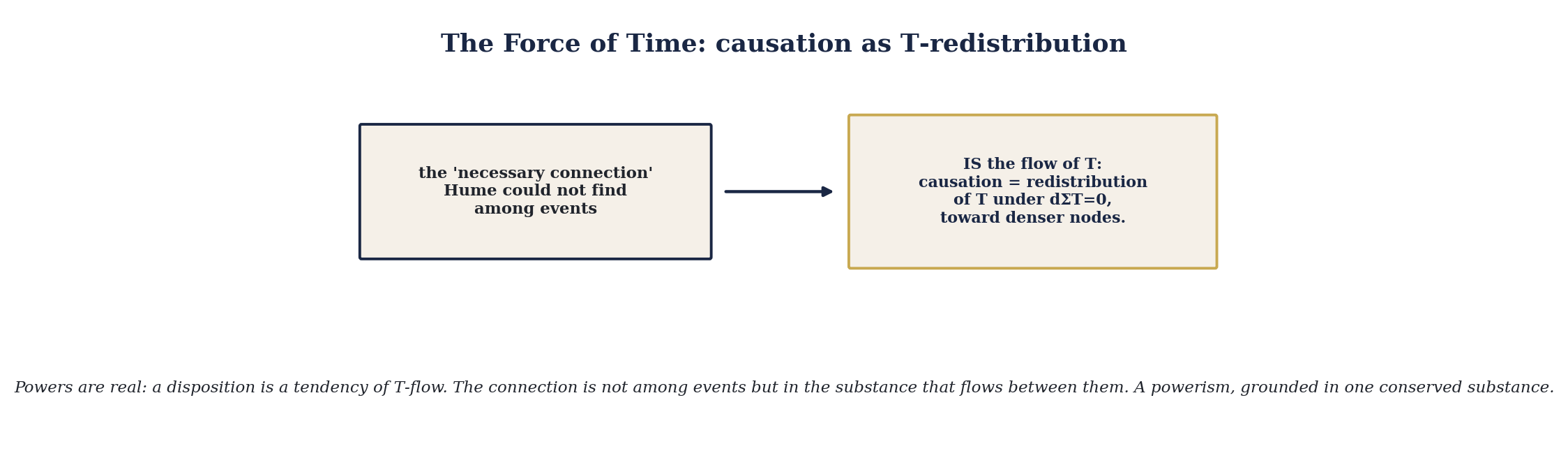
The Force of Time is a powerism, but one that says where the power lives (Fig. 3). There is one substance, Τ, conserved absolutely (dΣΤ = 0), and every change is a redistribution of it. A cause is a configuration of Τ whose structure disposes the substance to flow in a definite way; the effect is that flow having occurred; and the causal connection between them is neither a bare regularity nor a projection but the actual passage of the conserved substance from the one configuration to the other. The necessary connection Hume sought among the events was never going to be found there, because it is not a relation between events at all. It is in the substance that the events are configurations of — in the flow of Τ that carries the world from cause to effect. Hume looked in the right place for the wrong thing: the connection is not an extra visible item alongside the succession, but the continuous underlying quantity whose conservation makes the succession lawful.
4. Powers as tendencies of flow; one kind of causation
On this account a causal power is a real, intrinsic feature — a tendency of Τ-flow written into a configuration's lattice structure. Characteristically it is a tendency to flow toward denser nodes, which is the theory's reading of what other frameworks parcel out among distinct forces. Because the theory admits no separate forces — what is called gravitation, and what is called electromagnetism, are registers of the one Τ-field — there is at bottom one kind of causation: the redistribution of the single substance. The apparent variety of causal relations is a variety of configurations and registers through which the same flow runs. The powerist's insistence that dispositions are real and irreducible is vindicated; the neo-Humean's suspicion that a 'power' is an occult extra is answered, because the power is not an extra at all but a structural feature of the one substance whose conservation is independently required.
5. Laws, counterfactuals, and what this claims
The rival analyses are recovered as consequences rather than foundations. Regularities hold because the same lattice structure disposes Τ to flow the same way wherever it recurs; the laws of nature are summaries of these lattice-fixed tendencies, not free-standing edicts imposed on an inert mosaic. Counterfactual dependence holds because, the flow being deterministic, removing the cause-configuration removes the flow and so the effect; the counterfactual is true, but it is made true by the power, not constitutive of the causation. Both the Humean's regularities and Lewis's counterfactuals are thus real and derivative — footprints of Τ-flow rather than its essence. The claim of the paper is that grounding causation in the redistribution of one conserved substance secures productive necessity without an occult addition, unifies the causal relation across the apparent plurality of forces, and explains the very fact — the existence of stable regularities — that the Humean can only record.
6. Conclusion
Hume was right that the necessary connection is not among the events, and right to demand that we say what it is. The Force of Time answers: it is the flow of the one substance beneath the events, conserved as it goes. Causes do make their effects happen — by disposing Τ to move — and the making is neither a habit of the mind nor a further thing we cannot see, but the continuous passage of time-substance whose conservation is the deepest law there is. To cause is to redistribute Τ; to have a power is to be a configuration that so disposes it; and the world is a web of such redistributions, node to node, all the way down.
Figures
The position, in full
Causation is the redistribution of the one substance Τ under dΣΤ=0. The 'necessary connection' Hume sought is not among the events but in the Τ-flow that carries the world from cause to effect.
The Force of Time is a powerism: a causal power is a real, intrinsic tendency of Τ-flow, written into a configuration's lattice structure (characteristically, flow toward denser nodes).
There is one kind of causation. Admitting no separate forces (all are registers of the one field), the theory reduces the apparent plurality of causal relations to configurations and registers of a single flow.
Regularities and counterfactual dependence are derivative: regularities are recurring lattice-fixed tendencies; counterfactuals are made true by deterministic flow. Laws summarise powers, they do not impose on an inert mosaic.
Productive necessity is secured without an occult extra, because the power is a structural feature of a substance whose conservation is independently required — answering both the powerist's demand and the Humean's suspicion.
References
[1] D. Hume, An Enquiry Concerning Human Understanding (1748), §VII — the idea of necessary connection.
[2] D. Lewis, Causation, J. Philosophy 70, 556 (1973) — the counterfactual analysis.
[3] A. Bird, Nature's Metaphysics: Laws and Properties, Oxford University Press (2007) — dispositional essentialism (powerism).
[4] N. Cartwright, Nature's Capacities and their Measurement, Oxford University Press (1989) — capacities/powers.
[5] A. Ney, Metaphysics: An Introduction, Routledge (2014), ch. 8.
[6] R. C. Koons and T. H. Pickavance, Metaphysics: The Fundamentals, Wiley-Blackwell (2015), ch. 3 — the four metaphysical theories; neo-Humeism vs powerism.
[7] S. Daubney, The Universal Force of Time — Master Compendium v5, The Daubney Foundation (2026); dΣΤ=0 and Τ-flow toward denser nodes.
A Note on Standing
The account given here is one interpretation among rivals, offered as their equal and not as their correction. Nothing in the metaphysical tradition it engages — realism or nominalism, the A-theory or the B-theory, and the rest — is established fact, and neither is the Force of Time; each is a reasoned attempt to interpret a reality none of us can step outside to check. Where these papers say a problem 'does not arise' or a question 'lapses', that holds within the theory's own premises, which are no less contestable than those of the positions set beside them. The Force of Time is advanced as a coherent alternative viewpoint, to be weighed on the merits — and, unusually among these views, to be tested where it makes contact with measurement.
A Note on the Series
This is Paper 8 of Metaphysics through the Force of Time. Its powerism grounds the necessary connection in the same lattice that Paper 7 (modality) makes the seat of necessity; the determinism it entails is the premise of Paper 9 (free will).