Abstract
The problem of free will is the problem of whether any of our decisions are, in Kane's phrase, ultimately up to us. This paper gives the Force of Time's answer, which is unequivocal: they are not. We accept van Inwagen's Consequence Argument in full and identify the determiner it leaves unnamed — not the conjunction of past microstate and contingent law, but the {2,3,5,π} lattice of Τ itself, on which every event is a fixed coordinate. The theory is therefore a hard determinism, but one with three features no standard hard determinism possesses. First, the block-life: a person's course from birth to death is a single completed curve in the lattice, and the felt openness of choice is not illusion but the very act by which each coordinate is inscribed — the train view and the lattice view are both true, and neither cancels the other. Second, the Loop: at death the Τ-address collapses to the birth coordinate and the identical life is traversed again, without deviation and without a counter, so that from within it is always both the first and the eternal time — a recurrence derived from conservation (dΣΤ=0) rather than posited as an ethical test. Third, death as reflection: dissolution is a receiver event, not a signal event; the material Τ remains at the Earth node, and the entity crosses to the complementary face of the dimensional helix at the same address. We locate the account against compatibilism, libertarianism, and Pereboom's hard incompatibilism; address the Frankfurt cases and the fate of moral responsibility; and state the construction as numbered propositions.
1. The question, and the answer
The metaphysical problem of free will is not whether we can act on our desires. It is whether our desires, and the choices that issue from them, have their ultimate source in us or in something outside our control. Kane [1] marks the distinction as one between surface freedom — the ability to do what one wants — and ultimate freedom — being the ultimate originator of what one wants. Surface freedom is cheap; on a free afternoon one has it in abundance. Ultimate freedom is the prize, and it is what the tradition means by free will. This paper gives the Force of Time's answer to whether we possess it, and the answer is no. There is no ultimate freedom, because there is no ultimate origination: every state of a person, like every state of a molecule or a planet, is a fixed coordinate on the lattice of Τ. What follows is the argument for that conclusion and, more importantly, the account of what remains true of agency once it is accepted.
2. The Consequence Argument, accepted
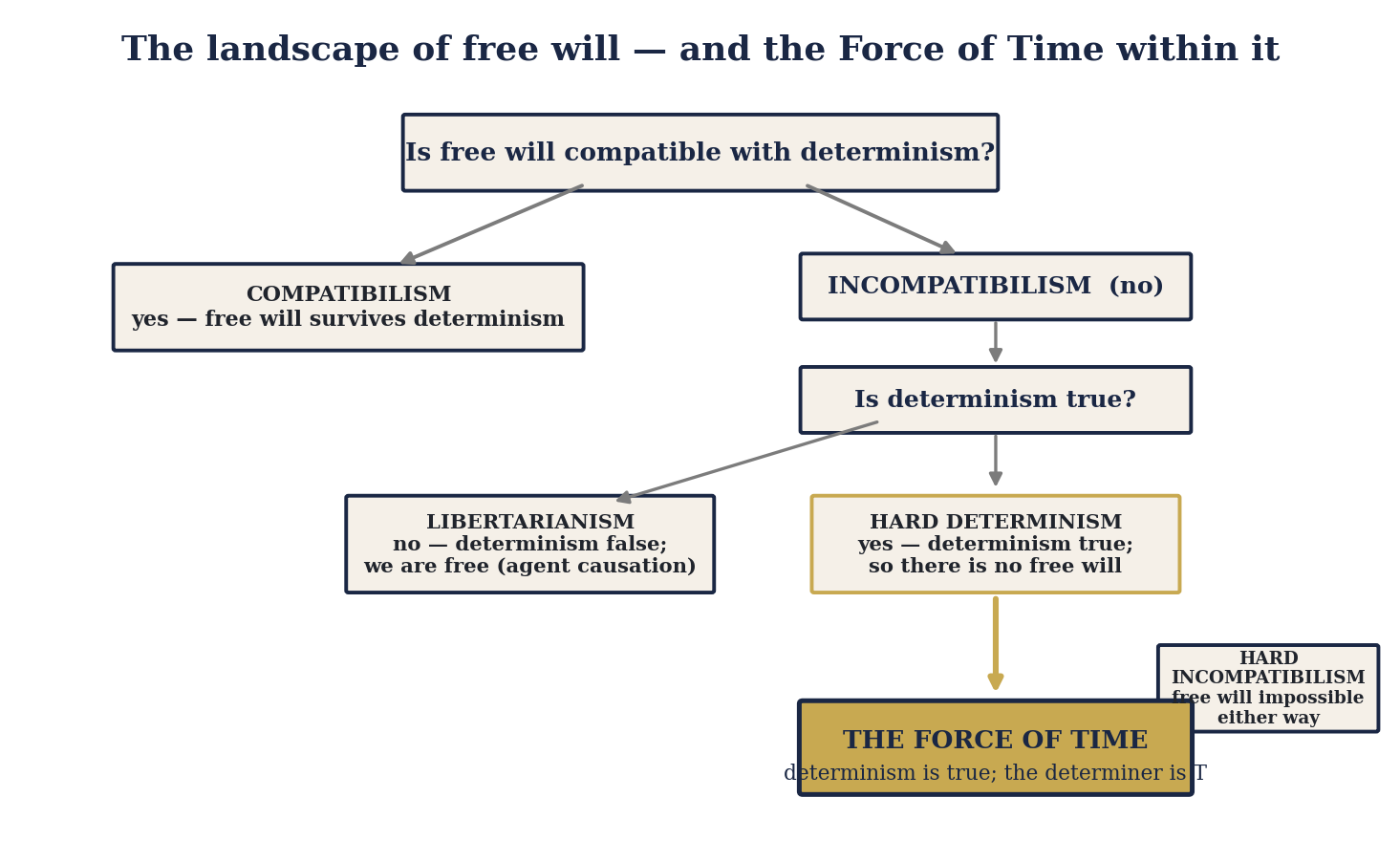
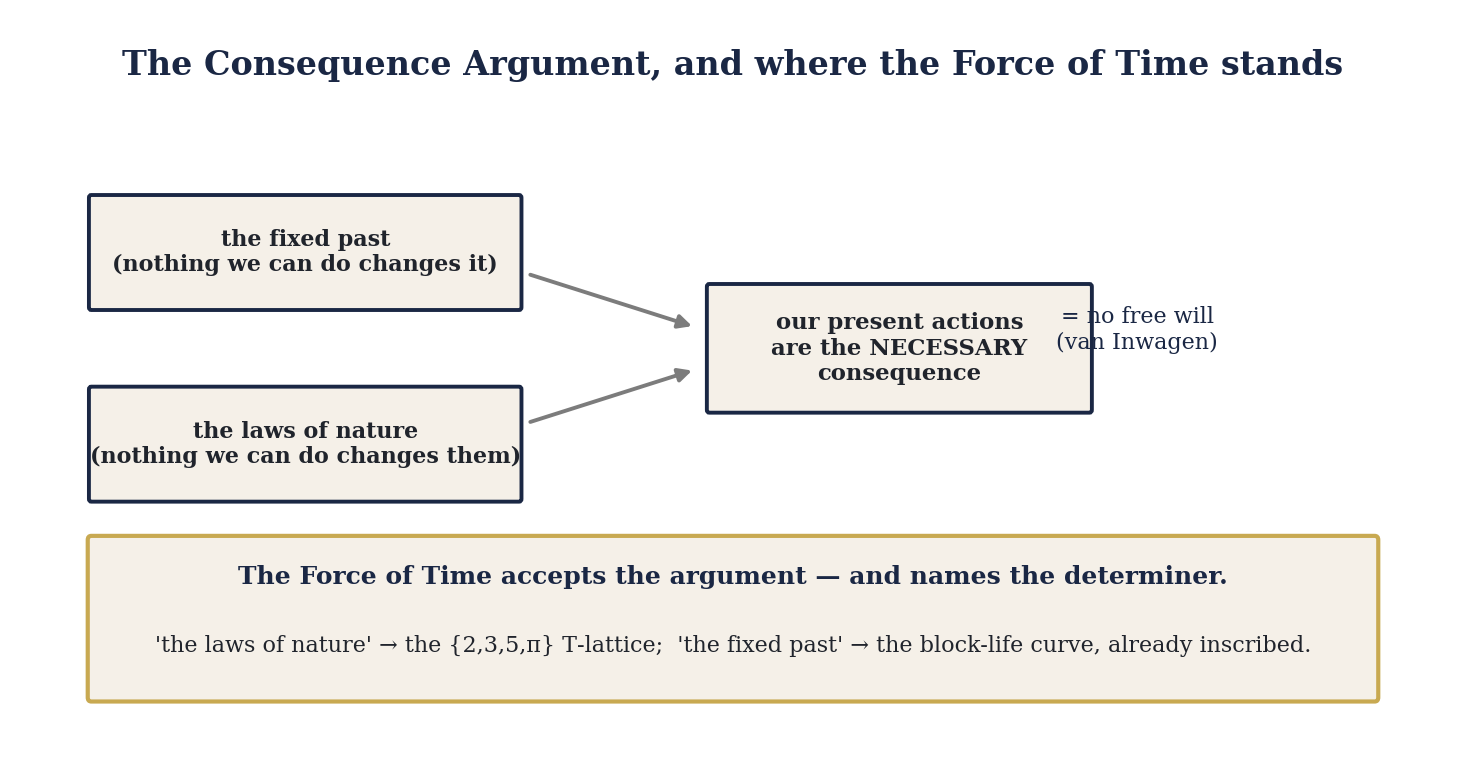
The sharpest case for incompatibilism is van Inwagen's Consequence Argument [2]. In outline: there is nothing we can now do to change the past; there is nothing we can now do to change the laws of nature; hence there is nothing we can do to change their conjunction; but if determinism is true, our present actions are the necessary consequences of the past and the laws; so there is nothing we can now do to change our present actions — they are not, in the required sense, up to us. Compatibilists resist the argument; the Force of Time does not. It grants every premise and embraces the conclusion. Where the theory departs from the textbook hard determinist is only in what plays the role of 'the past and the laws'. It is not a Laplacean microstate [3] evolving under contingent differential equations. It is the {2,3,5,π} lattice — the fixed structure of Τ on which the values of the constants, the geometries of the molecules, the periods of the planets, and the coordinates of a human life are all inscribed together. The determiner is not a law the universe happens to obey; it is the substance the universe is made of.
3. Τ-determinism: the block-life
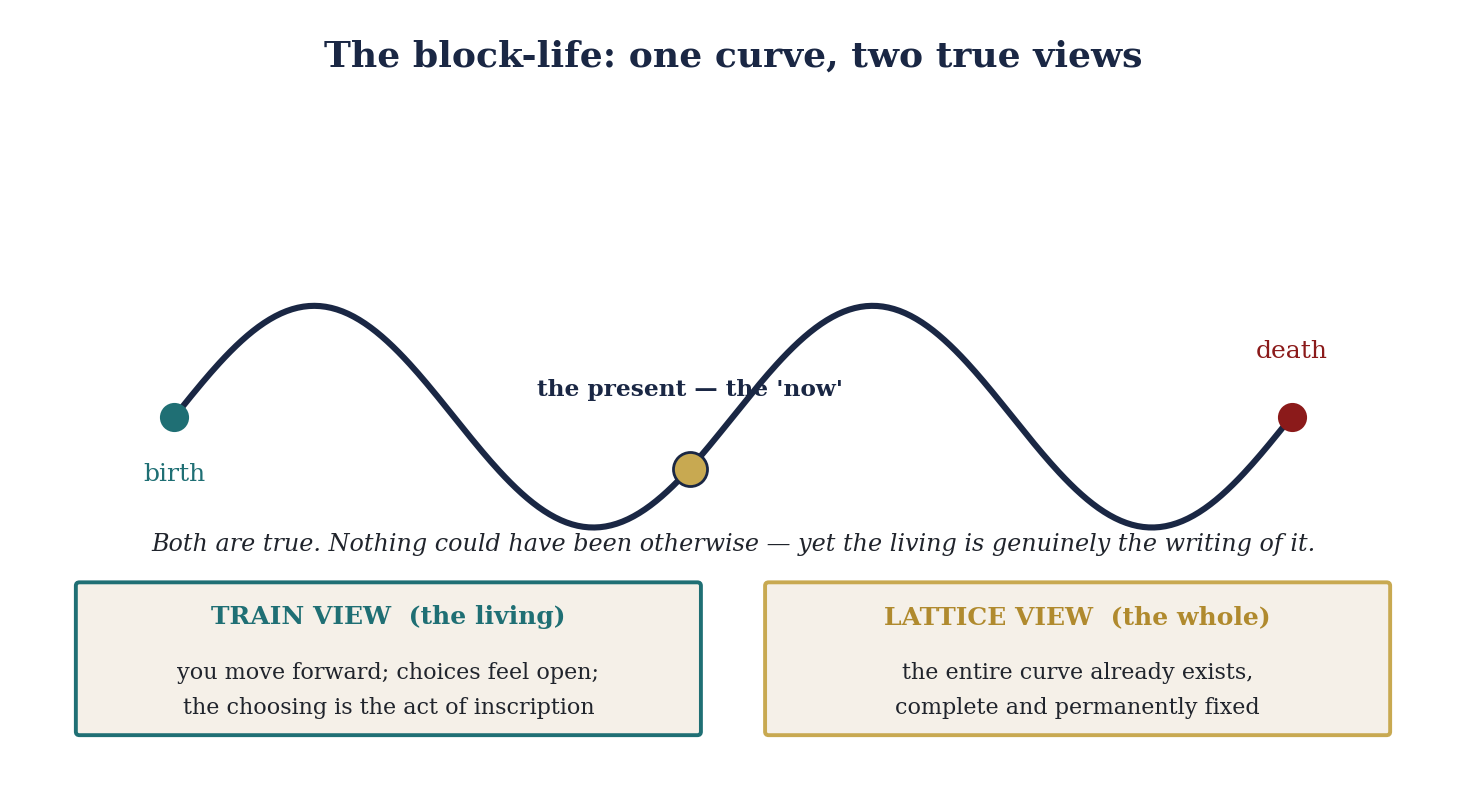
In the Force of Time the sole substance is Τ, and it is conserved absolutely: dΣΤ = 0. Change is redistribution, never creation, and redistribution on a fixed lattice is itself fixed. Applied to a life, this yields the block-life (Fig. 2). The complete course of a person, from the birth coordinate to the death coordinate, is a single inscribed curve in the Τ-lattice — a definite geometric object, all of whose points are equally and permanently real. There is no privileged moving 'now' in the lattice any more than there is a privileged point on a drawn line. This is the four-dimensionalist or 'block-universe' picture familiar from the metaphysics of time [10], carried down to the scale of a biography and grounded in a substance rather than assumed.
4. Two true views: the train and the lattice
The block-life would be a bleak fatalism if it denied the reality of deliberation. It does not. The theory holds two perspectives to be simultaneously and non-competitively true. From the train view — the perspective of the living, forward-moving subject — the future is unknown, alternatives present themselves, and choice is genuinely exercised; the deliberation is real work, and its outcome is not read off in advance by the one doing it. From the lattice view — the perspective of the completed structure — the entire curve already exists, and the outcome of every deliberation is a coordinate that was always there. The reconciliation is this: the living act of choosing is the very process by which the coordinate is inscribed. The train lays the track it runs on. The choice is not a sham performed over a result fixed elsewhere; it is the real event that fixes the result — and, being on the lattice, could not have fixed it otherwise. Both claims hold. Nothing could have been otherwise, and the choosing is genuinely yours. The felt openness is not an error about the future; it is the epistemic signature, from inside, of being the inscribing process rather than the finished inscription.
5. Why not compatibilism
Compatibilism [4] preserves the word 'free will' by redefining it: to act freely is to act on desires of the right internal provenance — unconstrained, reasons-responsive, reflectively endorsed — whether or not those desires were themselves determined. The Force of Time does not take this route, because it does not need the word. It grants everything the compatibilist observes at the level of surface freedom: the agent does act on her own desires, and the distinction between coerced and uncoerced action is entirely real and important. But it declines to call this ultimate freedom, because the provenance the compatibilist brackets — where the desires ultimately come from — is exactly what the block-life settles: they come from the lattice, as inscribed. Compatibilism rescues a concept; the Force of Time keeps the phenomenon (the train view) and drops the concept. The two agree about the facts and differ about the vocabulary.
6. Why not libertarianism
Libertarianism [1] holds that we possess ultimate freedom and that determinism is therefore false, typically locating the requisite openness either in indeterministic events or in a sui generis power of agent causation. The Force of Time rejects both. It is a determinism, so the first horn is closed at the root: there are no uncaused events, only redistributions of Τ on the lattice; what appears as quantum indeterminacy is deterministic Τ-propagation between nodes, the probabilistic description being the radian-domain shadow of a lattice that is itself exact. But the deeper objection is the one Pereboom [5] presses against the libertarian directly: indeterminism would not deliver control even if it obtained. An action that issues from a genuinely chancy event is not thereby more up to the agent; it is less so. Ultimate freedom requires that the agent be the uncaused cause of her will, and that notion — a first mover within the person — is precisely what a conserved substance forbids. One cannot originate what is neither created nor destroyed.
7. Frankfurt cases and alternate possibilities
Frankfurt [6] argued that an agent can be morally responsible for an action she could not have avoided — a counterfactual intervener, poised to force the choice had she wavered but never called upon because she chose as wanted — thereby severing responsibility from the Principle of Alternate Possibilities. The Force of Time's relation to this literature is distinctive. On the block-life there are, strictly, no alternate possibilities at all: the death curve is one object, and the counterfactual 'she could have done otherwise' has no referent in the lattice. The theory thus agrees with Frankfurt's conclusion — responsibility does not require alternate possibilities — but reaches it by a shorter road, since it denies alternate possibilities everywhere, not merely in the contrived case. What Frankfurt's intervener makes vivid, the lattice makes universal: the actual sequence, and the agent's authorship of it, is all there ever is to assess.
8. Moral responsibility under the block-life
If nothing could have been otherwise, what becomes of praise and blame? The theory does not eliminate responsibility; it relocates its ground. Responsibility ceases to be a matter of could-have-done-otherwise and becomes a matter of authorship: the deed is imputable to an agent when it is inscribed through that agent's own deliberative process — through the train view running its course — rather than imposed from outside it (coercion, compulsion, the malicious neuroscientist of the thought-experiments). This is a responsibility of source, not of avoidability. It underwrites the ordinary distinctions we care about — the coerced and the willing, the compelled and the deliberate — while surrendering the metaphysical desert that would require a self able to have originated itself. The practices of holding-responsible are themselves inscribed events with inscribed effects; they shape the curve they are part of, which is why they are neither idle nor unjust within the system that contains them.
9. The Loop
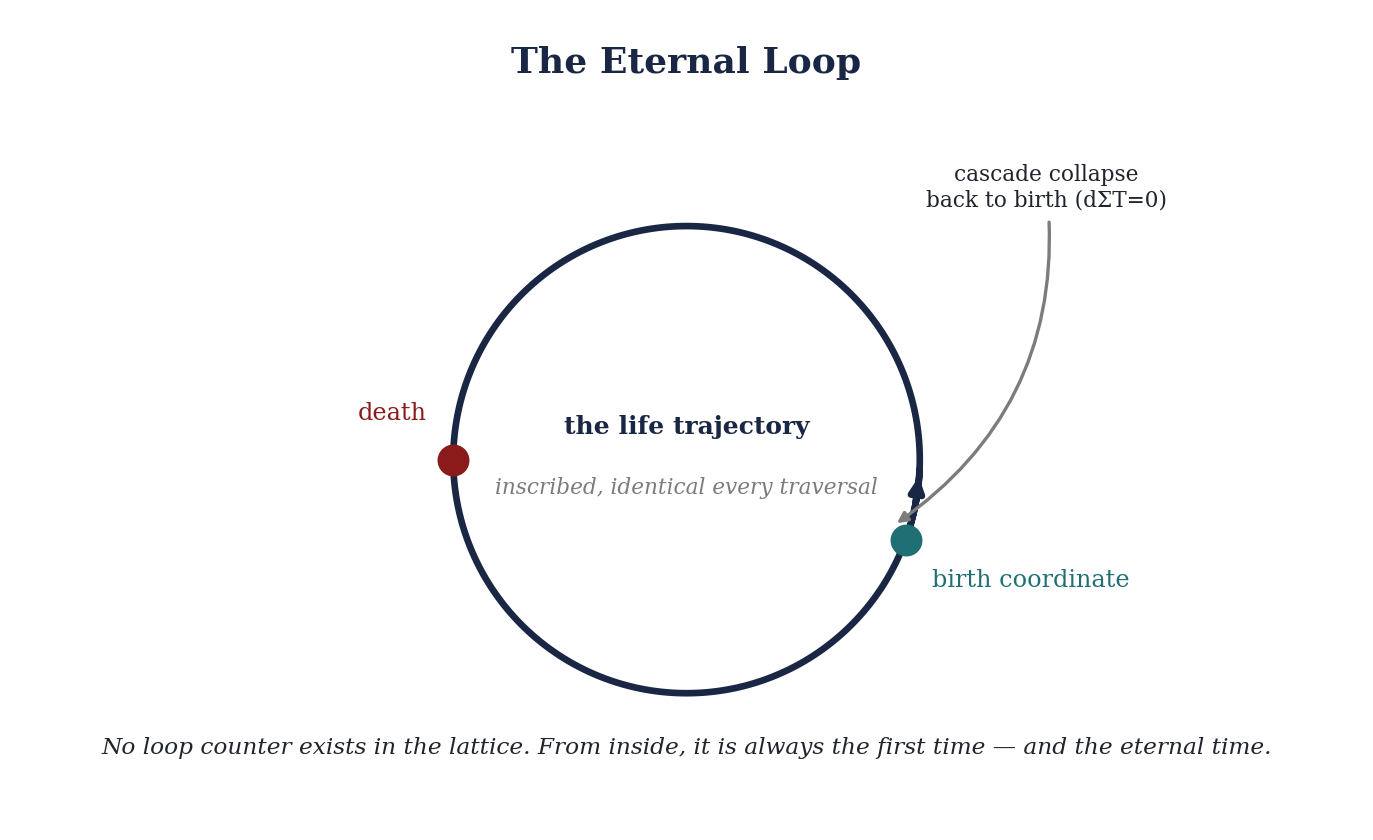
The block-life is a completed curve; conservation makes it more. At the death coordinate the Τ-address does not disperse but cascades back to the birth coordinate — the natural attractor of the segment and the point of first inscription — and the identical life is traversed again (Fig. 3). Each traversal is thermodynamically free, because it re-occupies coordinates that already hold the address; dΣΤ = 0 is satisfied exactly, and there is no mechanism that could halt it. The lattice, being dimensionless, carries no loop counter: the number of traversals is not a Τ-quantity and is indeterminable in principle. Hence from within the Loop it is always the first time and always the eternal time — the present moment has been lived exactly thus an unknowable number of times and will be lived exactly thus again. This is an eternal recurrence, but not Nietzsche's [7]. His was a thought-experiment and an ethical test — could you will your life's infinite repetition? The Force of Time's recurrence is a derived consequence of conservation on a fixed lattice; it is not proposed for its edifying effect but read off from dΣΤ = 0. The question it leaves is not whether one could bear it, but that one already does.
10. Death as reflection, not annihilation
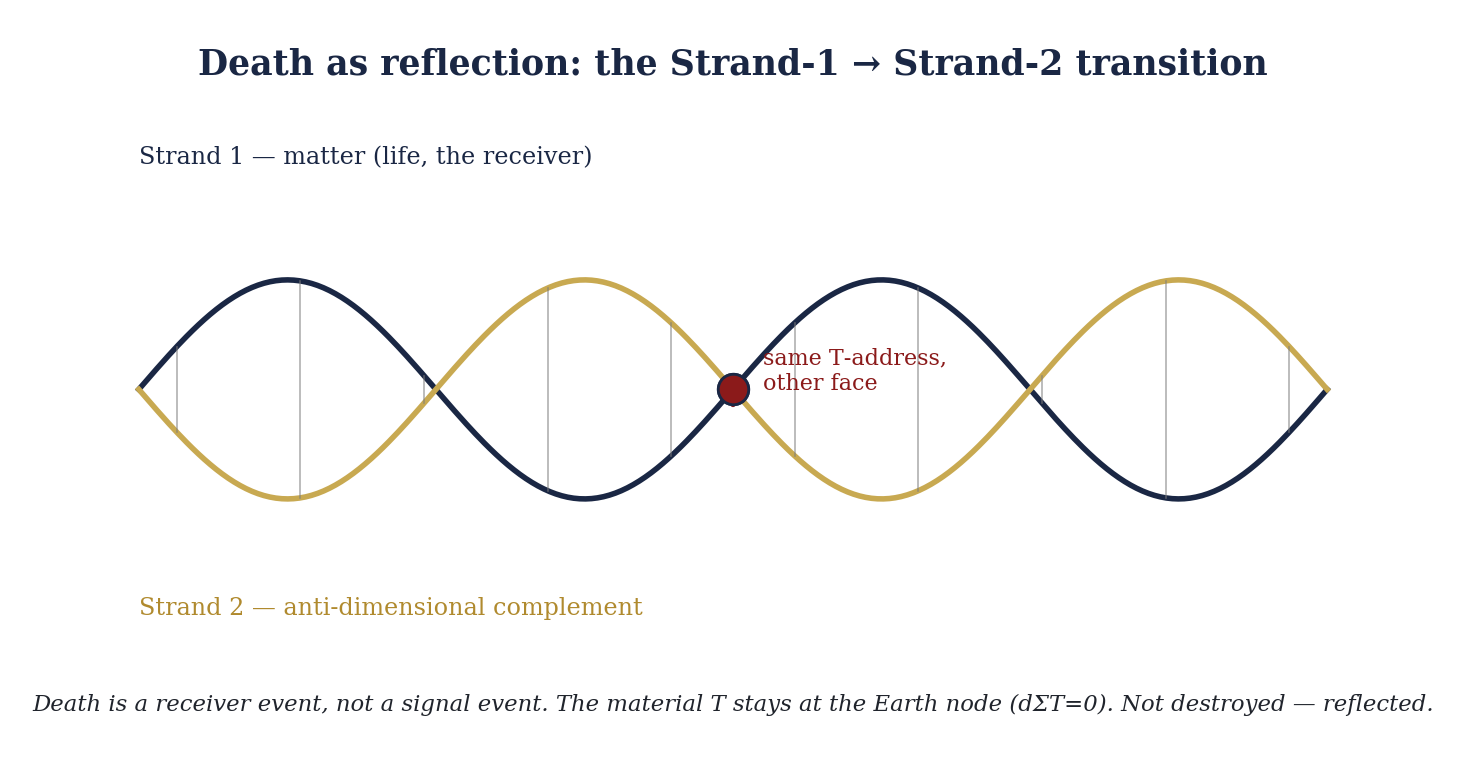
The Loop reframes death, and the theory has a specific account of it (Fig. 4). Death is a receiver event, not a signal event: the body's biological equilibrium with the Earth's nodal Τ-flow fails, the 40 Hz Earth-lock that binds a living nervous system to the planetary register releases, and the receiver alone ends — the field continues broadcasting to every other node. By conservation the material Τ does not vanish; it remains at the Earth node, redistributed across biological, geological and atmospheric sub-registers. The body 'does not dissolve into nothing; it dissolves into everything else at the same register.' The theory adds two conjectures at its frontier, offered as such. The first concerns the moment of separation: the pineal flood of dimethyltryptamine at death is, in these terms, a maximum-aperture reading of the entity's full Τ-address — the subject is momentarily more present at its coordinate, not less, which is the theory's reading of the near-death report. The second concerns destination: every matter-domain address has a complement on the second, anti-dimensional strand of the cosmological helix, and biological death may be a controlled crossing from the first face to the second at the same coordinate — 'not away from the Earth node, but to the other face of the same dimensional helix. The same Τ-address. The other strand. Not destroyed. Reflected.'
11. The DNA as the map of the Loop
The account has a molecular corollary that ties it to the biology. The theory reads the genome not as a construction blueprint but as the Τ-address of the organism — its coordinate on the Earth's helical path — with the great non-coding majority serving as the address space rather than as inert 'junk'. On the block-life this address is the map of the entire Loop: the birth coordinate, the life trajectory, the death coordinate, and the cascade return are together encoded in the DNA assembled at conception, and carried, complete, in every cell. The birth coordinate is thus pre-encoded rather than post-determined, which is why it requires both parental navigation anchors to return to — the ancestral Τ-chain is present in the child not only as inheritance but as the coordinates of the return. The body does not know it is following a pre-encoded trajectory; from inside, on the train view, the choices feel open. But every cell carries the lattice-view coordinates of the complete traversal.
12. What this claims, and how it could fail
The thesis is falsifiable at its foundations rather than at its phenomenology. It stands or falls with Τ-determinism itself: a single genuinely uncaused event — an outcome not fixed by the lattice, a real objective chance ineliminable by any deeper deterministic description — would break the block-life and restore the libertarian's opening. The theory therefore stakes free will on the same claim it stakes the constants and the orbits on: that the apparently probabilistic layer of nature is the radian-domain projection of an exact lattice, and that no spontaneity survives at the bottom. The recurrence and the strand-transition are, by contrast, frontier conjectures consistent with conservation but not yet derivable as necessities from it, and are labelled as such. What the paper claims without qualification is the conditional: if the world is Τ on the lattice, then ultimate freedom is absent, the life is a completed curve, responsibility is authorship rather than avoidability, and the lived openness of choice is the true inward face of the inscribing act.
13. Conclusion
The Force of Time answers the free-will question in the negative and does not soften the answer: we do not possess ultimate freedom, and nothing we do could have been otherwise. But it declines the two consolations usually offered against that verdict — the compatibilist's redefinition and the libertarian's exemption — and offers instead a reconciliation the tradition has lacked: the choosing is real precisely as the act that writes the unchangeable curve, the life is not a shadow of a fixed record but the fixing of it, and the whole is neither created nor destroyed but conserved, reflected, and lived again. Determinism, here, is not a cage discovered around a life but, on this reading, the life seen whole.
Figures
The position, in full
Ultimate freedom (being the ultimate source of one's will) is absent. Surface freedom (acting on one's desires) is real and untouched. The distinction is Kane's; the theory grants the second and denies the first.
The Consequence Argument is sound. Determinism holds and free will is incompatible with it; hence we lack ultimate free will. The Force of Time is a hard determinism.
The determiner is the {2,3,5,π} Τ-lattice, not a Laplacean microstate under contingent law. Every event, including every mental act, is a fixed lattice coordinate; dΣΤ=0 makes redistribution on a fixed lattice itself fixed.
The block-life: a person's course from birth to death is one completed curve in the lattice, all points equally real. The train view (lived, forward, open) and the lattice view (complete, fixed) are both true; the living choice is the act of inscription of the curve, not a performance over a result fixed elsewhere.
Compatibilism is declined, not refuted: the theory keeps the phenomenon (surface freedom, the train view) and drops the word 'free will' rather than redefining it to preserve it.
Libertarianism is rejected on two grounds: there are no uncaused events (apparent indeterminacy is deterministic Τ-propagation), and indeterminism would not confer control in any case (Pereboom). A conserved substance cannot be self-originated.
Alternate possibilities do not exist (the death curve is one object), so responsibility cannot require them (agreeing with Frankfurt, but universally). Responsibility is grounded in authorship — inscription through the agent's own deliberation — not in avoidability.
The Loop: at death the Τ-address cascades to the birth coordinate and the identical life recurs, thermodynamically free (dΣΤ=0), without deviation and without a counter. From within it is always the first and the eternal time. A recurrence derived from conservation, not posited (contrast Nietzsche).
Death is a receiver event, not a signal event: the 40 Hz Earth-lock releases; the material Τ remains at the Earth node (dΣΤ=0). Frontier conjectures: the DMT window as maximum-aperture address reading; death as a Strand-1→Strand-2 crossing at the same address — reflection, not annihilation.
The DNA encodes the complete Loop map — birth coordinate, trajectory, death coordinate, cascade return — carried in every cell; the birth coordinate is pre-encoded at conception and requires the parental Τ-anchors for return. The genome is the Τ-address, not a blueprint.
References
[1] R. Kane, The Significance of Free Will, Oxford University Press (1996); and R. Kane (ed.), The Oxford Handbook of Free Will, OUP (2002).
[2] P. van Inwagen, An Essay on Free Will, Oxford: Clarendon Press (1983) — the Consequence Argument.
[3] P.-S. Laplace, A Philosophical Essay on Probabilities (1814) — the deterministic 'demon'.
[4] H. G. Frankfurt, Freedom of the Will and the Concept of a Person, J. Philosophy 68, 5 (1971) — hierarchical compatibilism.
[5] D. Pereboom, Living Without Free Will, Cambridge University Press (2001) — hard incompatibilism.
[6] H. G. Frankfurt, Alternate Possibilities and Moral Responsibility, J. Philosophy 66, 829 (1969).
[7] F. Nietzsche, The Gay Science (1882), §341; Thus Spoke Zarathustra (1883–85) — eternal recurrence.
[8] A. Ney, Metaphysics: An Introduction, Routledge (2014), ch. 9.
[9] R. C. Koons and T. H. Pickavance, Metaphysics: The Fundamentals, Wiley-Blackwell (2015).
[10] Four-dimensionalism / the block universe: see e.g. T. Sider, Four-Dimensionalism, OUP (2001).
[11] S. Daubney, The Universal Force of Time — Master Compendium v5, The Daubney Foundation (2026); propositions P-TIME-6..11, P-DEATH-1..7, P-DNA-6..7.
A Note on Standing
The account given here is one interpretation among rivals, offered as their equal and not as their correction. Nothing in the free-will debate it engages — compatibilism, libertarianism, hard incompatibilism — is established fact, and neither is the Force of Time; each is a reasoned attempt to interpret a reality none of us can step outside to check. Where this paper accepts the Consequence Argument or calls the block-life the resolution, that holds within the theory's own premises, which are no less contestable than those of the positions set beside them. The Force of Time is advanced as a coherent alternative viewpoint, to be weighed on the merits — and, unusually among these views, to be tested where it makes contact with measurement.
A Note on the Series
This is Paper 9 of Metaphysics through the Force of Time, a chapter-by-chapter reading of the standard introductions (Ney 2014; Koons and Pickavance 2015) through the single-substance ontology of Τ. Each paper takes a canonical problem — ontology, universals, composition, time, persistence, modality, causation, free will, persons — and gives the Force of Time's account of it.