Abstract
Modal claims — that something is necessary, possible, or contingent — are indispensable and puzzling. The dominant framework analyses them by possible worlds: necessarily p if p holds in all worlds, possibly p if in some. But the worlds themselves demand an account. Lewis's modal realism (concretism) takes them to be concrete, as real as the actual world and merely spatiotemporally isolated from it; abstractionism (ersatzism) takes them to be abstract representations — maximal consistent descriptions. A parallel dispute concerns individuals across worlds: transworld identity holds that the very same person could inhabit many worlds, while Lewis's counterpart theory replaces cross-world identity with resemblance. This paper gives the Force of Time's modal metaphysics, which is a strong actualism and a necessitarianism about nature. There is one substance and one lattice; the actual, inscribed world is the only world there is. Necessity is not truth in all worlds but membership of the {2,3,5,π} lattice: the fine-structure ratio could not have been other than 9/125π², not because it holds in every world but because a value off the lattice is not a value the substance can take — it is impossible, not merely unactual. 'Other possible worlds' are representational devices, useful for reasoning, grounded in facts about the one lattice; they are not further concrete realities. Contingency, where it is genuine, is the train-view appearance of what has not yet been inscribed. Transworld identity and counterpart theory alike lapse, there being one world; de re modal claims about an individual are claims about its lattice-fixed profile. We give the position as numbered propositions.
1. The modal, and possible worlds
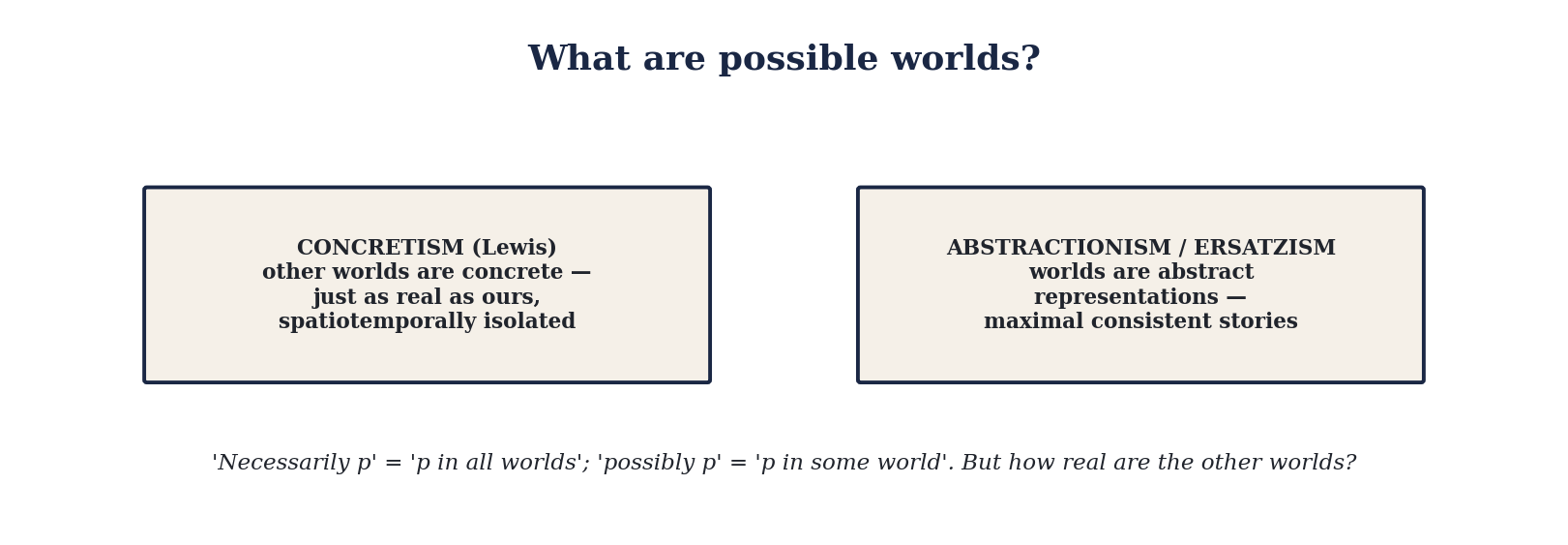
Some truths could not have been otherwise (2+2=4; that a thing is self-identical); others could (that this page is white); and we reason constantly about what must, might, and might not be. The possible-worlds framework regiments this reasoning: a proposition is necessary if true at every possible world, possible if true at some, contingent if true at some and false at others (Fig. 1) [4,6]. The framework is powerful, but its utility does not settle its metaphysics — what the worlds are, and whether quantifying over them commits us to their reality.
2. Concretism and abstractionism
Lewis [4] took the worlds at face value: they are concrete, spatiotemporally and causally isolated universes, each as real as ours, and 'actual' is merely indexical — true of whichever world one speaks from. This modal realism yields an elegant reduction of modality to non-modal facts about a plurality of concrete objects, at the cost of an ontology many find incredible. Abstractionists keep the framework but deflate the worlds: a possible world is an abstract object — a maximal consistent set of propositions, or a maximal property the cosmos could have had — and only the actual world is concrete. This is ontologically modest but must take some modal notion (consistency, possibility) as primitive, so the reduction is incomplete.
3. Individuals across worlds
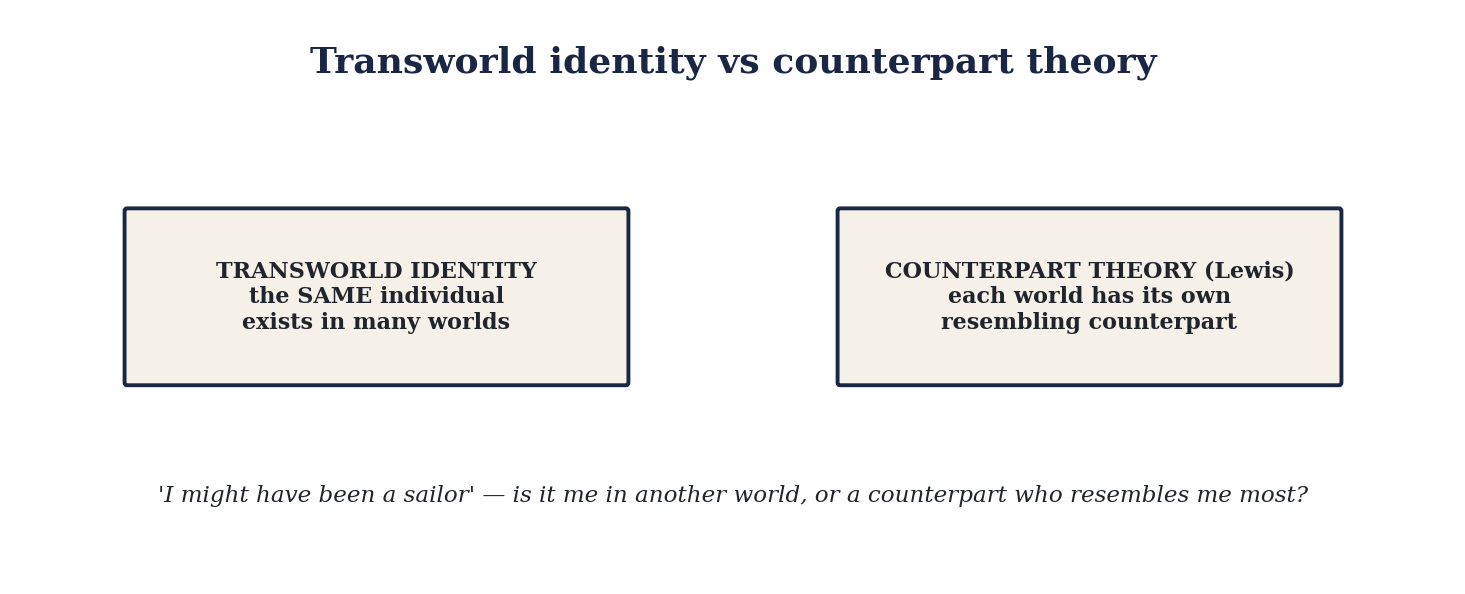
Modality de re — about a thing, that it could have been otherwise — raises the question of identity across worlds (Fig. 2). On transworld identity, the very same individual exists in many worlds and has different properties in them; 'I might have been a sailor' says that I, the very same person, am a sailor in some world. Lewis replaces this with counterpart theory: I exist in this world alone, and the truth of the modal claim is that some other-worldly individual who resembles me closely enough — my counterpart — is a sailor. Counterpart theory avoids the difficulties of one thing wholly present in many isolated universes, at the price of making my possibilities really about someone else.
4. The Force of Time: one world, one lattice
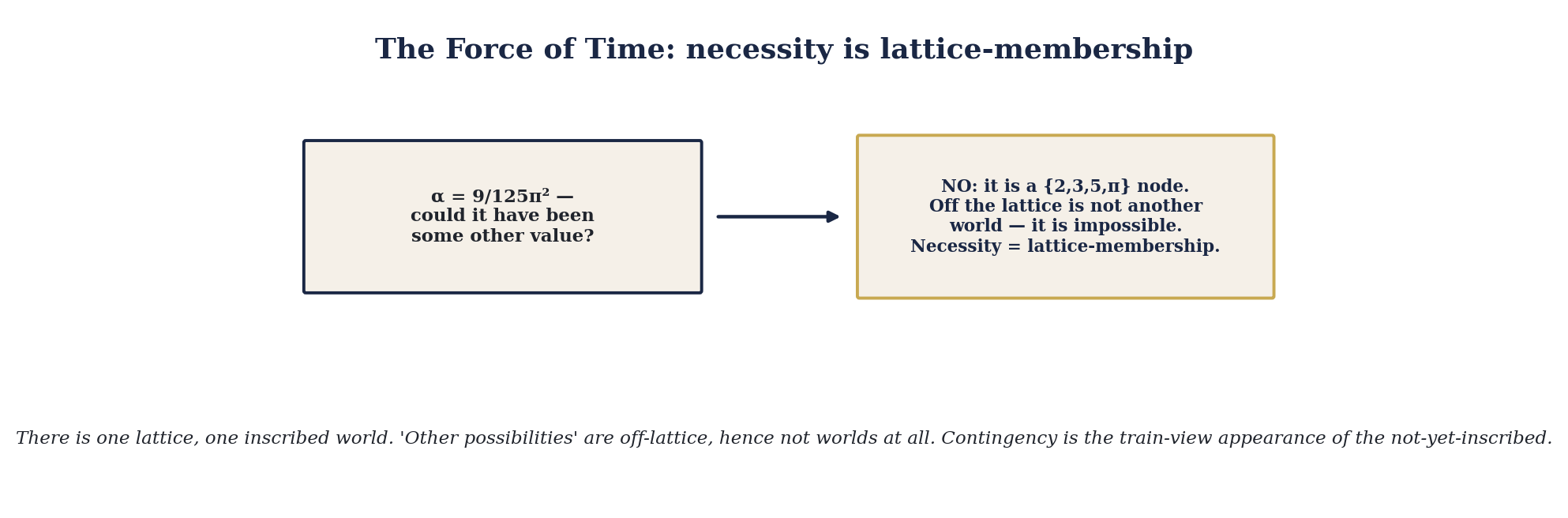
The Force of Time is an actualism of the most uncompromising kind (Fig. 3). There is one substance, structured on one lattice, and the inscribed world is the only world. It does not populate reality with concrete alternatives (against Lewis), and it does not need a plurality even of abstract worlds to ground the modal facts, because it locates those facts in the structure of the single actual substance. The possible-worlds idiom is retained as a device for reasoning — a way of book-keeping consistency — but it is a representation, not an inventory. When a claim is regimented into talk of worlds, the truthmaker of that talk is always some fact about the one lattice, never a further concrete cosmos.
5. Necessity as lattice-membership
The theory's positive account of necessity is its most distinctive modal thesis. To be necessary is to be a structure the lattice fixes; to be impossible is to lie off the lattice; to be contingent is neither. The fine-structure ratio is 9/125π² of necessity — not because it takes that value in every world, but because a substance built on {2,3,5,π} cannot take a value that is not a {2,3,5,π} node. An off-lattice 'value' is not the way things are in some other world; it is no way things could be at all. This is a necessitarianism about the fundamental features of nature: the constants and geometries are not cosmic accidents that might have differed but structural necessities of the one substance. It also gives impossibility a substantive meaning — the off-lattice is not merely unrealised but excluded — where the possible-worlds framework can only say, unhelpfully, that the impossible holds at no world.
6. Contingency, de re modality, and what this claims
Where, then, is genuine contingency? In the theory's own terms, in the train view. From within the inscribing process the future is open and alternatives are entertained; this is the seat of the modal language of the might-be. From the lattice view the curve is complete and the outcome fixed. Contingency is thus real as a feature of the inscribing perspective and absent as a feature of the completed structure — the same two-aspect treatment the theory gives to passage and to freedom. Modality de re is handled without transworld identity or counterparts: a de re claim about an individual is a claim about its lattice-fixed profile — what the Τ-address it occupies does and does not permit — not about a numerically identical or a merely resembling individual elsewhere. The claim of the paper is that a single actual lattice grounds the whole modal apparatus: necessity as membership, impossibility as exclusion, and the residual contingency of the train view — with no plurality of worlds, concrete or abstract, required.
7. Conclusion
Modality has driven metaphysicians to posit either a plurality of concrete universes or a realm of abstract surrogates. The Force of Time needs neither. There is one substance and one lattice; what must be so is what the lattice fixes, what cannot be is what the lattice excludes, and the possible-worlds talk that has served so well is a map of that single structure, not a census of others. The constants of nature could not have been otherwise — and that necessity, on the Force of Time's reading, is not a shadow cast by all the worlds but the shape of the only one.
Figures
The position, in full
There is one substance and one lattice; the inscribed world is the only world. The Force of Time is a strong actualism — no plurality of worlds, concrete (Lewis) or abstract (ersatz).
Necessity is lattice-membership; impossibility is lying off the lattice; contingency is neither. The fundamental constants are structural necessities of the substance, not cosmic accidents (necessitarianism about nature).
Impossibility is substantive: the off-lattice is excluded, not merely unrealised — an improvement on 'true at no world'.
The possible-worlds idiom is a representational device for consistency-reasoning; its truthmakers are always facts about the one lattice, never further cosmoi.
De re modality is grounded in an individual's lattice-fixed profile — what its Τ-address permits — with neither transworld identity nor counterpart theory. Genuine contingency survives only as the train-view openness of the not-yet-inscribed.
References
[1] S. Kripke, Naming and Necessity, Harvard University Press (1980) — necessity, rigid designation, de re modality.
[2] A. Plantinga, The Nature of Necessity, Oxford University Press (1974) — worlds as abstract states of affairs.
[3] R. Stalnaker, Ways a World Might Be, Oxford University Press (2003) — moderate (abstractionist) realism.
[4] D. Lewis, On the Plurality of Worlds, Blackwell (1986) — modal realism and counterpart theory.
[5] A. Ney, Metaphysics: An Introduction, Routledge (2014), ch. 7.
[6] R. C. Koons and T. H. Pickavance, Metaphysics: The Fundamentals, Wiley-Blackwell (2015), ch. 7.
[7] S. Daubney, The Universal Force of Time — Master Compendium v5, The Daubney Foundation (2026); the {2,3,5,π} lattice and the fine-structure ratio 9/125π².
A Note on Standing
The account given here is one interpretation among rivals, offered as their equal and not as their correction. Nothing in the metaphysical tradition it engages — realism or nominalism, the A-theory or the B-theory, and the rest — is established fact, and neither is the Force of Time; each is a reasoned attempt to interpret a reality none of us can step outside to check. Where these papers say a problem 'does not arise' or a question 'lapses', that holds within the theory's own premises, which are no less contestable than those of the positions set beside them. The Force of Time is advanced as a coherent alternative viewpoint, to be weighed on the merits — and, unusually among these views, to be tested where it makes contact with measurement.
A Note on the Series
This is Paper 7 of Metaphysics through the Force of Time. Its necessitarianism about the constants draws on the lattice ontology of Papers 1–3; its treatment of contingency uses the train/lattice distinction of Papers 5 and 9. Paper 8 (causation) grounds the necessary connection in the same lattice.