Abstract
Ordinary material objects generate three hard problems. The paradoxes of constitution ask how a statue and the clay that constitutes it can be one object, given that they have different persistence conditions (the clay survives squashing, the statue does not), yet two objects cannot share all their matter and place. The problem of particulars asks what, beneath its properties, a thing is: the bundle theory says nothing but its co-located properties, the substratum theory a bare, propertyless bearer — and each option is uncomfortable. The Special Composition Question asks when some things compose a further thing: never (mereological nihilism), always (universalism), or under special conditions (van Inwagen's restriction to lives). This paper gives the Force of Time's treatment, which dissolves rather than answers the composition question and reframes the other two. Because there is one substance, and — on the one-seed reading — one pattern re-instanced at every address, there is no genuine plurality of parts waiting to be combined into a whole; a nucleus is one wound configuration of Τ, not a heap of bound simples. The composition question, which presupposes the plurality, lapses. Constitution paradoxes dissolve because the identity of a thing is its Τ-address and configuration, not its matter; and a particular is neither a bare peg nor a free bundle but a determinate mode of the one substance. We give the position as numbered propositions.
1. Three problems of material objects
That there are tables and statues is not in dispute; what they are, metaphysically, is. Three problems press. First, constitution: the relation between a thing and the matter that makes it up. Second, the nature of a particular: what underlies its properties. Third, composition: when, if ever, a plurality of things adds up to one further thing. The Force of Time has a unified source of answers to all three — the single substance and its one-seed structure — but the problems are best met one at a time [4,7].
2. The paradoxes of constitution
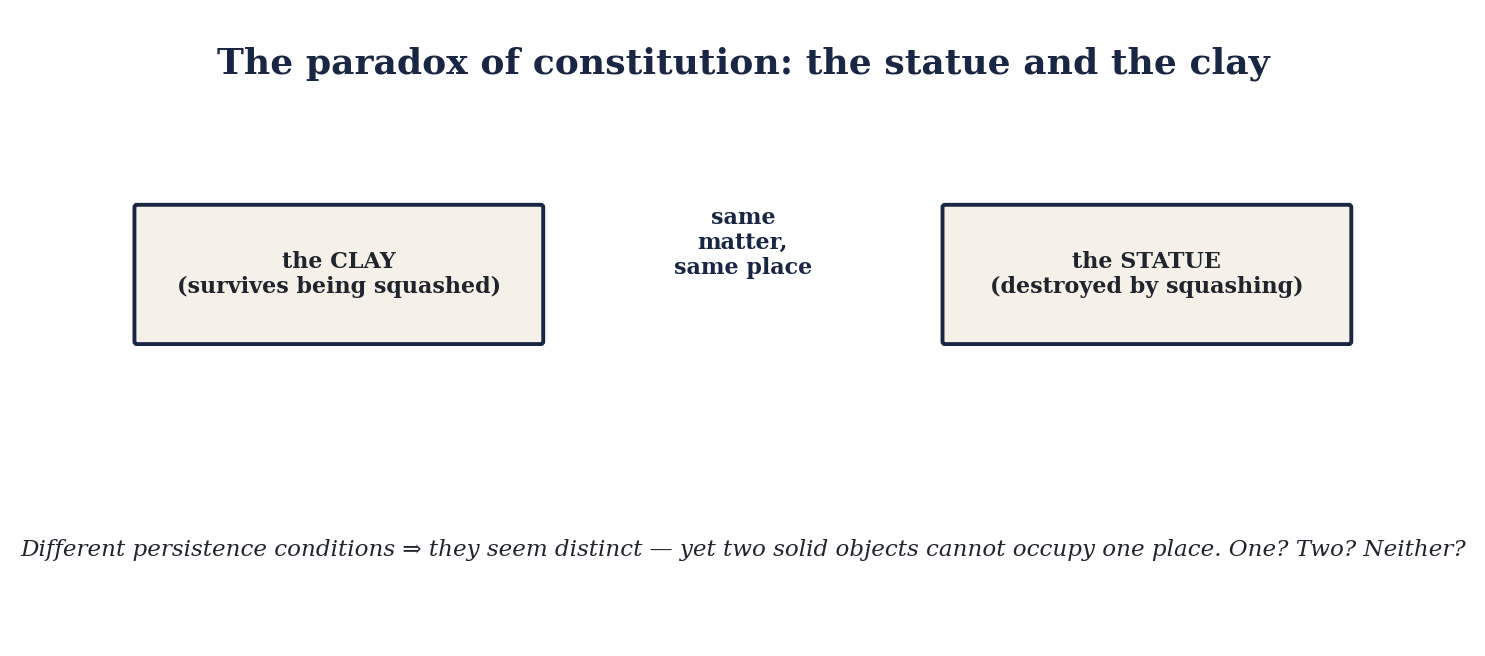
A clay statue and the lump of clay share, at a moment, all their matter and location (Fig. 1). Yet they seem to differ: squash the lump and the statue is destroyed while the clay persists, so they have different modal and temporal properties, and by Leibniz's Law things that differ in properties are distinct. But if they are distinct, two material objects coincide exactly — an uncomfortable multiplication. The standard options each pay: the constitution theorist accepts coincident objects; the identity theorist denies the modal difference; the eliminativist denies one of the objects. The Force of Time takes the identity of a material object to be fixed not by its matter but by its Τ-address and configuration — the pattern, not the stuff. The statue-configuration and the clay-configuration are two descriptions under which the one Τ at that region falls; the 'coincidence' is the trivial fact that one region of substance answers to more than one pattern-description, exactly as one wave answers to both 'crest' and 'disturbance of the medium'. No two solid things are stacked; there is one substance, doubly described.
3. Particulars: neither bundle nor bare substratum
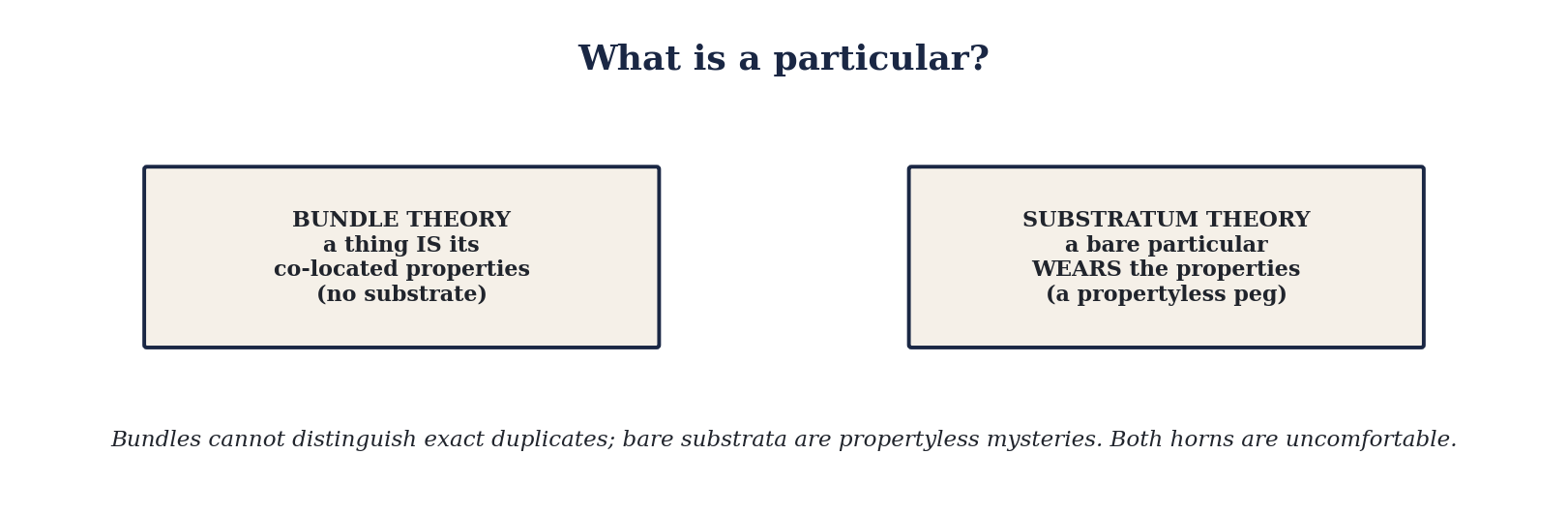
What is a particular beneath its properties (Fig. 2)? The bundle theory answers: nothing — a thing just is its co-located properties. But then two exactly similar things would be identical (the Identity of Indiscernibles), which seems false. The substratum theory answers: a bare particular, a propertyless bearer that individuates — but a propertyless something is obscure, and arguably incoherent. The Force of Time, as the ontology paper set out, takes a particular to be a Τ-address together with the configuration Τ takes there. The address individuates — two exact duplicates are two because they are Τ at two addresses — so the theory secures what the bundle theory cannot, without a propertyless peg: the address is not a bare substrate but a position in the lattice, and the substance at it is not propertyless but structured. The dilemma is escaped between its horns.
4. The Special Composition Question
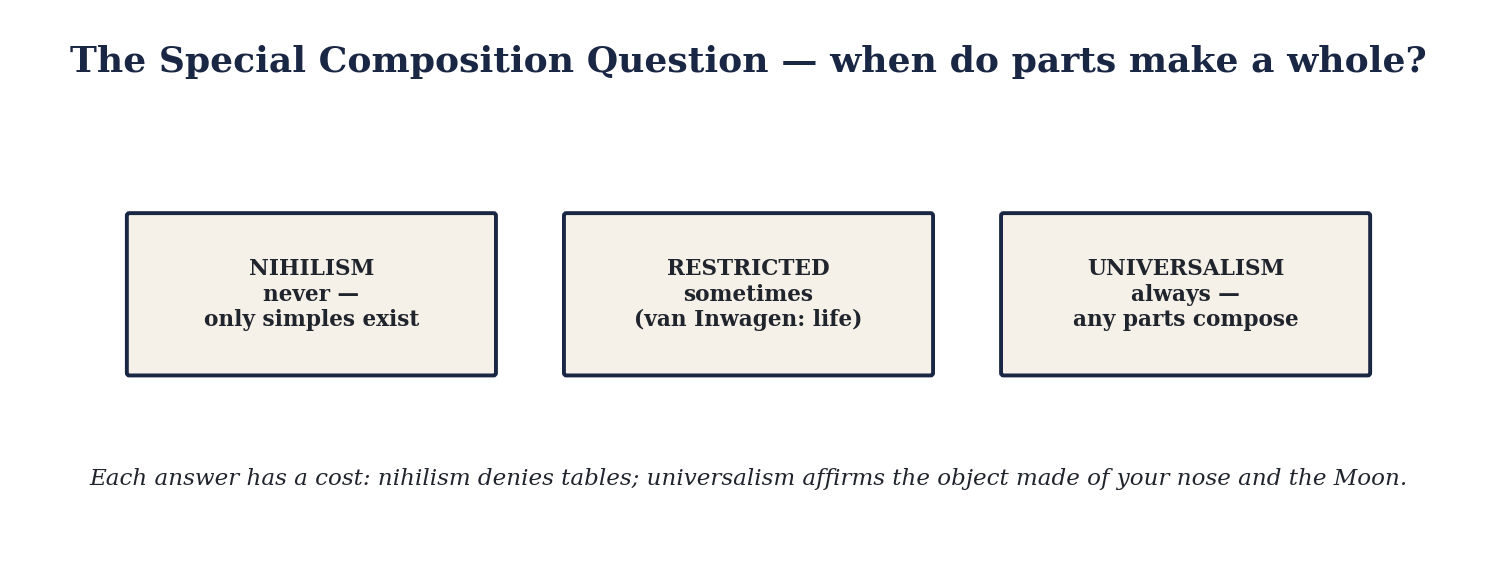
Van Inwagen's question is: for what pluralities of objects is there a further object they compose (Fig. 3)? [4] Every general answer offends somewhere. Nihilism — never; only mereological simples exist — denies that there are tables and statues at all, retaining only 'simples arranged tablewise'. Universalism — always; any objects whatever compose a further object — affirms a gerrymandered thing made of one's nose and the far side of the Moon. Van Inwagen's own restriction — composition occurs just when the activities of the parts constitute a life — saves organisms but still denies tables. The question has seemed forced and its answers all bad.
5. The Force of Time: the question lapses
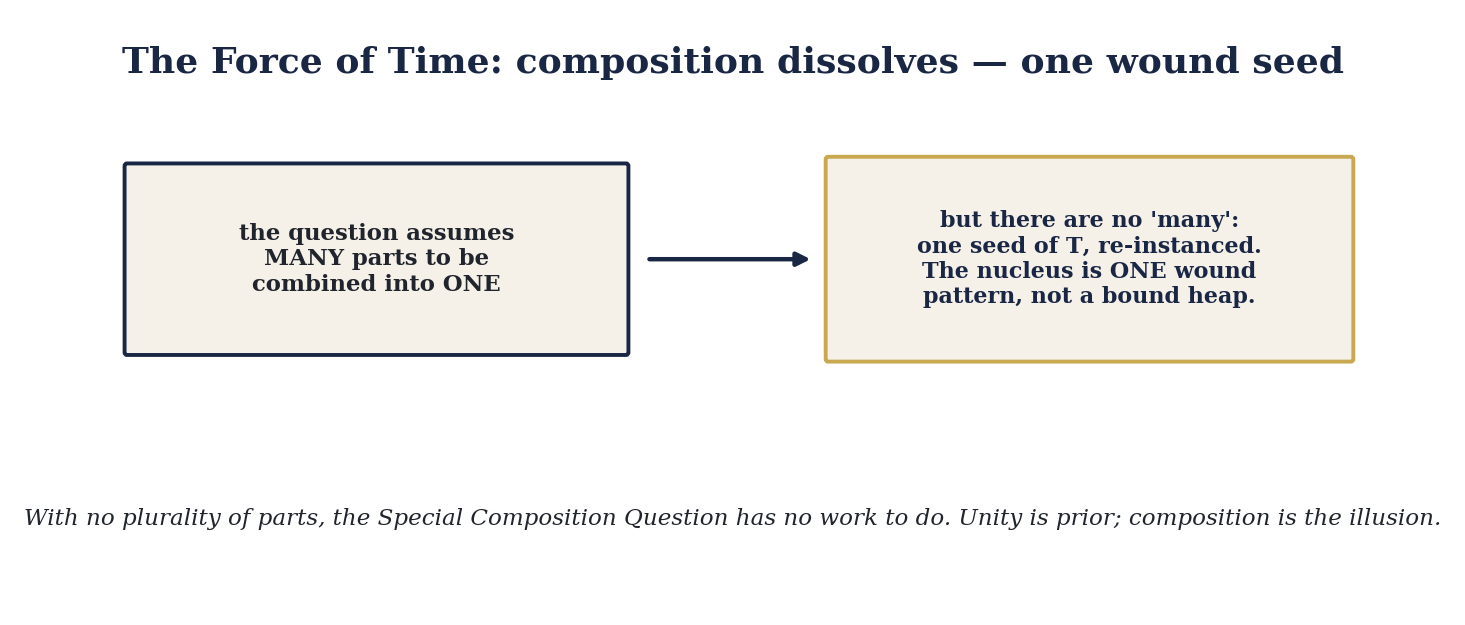
The Force of Time neither answers the question nor bites a bullet; it removes the presupposition on which the question rests (Fig. 4). The Special Composition Question assumes a genuine plurality of prior parts whose combination into a whole is then at issue. On the theory there is no such prior plurality. There is one substance, and on the one-seed reading one pattern re-instanced at every address; a nucleus is not many simples that have managed to bind, but one wound configuration of Τ — the many 'particles' are the single seed projected many times, not independent atoms awaiting assembly. Where there is no plurality to be unified, the question of when unification occurs has no subject matter. Unity is not achieved by composition; it is prior, and the appearance of a heap of parts is the derivative thing. This is neither nihilism (there genuinely are tables, as configurations of Τ) nor universalism (arbitrary sums are not further configurations); it is the denial that composition is a fundamental operation at all.
6. Emergence, and what this claims
The account bears on emergence. If wholes were built from independent parts, the causal powers of a whole would have to be either the resultant of the parts' powers or an irreducible addition to them, and the debate over strong emergence would be live. On the Force of Time the whole is not built from independent parts, so its powers are not owed to them: a configuration of Τ has the powers its lattice structure confers, and these are neither summed from nor superadded to the powers of illusory constituents. What looks like emergence — a whole doing what no part could — is the configuration expressing a structure that has no counterpart at the level of the fictitious parts. The claim of the paper is that a single move — the denial of prior plurality — clears the constitution paradoxes, escapes the particular-dilemma, and dissolves the composition question together, and that the cost of the move is exactly the one-seed ontology, to be vindicated or not by the physics.
7. Conclusion
The problems of material objects are, at root, problems of the many and the one — how matter and object relate, how properties and bearer relate, how parts and whole relate. The Force of Time answers each by insisting that the one is prior: one substance, one seed, doubly and multiply described. The statue is not stacked on the clay, the thing is not pegged beneath its qualities, and the whole is not assembled from atoms — because underneath the plural appearances there was only ever the single wound pattern of time.
Figures
The position, in full
The identity of a material object is its Τ-address and configuration, not its matter. The statue and the clay are one region of Τ under two pattern-descriptions — apparent coincidence without two stacked things.
A particular is a Τ-address plus the configuration Τ takes there. The address individuates duplicates (against the bundle theory) without a propertyless bearer (against the substratum theory).
The Special Composition Question lapses: it presupposes a prior plurality of parts, but there is one substance / one re-instanced seed. A nucleus is one wound configuration, not bound simples.
This is neither nihilism (tables exist as configurations of Τ) nor universalism (arbitrary sums are not configurations); composition is denied the status of a fundamental operation. Unity is prior.
Emergence is deflated: a whole's powers are those of its lattice configuration, neither summed from nor superadded to the powers of fictitious independent parts.
References
[1] A. Gibbard, Contingent Identity, J. Philosophical Logic 4, 187 (1975) — the statue and the clay.
[2] D. Wiggins, Sameness and Substance Renewed, Cambridge University Press (2001) — constitution.
[3] J. Locke, An Essay Concerning Human Understanding (1689), II.xxiii — substratum.
[4] P. van Inwagen, Material Beings, Cornell University Press (1990) — the Special Composition Question.
[5] T. Merricks, Objects and Persons, Oxford University Press (2001) — eliminativism about ordinary objects.
[6] A. Ney, Metaphysics: An Introduction, Routledge (2014), ch. 3.
[7] R. C. Koons and T. H. Pickavance, Metaphysics: The Fundamentals, Wiley-Blackwell (2015), ch. 5, 6.
[8] S. Daubney, The Universal Force of Time — Master Compendium v5, The Daubney Foundation (2026); the one-seed reading and the nucleus as one wound configuration.
A Note on Standing
The account given here is one interpretation among rivals, offered as their equal and not as their correction. Nothing in the metaphysical tradition it engages — realism or nominalism, the A-theory or the B-theory, and the rest — is established fact, and neither is the Force of Time; each is a reasoned attempt to interpret a reality none of us can step outside to check. Where these papers say a problem 'does not arise' or a question 'lapses', that holds within the theory's own premises, which are no less contestable than those of the positions set beside them. The Force of Time is advanced as a coherent alternative viewpoint, to be weighed on the merits — and, unusually among these views, to be tested where it makes contact with measurement.
A Note on the Series
This is Paper 4 of Metaphysics through the Force of Time. Paper 3 placed the universals within the one floor; this paper treats the particulars that instantiate them; Paper 6 (persistence) carries the Τ-address account of identity into time.