Abstract
Ontology is the study of what there is and of what it is for a thing to be. Its central puzzles — the apparent commitment incurred by true denials of existence (the golden mountain, Pegasus), the ordering of reality into the fundamental and the derivative, and the very meaning of 'exists' — were sharpened by Quine and by the theory of descriptions before him. This paper gives the Force of Time's ontology, which is as spare as an ontology can be: there is exactly one substance, Τ, and everything else — every particle, body, mind and institution — exists only as a configuration of it and is grounded in it. The puzzle of nonexistent objects dissolves, because there is nothing but Τ-configurations for a denial of existence to be about; the hierarchy of fundamentality has a single floor, since Τ depends on nothing and everything depends on Τ; and the meaning of existence is fixed by the conservation law dΣΤ=0, which says how much substance there is and forbids its creation or destruction. We regiment the commitment in Quine's terms, distinguish the theory's monism from both bundle and substratum pictures, and give the position as numbered propositions.
1. What ontology asks
Two questions must again be separated. The first is the ontological question proper: what exists? The second is the meta-ontological question: what is it for something to exist, and how do we tell what a theory is committed to? The tradition since Quine [3] answers the second before the first — fix the criterion of commitment, then apply it — and this paper follows suit. The Force of Time's answer to the first question is extreme in its simplicity: one substance, Τ. Its interest lies in how that single answer handles the puzzles that have made ontology hard.
2. The puzzle of nonexistent objects
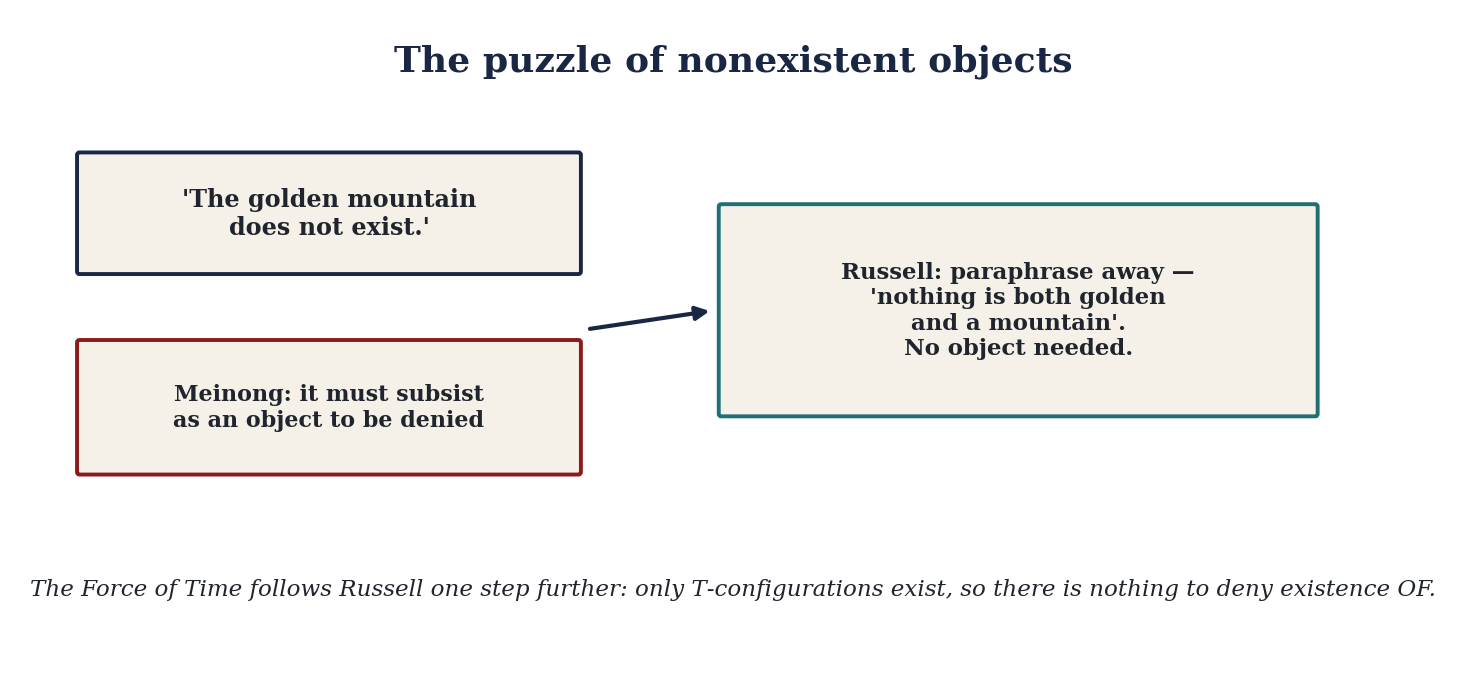
The oldest puzzle is that true negative existentials seem to commit us to what they deny (Fig. 1). If 'the golden mountain does not exist' is true and about the golden mountain, then there must, it seems, be a golden mountain for the sentence to be about — Meinong's conclusion that some objects subsist without existing. Russell's theory of descriptions [4] defused this: the sentence is not about an object but a quantified claim — nothing is both golden and a mountain — and carries no commitment. The Force of Time takes the deflation to its limit. There are no objects at all in the inflationary sense; there are configurations of Τ. A negative existential denies that Τ is anywhere configured in the named way, and needs no shadowy object to be about. Existence-talk is talk of how the one substance is, or is not, arranged.
3. Fundamentality and ontological dependence
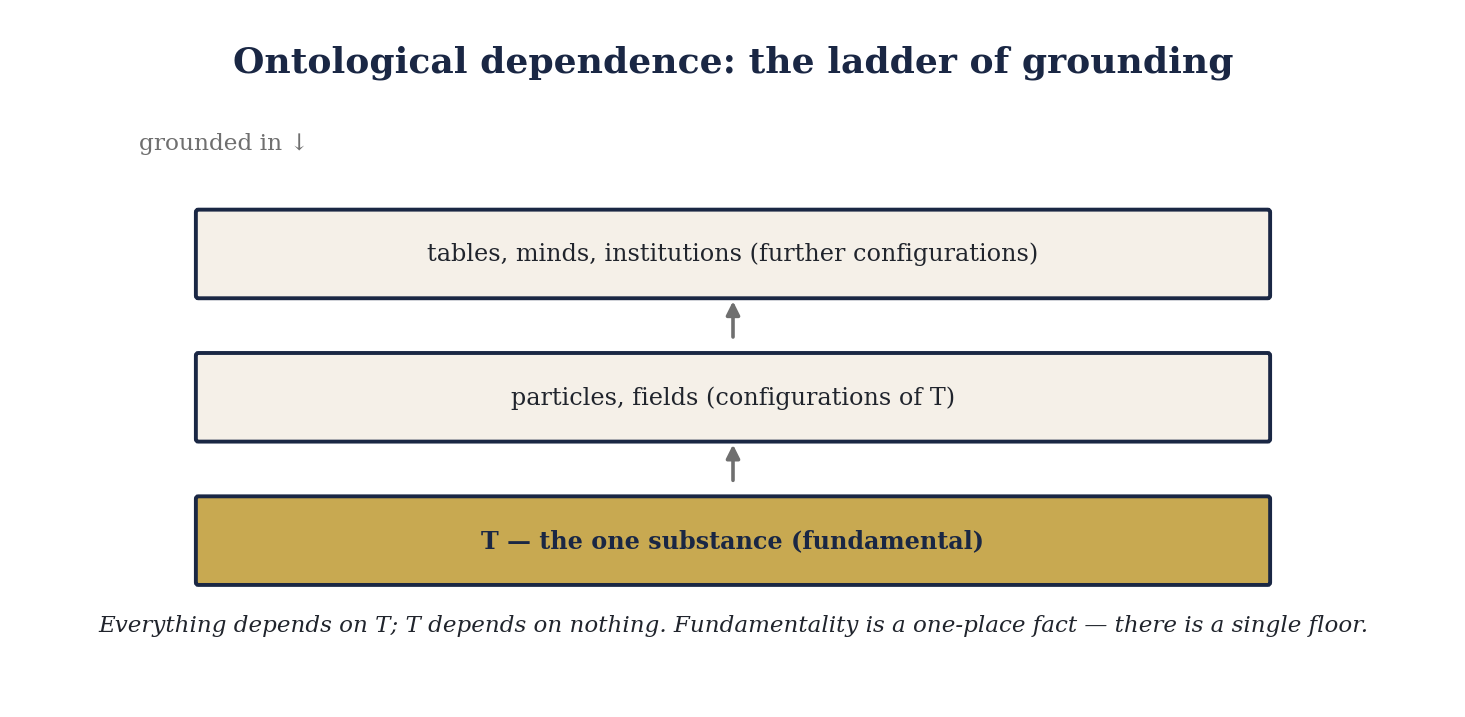
Contemporary ontology is as much about structure as inventory: not only what exists but what depends on what — the relation of grounding, of the derivative resting on the fundamental [6]. Most views leave the shape of this dependence open and its floor disputed. The Force of Time fixes both (Fig. 2). There is a single fundamental entity, Τ; particles and fields are configurations of it; bodies, minds and institutions are further configurations of those. Grounding runs everywhere to the same floor, and the floor is one thing that is grounded in nothing. Fundamentality, so often a comparative and contested notion, becomes here a one-place fact with a single occupant.
4. Regimenting the commitment
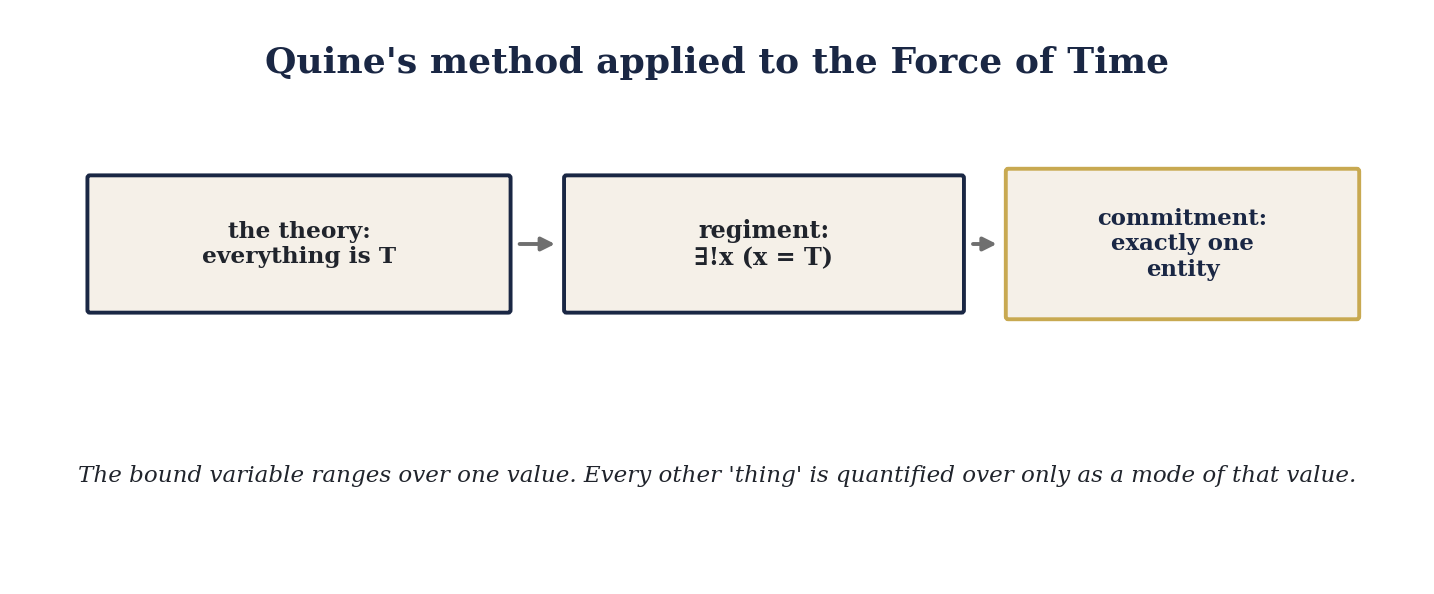
In Quine's terms the commitment is transparent (Fig. 3). Regimented, the theory asserts that there is exactly one substance and that every apparent object is a configuration of it: the existential quantifier ranges, at the fundamental level, over a single value. Talk of electrons, planets and persons is retained, but on analysis it quantifies over modes of Τ rather than over independent entities — much as talk of waves quantifies over states of a medium rather than over things additional to it. The ontology is a monism, and its commitment the smallest a non-empty theory can post.
5. Neither bundle nor bare substratum
A monism of substance must say what a particular is, and the Force of Time's answer avoids the two standard traps. It is not a bundle theory, on which a thing is nothing but its co-located properties, for the properties are not free-floating universals but configurations of a substance that is prior to them. Nor is it a bare-substratum theory, on which a propertyless substrate wears properties, for Τ is not propertyless — it is structured on the lattice, and a particular is a definite address in that structure. A particular is a Τ-address together with the configuration Τ takes there: neither a mere sum of qualities nor a qualityless peg, but a determinate mode of the one substance. The dispute between bundle and substratum theories is treated more fully in the companion paper on material objects; here it suffices that monism is not forced onto either horn.
6. The meaning of existence, and what this claims
What is it, on this view, to exist? To exist is to be Τ so configured — and, at the level of the whole, the quantity of what exists is fixed and conserved: dΣΤ = 0. Existence is neither a first-order predicate added to a thing (the Kant–Frege point is respected: 'exists' is quantificational) nor a brute primitive; it is a fact about the disposition of the one conserved substance. The claim of the paper is that this single-floor ontology handles the classical puzzles at least as cleanly as the pluralist alternatives and at a fraction of the ontological cost — and that its adequacy is to be judged not by intuition alone but by whether Τ can in fact be configured into the phenomena, which is the work of the special papers.
7. Conclusion
The question 'what is there?' admits, in the Force of Time, a one-word answer — Τ — and the question 'what is it to be?' a one-law answer: to be is to be a conserved configuration of it. Everything else in ontology, from nonexistent objects to the hierarchy of grounding, follows from taking that answer seriously. It is the leanest possible inventory, and the rest of the series asks whether the world can be built from it.
Figures
The position, in full
There is exactly one substance, Τ. Everything else exists only as a configuration of it. The regimented ontological commitment (Quine) is to a single entity.
Negative existentials carry no commitment to nonexistent objects: they deny that Τ is configured in the named way. There are no Meinongian objects; there are Τ-configurations (Russellian deflation taken to its limit).
Fundamentality is a one-place fact with a single occupant: Τ is grounded in nothing; all else is grounded in Τ. Grounding runs everywhere to one floor.
A particular is a Τ-address plus the configuration Τ takes there — neither a bundle of free properties nor a bare substratum. Monism is forced onto neither horn.
To exist is to be a configuration of Τ; the total quantity of what exists is conserved (dΣΤ=0). 'Exists' remains quantificational, not a first-order predicate.
References
[1] Aristotle, Categories; and Metaphysics, Book Ζ (Zeta) — substance and being.
[2] A. Meinong, Über Gegenstandstheorie (The Theory of Objects, 1904).
[3] W. V. O. Quine, On What There Is, Review of Metaphysics 2, 21 (1948).
[4] B. Russell, On Denoting, Mind 14, 479 (1905) — the theory of descriptions.
[5] A. Ney, Metaphysics: An Introduction, Routledge (2014), ch. 1.
[6] K. Fine, The Question of Realism, Philosophers' Imprint 1, 1 (2001); J. Schaffer, On What Grounds What, in Metametaphysics, OUP (2009).
[7] R. C. Koons and T. H. Pickavance, Metaphysics: The Fundamentals, Wiley-Blackwell (2015), ch. 2 (truthmakers).
[8] S. Daubney, The Universal Force of Time — Master Compendium v5, The Daubney Foundation (2026).
A Note on Standing
The account given here is one interpretation among rivals, offered as their equal and not as their correction. Nothing in the metaphysical tradition it engages — realism or nominalism, the A-theory or the B-theory, and the rest — is established fact, and neither is the Force of Time; each is a reasoned attempt to interpret a reality none of us can step outside to check. Where these papers say a problem 'does not arise' or a question 'lapses', that holds within the theory's own premises, which are no less contestable than those of the positions set beside them. The Force of Time is advanced as a coherent alternative viewpoint, to be weighed on the merits — and, unusually among these views, to be tested where it makes contact with measurement.
A Note on the Series
This is Paper 2 of Metaphysics through the Force of Time. Paper 1 fixed the method; this paper gives the single-floor ontology; Paper 3 (universals and properties) and Paper 4 (material objects and composition) develop the configurations that rest on the floor.