Abstract
A thing exists at many times and remains, in some sense, the same thing. How? Endurantism holds that the thing is wholly present at each moment — a three-dimensional object that is strictly identical across time. Perdurantism holds that it is a four-dimensional 'worm' with a distinct temporal part at each moment, so that what is present now is a part, not the whole. Exdurantism (the stage view) holds that only the momentary stage exists and that persistence-talk is really about a series of stages linked by counterpart relations. The decisive pressure on endurantism is Lewis's problem of temporary intrinsics: if a thing is wholly present when bent and again when straight, it seems to bear incompatible shapes without qualification. This paper gives the Force of Time's account, which follows directly from its treatment of time. Persistence is the re-instancing of a single seed of Τ along the coordinates of its block-life: the persisting thing is one Τ-pattern projected at each of its addresses. This is a perdurantism in form — the thing is spread along a series of temporal coordinates — but a distinctive one, since the 'temporal parts' are re-instancings of one seed rather than independent slices, which is why every electron is exactly identical to every other. The problem of temporary intrinsics does not arise: different addresses carry different configurations, so nothing bears incompatible properties at one address. Personal identity, and the puzzle cases (the Ship of Theseus, fission), are handled by making the Τ-address, encoded in the DNA, the criterion of identity rather than matter or psychological continuity. We give the position as numbered propositions.
1. The problem of persistence
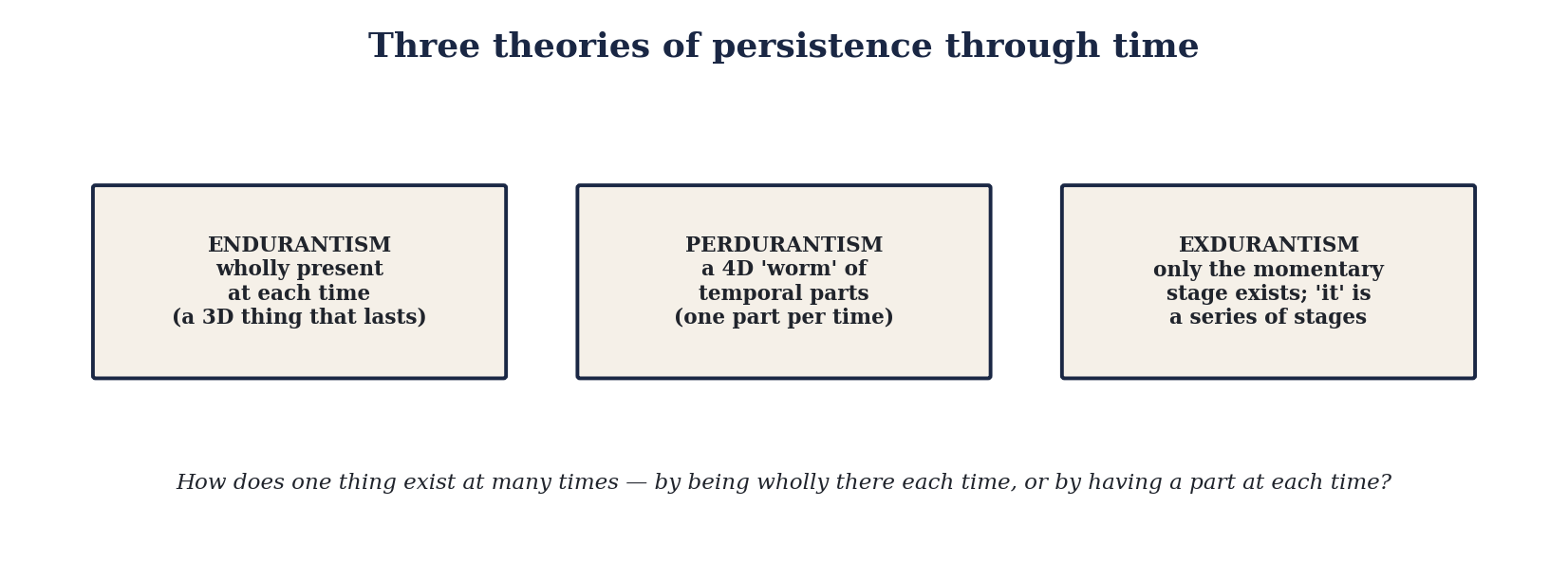
Identity over time is puzzling because the thing that persists changes: the tree is short, then tall; the person is bent, then straight. If a persisting thing is strictly one and the same throughout, how does it accommodate incompatible properties at different times? Three theories divide the ground (Fig. 1) [6,7]. Endurantism: the thing is wholly present at every time it exists, and persistence is strict identity across time. Perdurantism: the thing perdures by having temporal parts, one at each time, so that it is extended in time as a road is extended in space; what is present now is a proper part of the whole four-dimensional object. Exdurantism, or the stage view: only the instantaneous stage is real, and 'the same thing later' refers to a later stage that is a temporal counterpart of the present one.
2. The problem of temporary intrinsics
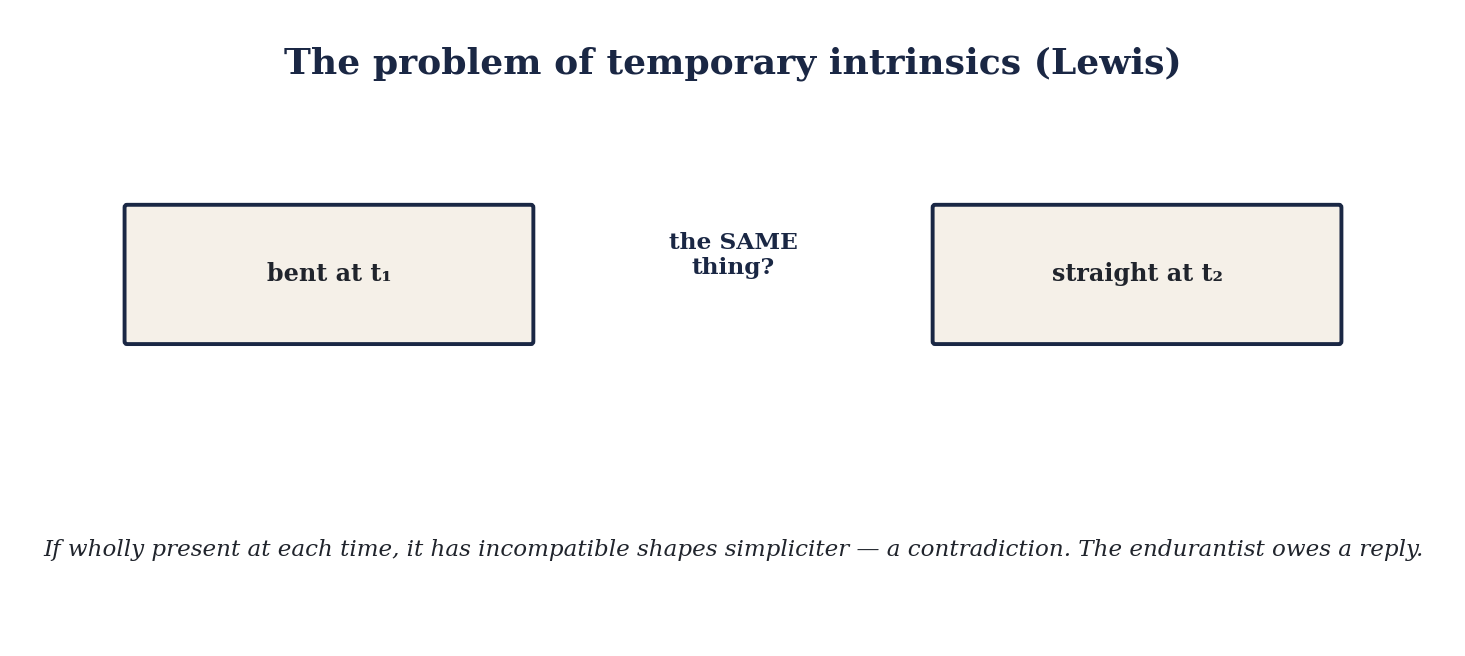
Lewis's argument [6] presses hardest on endurantism (Fig. 2). Shape is a temporary intrinsic: a thing has it in its own right, not in relation to anything, and it changes over time. If one and the same thing is wholly present both when bent and when straight, then it has bentness and straightness — incompatible intrinsic shapes — full stop, which is a contradiction. The endurantist must qualify the having: perhaps shapes are had relative to times, or times are operators on the whole proposition. Each repair has costs — relativising intrinsics seems to make them extrinsic, indexing propositions strains the logic. Perdurantism avoids the problem cleanly: it is one temporal part that is bent and a numerically distinct part that is straight, so no single thing bears both.
3. The Force of Time: re-instancing
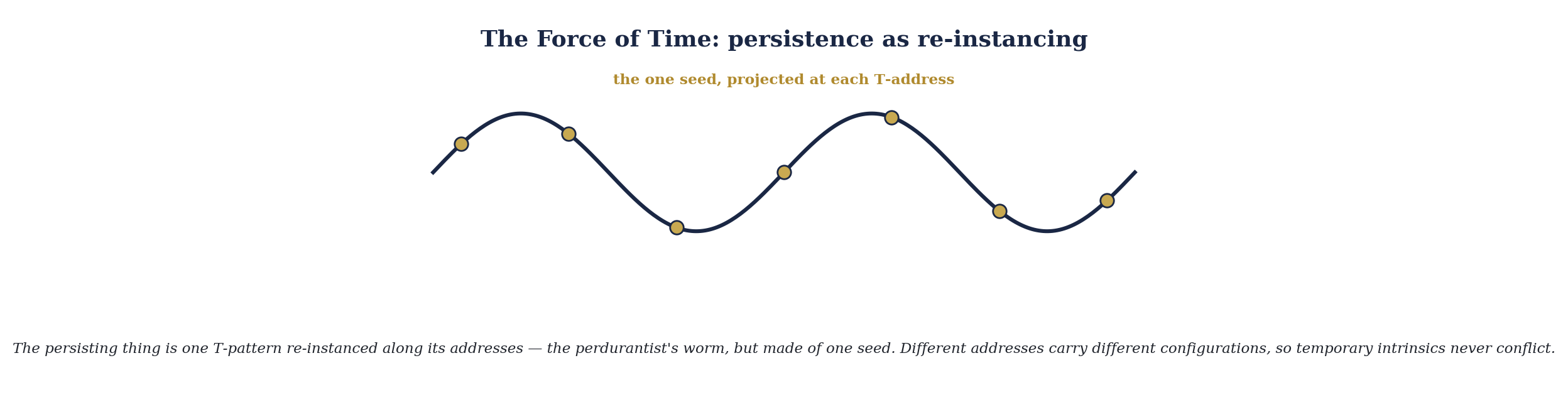
The Force of Time inherits its answer from the metaphysics of time (Fig. 3). A persisting thing is a single seed of Τ re-instanced at each of the Τ-addresses along its block-life curve. In form this is a perdurantism: the thing is spread along a series of temporal coordinates, and what is present now is the seed as projected at the present address, not the whole worm. It therefore takes over perdurantism's clean solution to temporary intrinsics: the configuration at the bent address and the configuration at the straight address are configurations at distinct addresses, and no single address bears both shapes. There is no need to relativise intrinsics or index propositions; the shapes are had simpliciter, each at its own coordinate.
4. Not ordinary perdurance: the one seed
The theory's perdurantism is distinctive in what the temporal parts are. For the standard perdurantist the parts are independent slices, related by causal and qualitative continuity into a worm. For the Force of Time the 'parts' are re-instancings of one seed — the same pattern projected again and again — so the unity of the persisting thing is not a relation stitched between independent slices but the numerical singleness of the seed that is re-instanced. This is why the theory can explain what standard perdurance leaves brute: the exact qualitative identity of the fundamental particles. Two electrons, and the one electron at two times, are the same because they are one seed, re-instanced. Persistence and the identity of indistinguishables are, at bottom, the same fact.
5. Identity: the Τ-address, not the matter
For personal and object identity the theory makes the criterion the Τ-address rather than the matter or the psychology. The Ship of Theseus — repaired plank by plank until none of the original remains, while the removed planks are reassembled — has no answer if identity goes with matter, since both claimants have equal title. On the Force of Time the ship is its Τ-address and configuration; identity follows the pattern, not the timber, and the puzzle is a question about which continuant the pattern tracks, not an irresoluble tie between matter-claimants. For persons the criterion is neither Lockean psychological continuity nor bare biological continuity but the Τ-address encoded in the DNA — the coordinate the organism occupies on the Earth's helical path, unique to the individual and carried in every cell. Fission cases, which defeat psychological criteria by producing two equally continuous successors, are handled by the fact that a single Τ-address cannot be numerically shared: at most one successor occupies it, and any second is a distinct address, however similar.
6. What this claims
The paper claims that persistence is re-instancing, that this is a perdurantism which solves the temporary-intrinsics problem by the same means as ordinary perdurance while improving on it by grounding the unity of the worm in one seed rather than in an external continuity relation, and that identity — for ships and for selves — tracks the Τ-address rather than matter or memory. The account is answerable to the same commitments as the rest of the theory: the one-seed reading and the coding of the Τ-address in the genome. Where those hold, the classical puzzles of identity over time have a uniform solution; where they fail, so does the account.
7. Conclusion
To persist is not to drag one three-dimensional whole through the moments, nor to string independent slices into a worm, but to be one seed of time re-instanced along a curve. The thing is spread through time as it is spread through the lattice, and it is one because the seed is one. Change is no threat to its identity, because each shape belongs to its own coordinate; and the self is one across a life for the same reason a particle is one across the world — because underneath the many instancings there is a single pattern of Τ.
Figures
The position, in full
Persistence is the re-instancing of one seed of Τ along the Τ-addresses of a block-life curve. What is present now is the seed projected at the present address, not the whole four-dimensional object — a perdurantism in form.
The problem of temporary intrinsics does not arise: incompatible properties are had at distinct addresses, each simpliciter, with no relativising of intrinsics or indexing of propositions.
The temporal 'parts' are re-instancings of one seed, not independent slices; the unity of the persisting thing is the numerical singleness of the seed, which also explains the exact identity of the fundamental particles.
Identity tracks the Τ-address, not the matter (Ship of Theseus) or the psychology (fission). For persons the criterion is the Τ-address encoded in the DNA; a single address cannot be numerically shared.
The account is uniform with the metaphysics of time (Paper 5) and free will (Paper 9): the block-life curve is the object of persistence, and its coordinates are the temporal parts.
References
[1] Plutarch, Life of Theseus — the ship puzzle.
[2] J. Locke, An Essay Concerning Human Understanding (1689), II.xxvii — psychological continuity.
[3] D. Parfit, Reasons and Persons, Oxford University Press (1984) — fission and what matters in survival.
[4] D. Lewis, On the Plurality of Worlds, Blackwell (1986), §4.2 — temporary intrinsics.
[5] T. Sider, Four-Dimensionalism, Oxford University Press (2001) — perdurance and the stage view.
[6] A. Ney, Metaphysics: An Introduction, Routledge (2014), ch. 6.
[7] R. C. Koons and T. H. Pickavance, Metaphysics: The Fundamentals, Wiley-Blackwell (2015), ch. 8.
[8] S. Daubney, The Universal Force of Time — Master Compendium v5, The Daubney Foundation (2026); the one-seed reading and the DNA Τ-address.
A Note on Standing
The account given here is one interpretation among rivals, offered as their equal and not as their correction. Nothing in the metaphysical tradition it engages — realism or nominalism, the A-theory or the B-theory, and the rest — is established fact, and neither is the Force of Time; each is a reasoned attempt to interpret a reality none of us can step outside to check. Where these papers say a problem 'does not arise' or a question 'lapses', that holds within the theory's own premises, which are no less contestable than those of the positions set beside them. The Force of Time is advanced as a coherent alternative viewpoint, to be weighed on the merits — and, unusually among these views, to be tested where it makes contact with measurement.
A Note on the Series
This is Paper 6 of Metaphysics through the Force of Time. It applies the block-life and re-instancing of Paper 5 (Time) and Paper 9 (Free Will) to identity over time; Paper 10 (Persons) develops the Τ-address criterion of personal identity.