Abstract
Metaphysics reaches, finally, the entities we ourselves are and the world we build. Three problems close the series. Personal identity asks what makes a person at one time the same person as one at another: the psychological criterion (Locke, Parfit) locates it in continuity of memory and character; the biological criterion, or animalism, in the persistence of the human organism — and puzzle cases (amnesia, fission, teletransportation) pull the two apart. Social ontology asks what social entities — money, borders, universities — are, and how collective attitudes bring them into being (Searle's institutional facts and status functions). The metaphysics of race asks whether race is a biological natural kind, a real but socially constructed kind, or no kind at all — a folk category that fails to refer. This paper gives the Force of Time's account. The deep identity of a person is neither psychological nor merely biological but the Τ-address encoded in the DNA — the unique coordinate the individual occupies on the Earth's helical path, carried in every cell. Race, on this account, is a surface expression, not the address: since the individuating fact is a coordinate unique to each person and the shared substrate is one Τ-field, biological race is not a fundamental kind, though its social reality and effects are not thereby denied. Social entities are configurations of Τ sustained by the aligned attitudes of many Τ-addresses — communities as nodal clusters, institutions as shared address-structures. We give the position as numbered propositions and close the series.
1. The person, and its identity
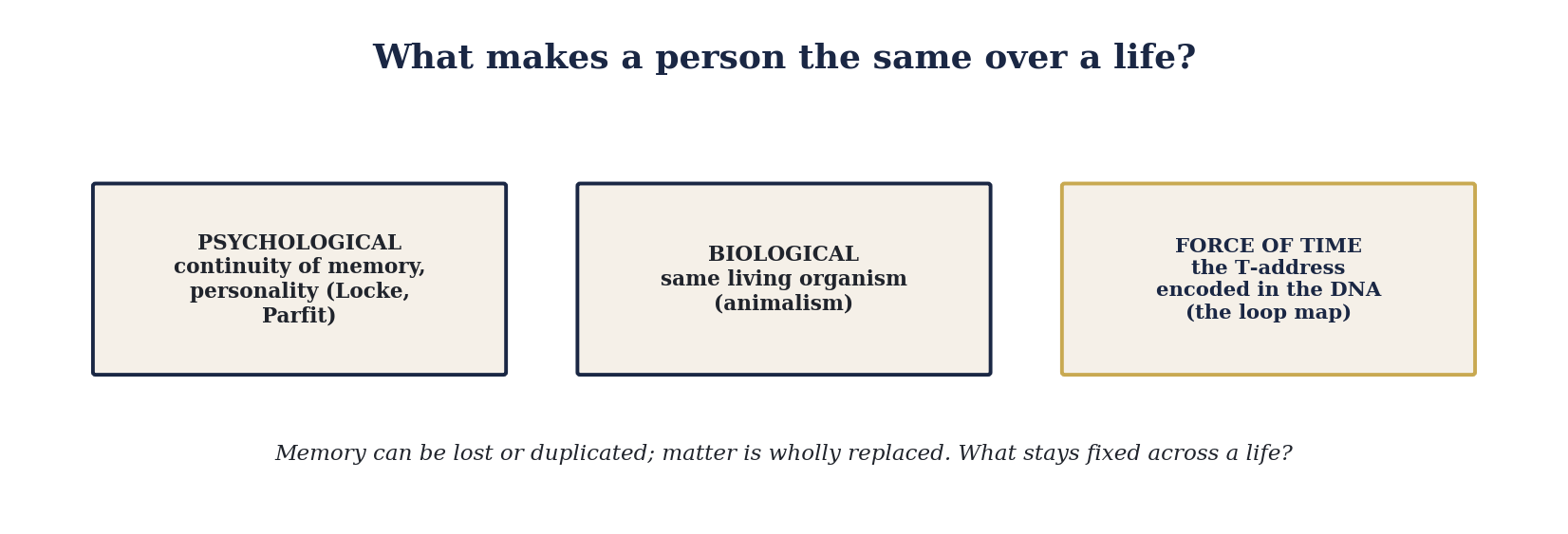
What makes the person reading this the same as the child in an old photograph (Fig. 1)? The matter is entirely replaced; much of the memory is gone; the character has changed. Locke's answer was psychological continuity — sameness of consciousness, memory, personality — and it captures much of what we care about in survival [2]. But it is defeated by cases: total amnesia would end the person though the human lives on; fission (one stream of consciousness continued by two) yields two equally continuous successors and so, absurdly, one person who is two. Animalism answers instead with the persistence of the organism — the person is the human animal — securing a determinate criterion at the cost of divorcing personal identity from the psychology that seemed to matter [3]. The debate is a standoff between what matters (the psychology) and what is determinate (the biology).
2. The Force of Time: identity as the Τ-address
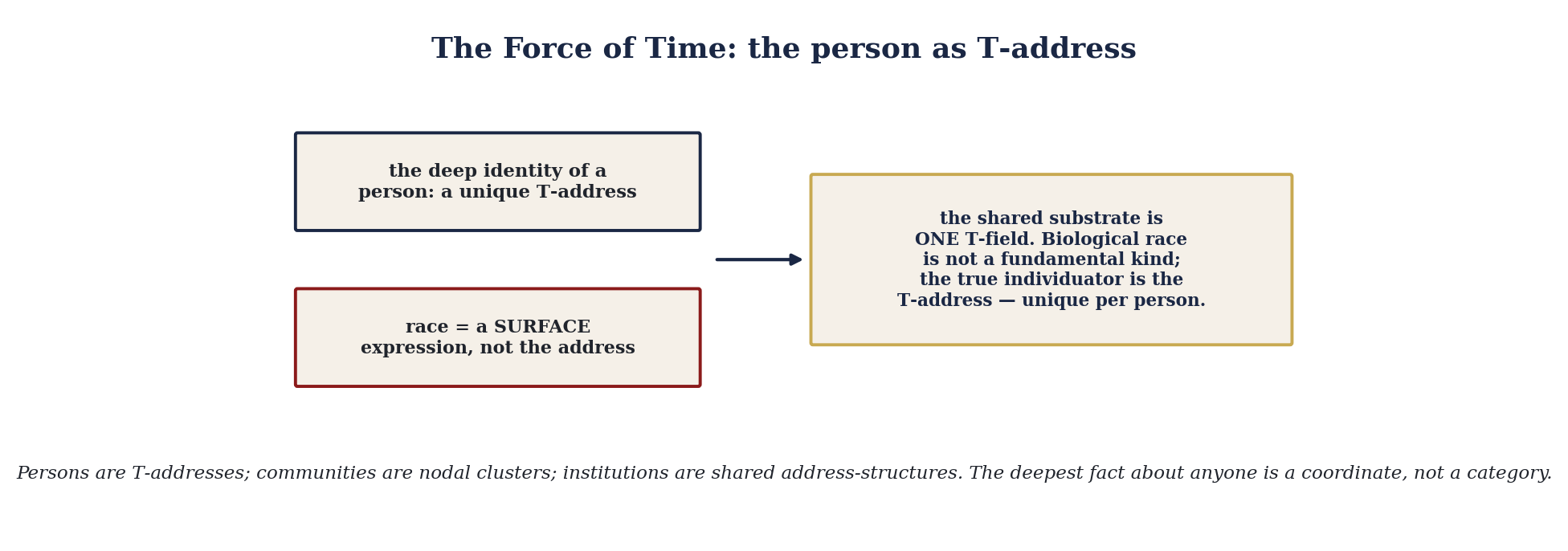
The Force of Time supplies a third criterion that is both determinate and deep (Fig. 3). A person's identity is the Τ-address they occupy — the unique coordinate on the Earth's helical Τ-path — encoded in the DNA and carried, complete, in every cell. This is neither the psychology nor the bare biology, though it is written in the biological molecule: it is the lattice coordinate that the genome specifies. It is determinate where the psychological criterion is not — a single Τ-address cannot be numerically shared, so fission produces at most one occupant of the address and any second successor is a distinct address, however similar, dissolving the paradox. And it is deep where animalism is shallow — the address is not merely the fact that an organism persists but the specific coordinate that makes this individual this individual and no other. What matters in survival and what is determinate coincide, because the address is at once the seat of the individual and a definite point in the structure of Τ.
3. The metaphysics of race
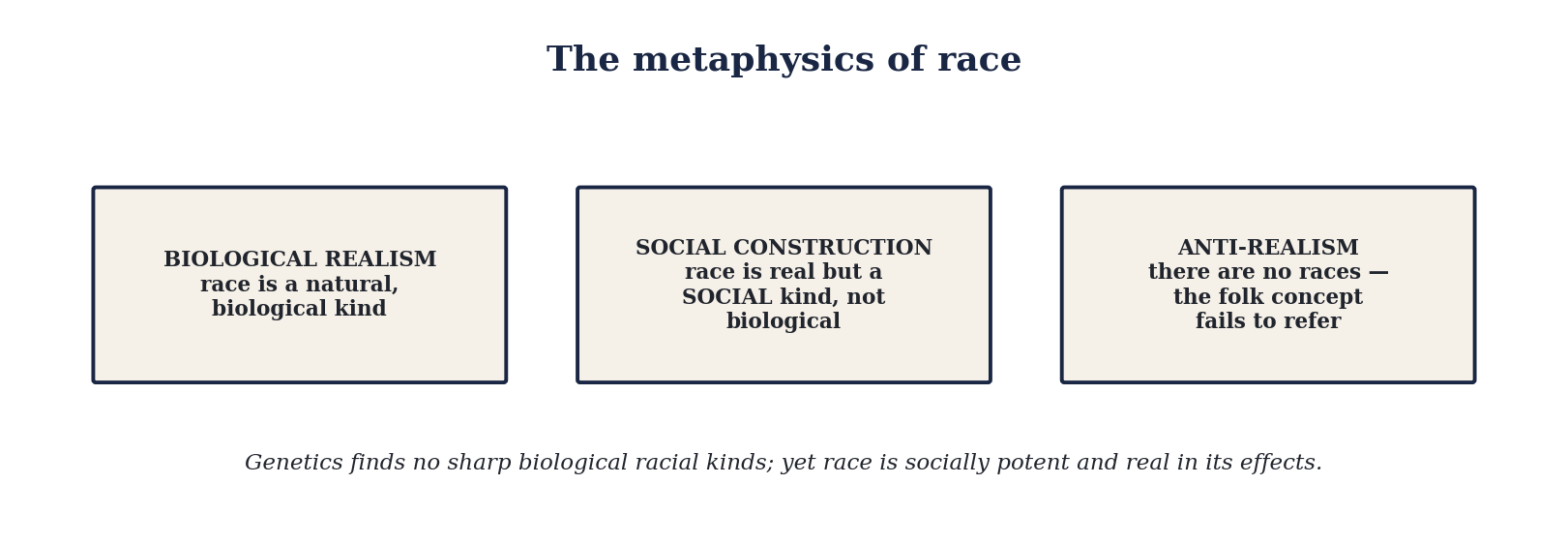
Race presents the most socially charged question in the field (Fig. 2) [5]. Biological realism holds that races are natural biological kinds; but human genetic variation is largely continuous and does not partition into the sharp, deep kinds the folk concept imagines, and most population genetics finds no such biological joints. Social constructionism holds that race is real but a social kind — brought into being and sustained by social practices, not by biology — and that its being socially constituted makes it no less real in its effects. Anti-realism holds that the folk concept of race, freighted with false biological assumptions, simply fails to refer, so that strictly there are no races, only racialised social relations.
4. The Force of Time on race: surface, not address
On the Force of Time the individuating fact about a person is the Τ-address, which is unique to the individual, and the substrate all persons share is one Τ-field. Biological race — a proposed partition of humanity into a few deep natural kinds — is therefore not a fundamental kind: the deep differences the concept posits do not exist at the level of the address, where every person is a distinct coordinate, nor at the level of the substrate, where all are one field. Racial traits are surface expressions of configuration, not marks of the address. This aligns the theory with the biological anti-realist against biological realism. It does not, however, deny the social reality of race: social kinds, as the next section holds, are genuine configurations of Τ sustained by collective attitudes, and race so understood is real, consequential, and a proper object of study — a construction with force, not a biological essence. The theory thus separates cleanly what the debate often conflates: there is no deep biological race, and there is a real social one.
5. Social ontology: nodal clusters and shared addresses
What are money, a border, a university? Searle's account makes them institutional facts: a physical thing is assigned a status function — 'counts as money' — by collective acceptance, and the social object exists so long as the acceptance does [4]. The Force of Time can take this over and ground it. A social entity is a configuration of Τ sustained not by one address but by the aligned attitudes of many: a community is a nodal cluster of Τ-addresses whose configurations are coordinated, and an institution is a shared address-structure — a pattern that exists in the joint configuration of the participants and persists as long as they sustain it. Collective intentionality, on this reading, is the alignment of many Τ-addresses into a common structure; the social world is as real as that alignment, and no more independent of it. Social facts are thus neither reducible to individual psychology nor free-floating: they are the shared configurations that many coordinated addresses jointly instantiate.
6. What this claims, and the close of the series
The paper claims that the Τ-address is the criterion of personal identity — determinate and deep, resolving the fission and amnesia cases where psychology and biology each fail; that biological race is not a fundamental kind, since the true individuator is a unique coordinate and the substrate is one field, while the social reality of race is fully preserved; and that social entities are shared Τ-configurations sustained by aligned addresses. With this the series closes. From the single substance of Paper 1 to the persons of Paper 10, one thesis has done the work throughout: there is only Τ, on its lattice, inscribed. The person is a coordinate in it, the community a cluster of coordinates, the institution a shared pattern among them — and the deepest fact about any of us is not a category but a place in the structure of time.
7. Conclusion
We end where metaphysics becomes personal. The self is not a stream of memories that could be copied, nor merely an animal that happens to think, but a unique address in the one substance — the same address the whole series has been circling, now worn by a person. Race, at that depth, disappears, because the depth is a coordinate and every coordinate is singular; and the shared world we build is the alignment of many such coordinates into common form. Underneath the categories we sort ourselves by, there is one field, and each of us a single point inscribed in it.
Figures
The position, in full
Personal identity is the Τ-address encoded in the DNA — the unique coordinate on the Earth's helical path, carried in every cell. Neither psychological continuity nor bare biology, though written in the biological molecule.
The criterion is determinate: a single Τ-address cannot be numerically shared, so fission yields at most one occupant; and deep: the address is what makes this individual this one.
Biological race is not a fundamental kind: the individuator is a unique Τ-address and the substrate is one Τ-field, so the deep partitions the concept posits do not exist. Racial traits are surface configurations, not addresses (biological anti-realism).
The social reality of race is preserved: as a social kind it is a genuine configuration of Τ sustained by collective attitudes — a construction with real effects, not a biological essence.
Social entities are shared Τ-configurations sustained by aligned addresses: a community is a nodal cluster of Τ-addresses; an institution is a shared address-structure; collective intentionality is the alignment of many addresses into common form (grounding Searle's institutional facts).
References
[1] J. Locke, An Essay Concerning Human Understanding (1689), II.xxvii — the memory (psychological) criterion.
[2] D. Parfit, Reasons and Persons, Oxford University Press (1984) — fission and what matters in survival.
[3] E. Olson, The Human Animal, Oxford University Press (1997) — animalism.
[4] J. Searle, The Construction of Social Reality, Free Press (1995) — status functions and institutional facts.
[5] R. Mallon, The Construction of Human Kinds, Oxford University Press (2016); and A. Appiah, in Color Conscious (1996) — the metaphysics of race.
[6] A. Ney, Metaphysics: An Introduction, Routledge (2014), ch. 10.
[7] R. C. Koons and T. H. Pickavance, Metaphysics: The Fundamentals, Wiley-Blackwell (2015).
[8] S. Daubney, The Universal Force of Time — Master Compendium v5, The Daubney Foundation (2026); the DNA Τ-address and social nodal clusters.
A Note on Standing
The account given here is one interpretation among rivals, offered as their equal and not as their correction. Nothing in the metaphysical tradition it engages — realism or nominalism, the A-theory or the B-theory, and the rest — is established fact, and neither is the Force of Time; each is a reasoned attempt to interpret a reality none of us can step outside to check. Where these papers say a problem 'does not arise' or a question 'lapses', that holds within the theory's own premises, which are no less contestable than those of the positions set beside them. The Force of Time is advanced as a coherent alternative viewpoint, to be weighed on the merits — and, unusually among these views, to be tested where it makes contact with measurement.
A Note on the Series
This is Paper 10, the final paper of Metaphysics through the Force of Time. It applies the Τ-address criterion of Paper 6 (persistence) to persons and the social world, and closes the series that began, in Paper 1, with the single substance.