Abstract
Two questions divide the metaphysics of time: whether time passes — whether the distinction between past, present and future is a real feature of the world (the A-theory) or a perspective upon a tenseless order of earlier and later (the B-theory) — and what exists: only the present (presentism), the past and present (the growing block), or all times alike (eternalism). This paper gives the Force of Time's answers, which rest on an identification more radical than any position in the standard debate: time is not a dimension along which things are arranged but the sole substance of which they are made. Τ is time, and everything is a configuration of it. From this the theory is eternalist — the {2,3,5,π} lattice is a block in which every coordinate is equally real — and it accepts the tenseless order the B-theorist describes. But it does not pay the B-theory's price of denying passage. Passage returns as inscription: the felt 'now' is the position of the process by which each coordinate is written, so the A-theorist's becoming and the B-theorist's block are both true and non-competing, as they are for a life on the block-life picture. We give the theory's distinctive mechanism of becoming — time as the re-instancing of a single seed at successive addresses — dissolve McTaggart's paradox by locating the 'now' in the inscribing act rather than in the events, and treat the relativity-of-simultaneity argument by denying that the propagation speed it privileges is a universal constant. The construction is given as numbered propositions.
1. The two questions
The philosophy of time turns on two questions that are easily run together and must be kept apart. The first is about passage: does time flow, is there an objective moving present, a real becoming by which the future turns into the past? The second is about existence: which times are real — only the present, or the present and the settled past, or all of them equally? The Force of Time answers both, but from a starting point no standard position shares. For the tradition, time is the medium in which things are arranged; the dispute is over the character of that medium. For the Force of Time there is no medium distinct from a content: time is the one substance, Τ, and every object and event is a configuration of it. To ask what time is, in this framework, is to ask what everything is.
2. The A-series and the B-series
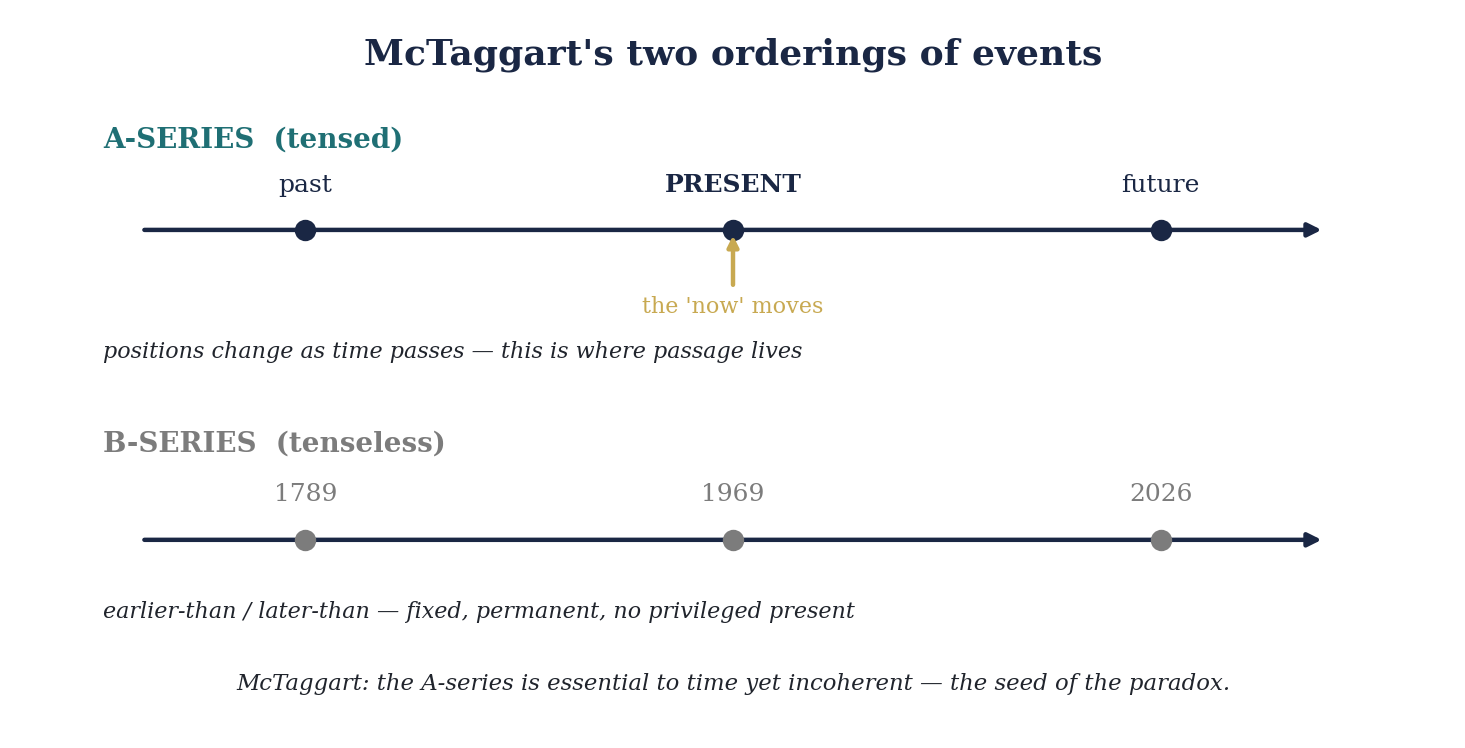
McTaggart [1] distinguished two ways of ordering events (Fig. 1). The A-series orders them as past, present, or future — a tensed ordering, in which an event's position changes as time passes: a battle once future becomes present, then ever more past. The B-series orders them as earlier-than and later-than — a tenseless ordering, in which positions never change: it is a permanent fact that 1789 precedes 1969. The A-theory holds that the A-series is fundamental and that passage — the movement of the present through the A-series — is a genuine feature of reality. The B-theory holds that the B-series is fundamental, that all tensed facts reduce to tenseless ones, and that passage is a feature of our perspective, not of time itself. Because it denies objective flow, the B-theory is often called the static or block theory.
3. The A-theory and its ontologies
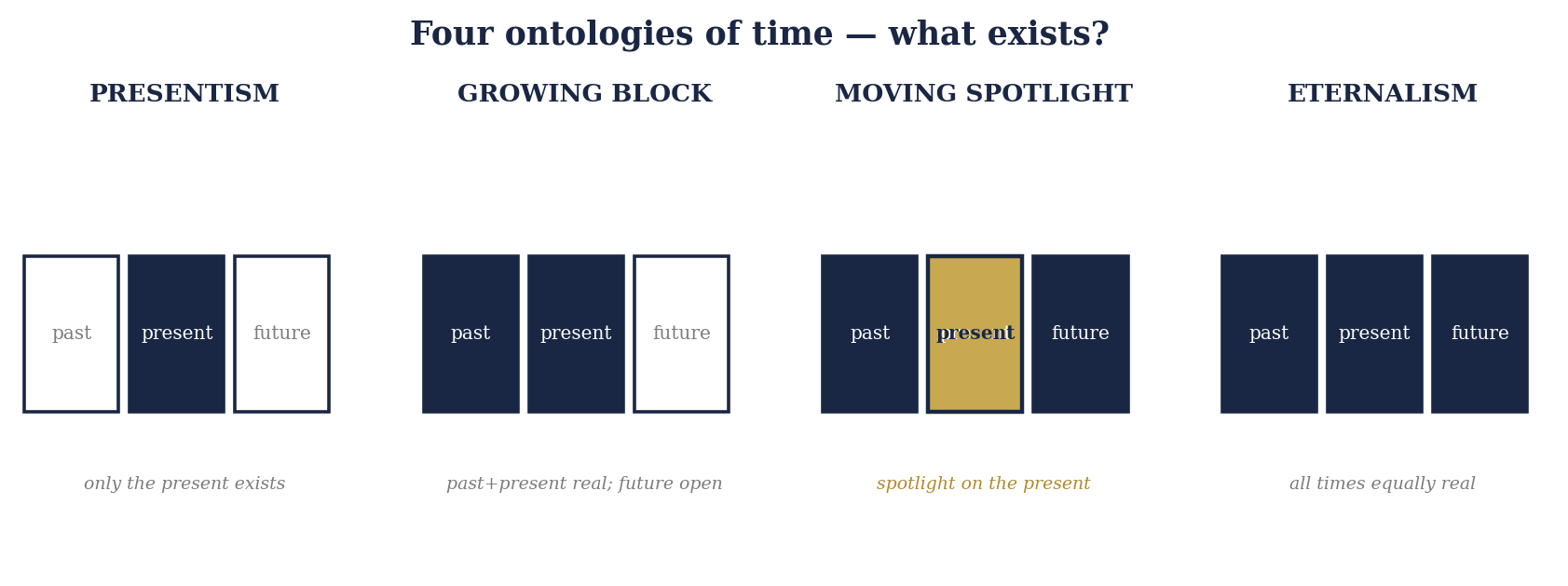
The A-theory comes in three main ontologies (Fig. 2). Presentism holds that only the present exists: the past is gone and the future not yet, and the sole reality is the momentary now. The growing block holds that the past and present are real and accumulate, while the future is genuinely open and unreal — reality grows by accretion at its leading edge. The moving spotlight holds that all times exist, as on the block, but that a privileged present — a spotlight of presentness — moves along them. What unites the three is the commitment to a real, objective present and a real passage; what divides them is how much of the timeline they admit into existence.
4. The B-theory, eternalism, and relativity
Against these stands eternalism: past, present and future are all equally real, and 'now' is indexical, like 'here' — true from a position, not a mark of privileged existence. This is the block universe, and it is the natural companion of the B-theory. Its strongest external support is from physics. Special Relativity denies any frame-independent fact about which distant events are simultaneous [4]; if there is no privileged slicing of spacetime into a universal present, then no such present can be the sole reality, and eternalism follows. Ney [2] observes that this leaves eternalism as the only ontology of time that does not make existence relative to a frame. The Force of Time will accept the eternalist conclusion while declining the relativistic route to it, for reasons given in §10.
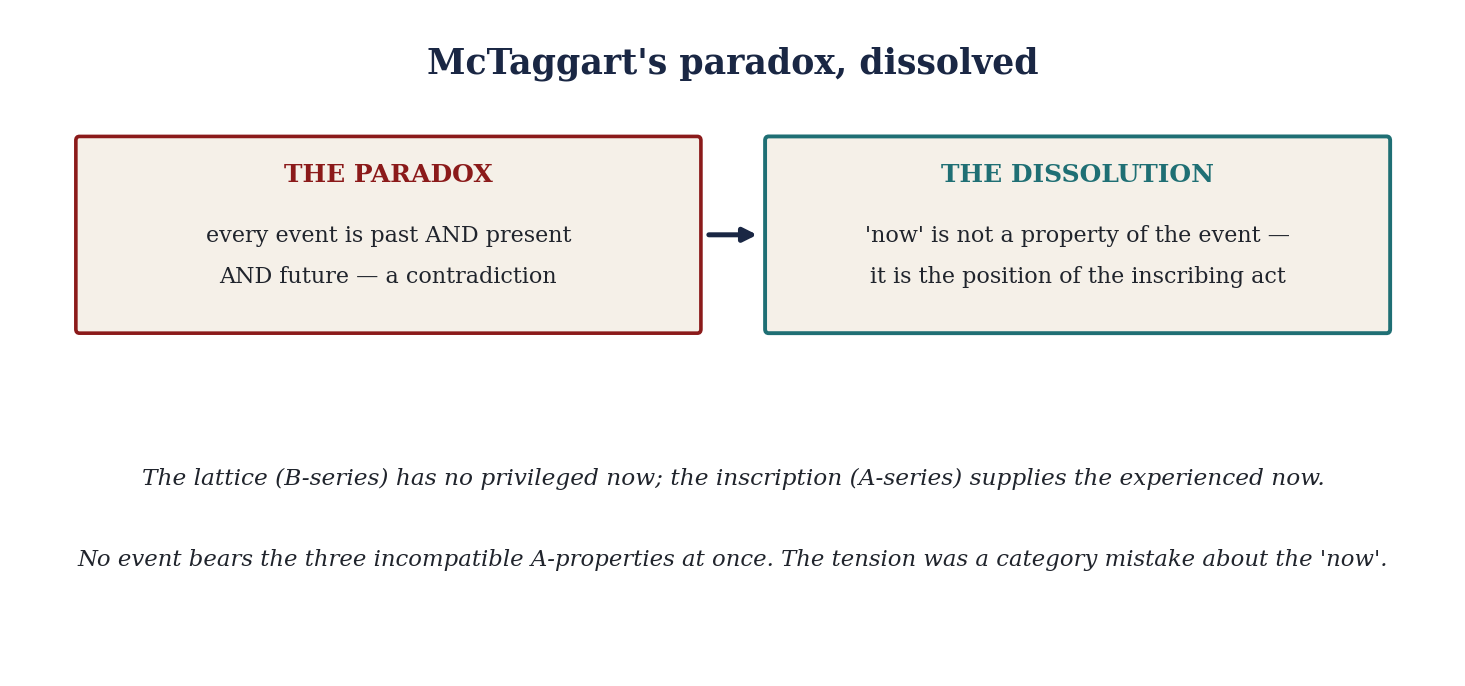
5. McTaggart's paradox
McTaggart pressed the two series into a famous argument for the unreality of time (Fig. 5). Change, he held, requires the A-series: the B-series alone is a fixed order in which nothing ever becomes anything, and an order without change is not a temporal order at all. But the A-series is incoherent. Its determinations — past, present, future — are mutually exclusive, yet every event must possess all three: any event is future, then present, then past. The natural reply — that it has them successively, not at once — either helps itself to a second-order A-series (it was going to be present, is present, will be past) and regresses, or covertly appeals to the tensed passage it was meant to explain. Since time requires the A-series and the A-series is contradictory, McTaggart concluded that time is unreal. Most philosophers reject the conclusion while conceding the argument's force against a naive tensed metaphysics; it is the pressure behind the retreat to the B-theory.
6. Τ is time
The Force of Time enters the debate one level below it. Its founding axiom is not a thesis about the structure of time but an identification of its substance: Τ, the only substance there is, is time itself — 'the living fabric of time'. A particle is not a thing that endures through time; it is a standing configuration of time. A force is not something that acts over time; it is a register of time's flow. This is not the innocuous remark that everything is temporal. It is the claim that there is nothing else for things to be made of. The conservation law dΣΤ = 0 is then a law about the total quantity of time-substance: it is neither created nor destroyed, only redistributed. Whatever one concludes about passage and existence must be read off this identification, not imposed on it.
7. The theory is eternalist
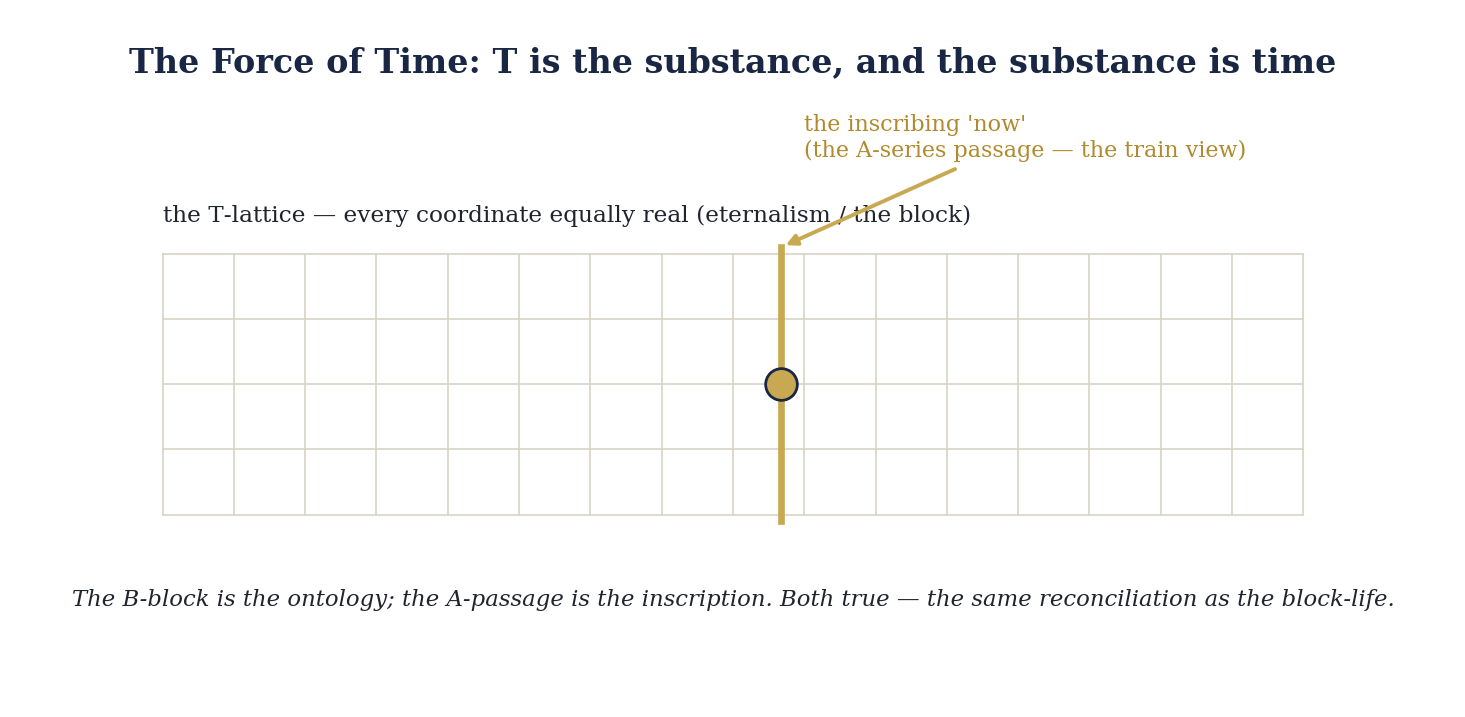
Because Τ is conserved and structured on a fixed lattice, the theory is eternalist (Fig. 3). Every event is a coordinate on the {2,3,5,π} lattice, and no coordinate is ontologically privileged over another any more than one point on a drawn line is more real than the rest. Past and future are as real as the present; 'now' is indexical. On the question of existence, then, the Force of Time sides squarely with the B-theorist and the eternalist against the presentist and the growing-block theorist: the block is the correct ontology, and it is the block of Τ. This is the same structure the companion treatment of agency calls the block-life [7] — there generalised from a single biography to the whole lattice.
8. Passage restored: the inscription
Here the theory parts from the pure B-theorist, who must treat the vivid sense of passage as mere appearance. The Force of Time keeps passage as real, by relocating it. The block is the lattice viewed as a completed structure — the lattice view. But the same lattice, viewed from within, is being written: the felt 'now' is the position of the process that inscribes each coordinate — the train view. Becoming is not the illusory motion of a spotlight over a finished block; it is the real activity of writing the block, seen from inside the writing. The A-theorist is therefore right that passage is objective — it is the inscription — and the B-theorist is right that the whole order is tenseless and fixed — it is the completed inscription. The two theses have appeared to compete only because each took its half of the truth for the whole. On the Force of Time they are two views of one lattice, and neither cancels the other.
9. Time as replication
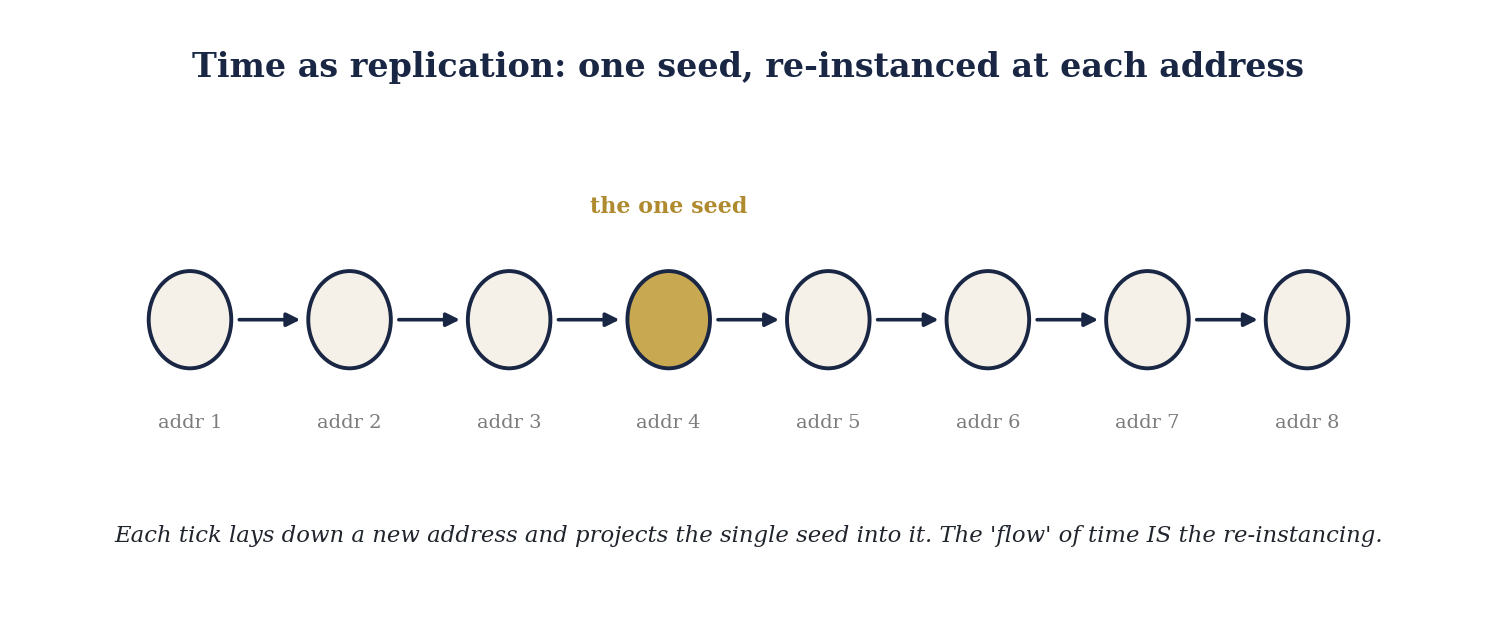
The reconciliation would be idle if 'inscription' were only a metaphor. The theory supplies a mechanism (Fig. 4). In the one-seed reading, there is at bottom a single pattern — one particle, one seed of Τ — and the many particles of the world are that one seed re-instanced at many addresses. Temporal becoming is this re-instancing: each tick lays down a new address on the lattice and projects the single seed into it. What we experience as the flow of time is the successive projection of the one pattern through the coordinates of the block. This gives the eternalist something the pure B-theory conspicuously lacks — a real process of becoming that does not smuggle back a moving present, because the movement is not of a spotlight over pre-existing events but of the inscribing projection that constitutes them. It also explains, at a stroke, why every electron is exactly identical to every other: they are numerically one, re-instanced.
10. McTaggart dissolved; simultaneity relocated
With passage lodged in the inscription rather than in the events, McTaggart's paradox dissolves (Fig. 5). The contradiction arose from treating past, present and future as incompatible properties that each event must nonetheless bear. But on this account presentness is not a property of an event at all; it is the position of the inscribing act. No event is past and present and future; each is simply its coordinate, and 'present' names wherever the inscription is. The regress never starts, because there is no first-order tensed property to iterate. The relativity argument is met differently. The Force of Time does not grant that the propagation speed relativity privileges is a universal constant: it holds that speed to be the spin-orbital rate of a particular dimensional register, not a fixed ceiling, so the relativity of simultaneity is a fact about how registers read one another — mediated by the degree-to-radian conversion the theory calls the veil, 180/π — not a fact about the lattice itself, which is frame-independent. The block does not depend on a privileged slicing; it depends on nothing, being the substance.
11. The arrow, and what this claims
The direction of time — the arrow — is on this account the direction of inscription: the asymmetry between the written and the unwritten, underwritten by conservation (dΣΤ = 0) rather than by a statistical gradient imposed on time from outside. The claims are separable and separately assessable. That Τ is time, and the world eternalist, stands with the single-substance ontology and its lattice; a demonstration of an objectively privileged present — a real presentist or growing-block 'edge' not reducible to the inscribing position — would count against it. That passage is the inscription is the theory's reconciliation of the A- and B-theories and is answerable to whether it genuinely captures temporal experience without a moving spotlight. Time as replication is the boldest element and the one most in need of independent support, though it earns its keep by also explaining the exact identity of the particles. What is not in doubt, within the framework, is the headline: time is not a stage on which the world is set; it is what the world is made of.
12. Conclusion
The Force of Time resolves the metaphysics of time by refusing its common presupposition. Time is not a container, a dimension, or a relation among things; it is the sole substance, and the block of it is real in every coordinate. Yet the block is not static, because it is being written, and the writing — seen from inside — is the passage we cannot doubt. Eternalism without the loss of becoming, a tenseless order that genuinely flows, a present that is real without being privileged: these are not a compromise between the A- and B-theories but the recognition that each described one face of a single thing. The world does not happen in time; on the Force of Time's reading, it is time, happening.
Figures
The position, in full
The two questions are distinct: passage (is there objective flow?) and existence (which times are real?). The Force of Time answers both from the identification of Τ with time itself.
Τ is time — the sole substance, not a medium in which things sit. Every object and event is a configuration of Τ; dΣΤ=0 is a conservation law for the total time-substance.
The theory is eternalist: every event is a lattice coordinate, all equally real; 'now' is indexical. On existence it sides with the B-theory/eternalism against presentism and the growing block.
Passage is real but relocated: the felt 'now' is the position of the inscribing process (train view); the completed order is tenseless (lattice view). The A- and B-theories are two views of one lattice, non-competing.
Time as replication: a single seed of Τ is re-instanced at successive lattice addresses; becoming is that projection. This supplies an eternalist mechanism of passage without a moving spotlight, and explains the exact identity of the particles (they are numerically one).
McTaggart's paradox dissolves: presentness is not a property of events but the position of the inscription. No event bears past, present and future together; the regress has no first-order tensed property to iterate.
The relativity of simultaneity is a register phenomenon, not a fact about the lattice. The propagation speed relativity privileges is a dimensional spin-orbital rate, not a universal constant; cross-register reading is mediated by the veil (180/π). The lattice is frame-independent.
The arrow of time is the direction of inscription, underwritten by dΣΤ=0 — an intrinsic asymmetry between written and unwritten, not a statistical gradient imposed from outside.
References
[1] J. M. E. McTaggart, The Unreality of Time, Mind 17, 457 (1908).
[2] A. Ney, Metaphysics: An Introduction, Routledge (2014), ch. 5.
[3] R. C. Koons and T. H. Pickavance, Metaphysics: The Fundamentals, Wiley-Blackwell (2015), ch. 8.
[4] A. Einstein, Zur Elektrodynamik bewegter Körper, Annalen der Physik 17, 891 (1905) — the relativity of simultaneity; and H. Putnam, Time and Physical Geometry, J. Philosophy 64, 240 (1967).
[5] D. H. Mellor, Real Time II, Routledge (1998) — the B-theory (tenseless) view.
[6] T. Sider, Four-Dimensionalism, Oxford University Press (2001) — the block universe.
[7] S. Daubney, Free Will and the Loop (Metaphysics through the Force of Time, Paper 9), The Daubney Foundation (2026) — the block-life, train view vs lattice view.
[8] S. Daubney, The Universal Force of Time — Master Compendium v5, The Daubney Foundation (2026) — the single-substance axiom, the one-seed reading, the veil (180/π), and c as a dimensional spin-orbital rate.
A Note on Standing
The account given here is one interpretation among rivals, offered as their equal and not as their correction. Nothing in the metaphysics of time it engages — the A-theory or the B-theory, presentism or eternalism — is established fact, and neither is the Force of Time; each is a reasoned attempt to interpret a reality none of us can step outside to check. Where this paper says McTaggart's paradox 'dissolves' or that Τ is time, that holds within the theory's own premises, which are no less contestable than those of the positions set beside them. The Force of Time is advanced as a coherent alternative viewpoint, to be weighed on the merits — and, unusually among these views, to be tested where it makes contact with measurement.
A Note on the Series
This is Paper 5 of Metaphysics through the Force of Time, a chapter-by-chapter reading of the standard introductions (Ney 2014; Koons and Pickavance 2015) through the single-substance ontology of Τ. The companion Paper 9 (Free Will and the Loop) develops the block-life and the train/lattice distinction used here; Paper 6 (Persistence) applies the same apparatus to identity over time.