Abstract
Distinct things share properties — three ripe tomatoes are each red — and the one-over-many argument takes this to require a single repeatable entity, a universal, that the many instances have in common. Realists (Plato's transcendent Forms, Armstrong's immanent universals) accept such entities; nominalists reject them and must account for resemblance by other means (predicate nominalism, class nominalism, resemblance nominalism); trope theorists occupy a middle position, admitting particular property-instances that resemble but denying any shared entity. Behind the dispute stands the abstract/concrete distinction and the special case of mathematical objects, whose apparent indispensability to science is the strongest argument for Platonism. This paper gives the Force of Time's account, which resolves the realism–nominalism quarrel by placing the universals inside the world. The {2,3,5,π} lattice — the fixed structure of Τ that fixes the fine-structure ratio, the spectral wavelengths and the rest — is a system of real, repeatable, mind-independent universals; but it is not an abstract realm apart from concrete reality. It is the concrete structure of the one substance. The theory is thus a realism about universals (they exist and are shared) and an immanentism (they are in things, not beyond them), and it makes the truthmakers of property-attributions the configurations of Τ on the lattice. Mathematical objects are real for the same reason — the lattice numbers are not describers of nature but constituents of it. We give the position as numbered propositions.
1. The one over many
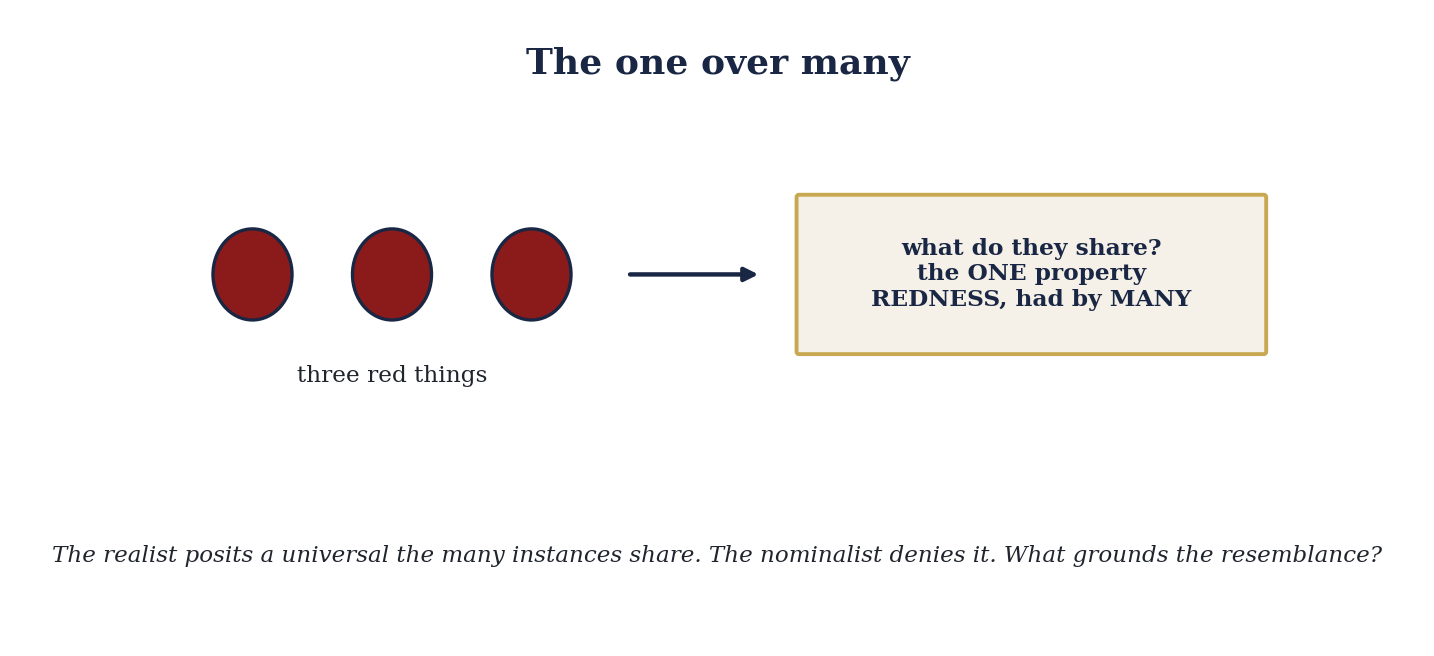
The problem of universals begins with an argument of great simplicity (Fig. 1). Many distinct things are, say, red; they are alike in this respect; their likeness is a fact needing explanation; and the natural explanation is that there is some one thing — redness — that each of the many has. If we accept it, we have admitted a universal: an entity that is wholly present in each of its many instances and repeatable across them, unlike the particulars, which are each in one place at a time. The question of universals is whether such entities exist, and if not, what does the explanatory work they were introduced to do [4,6].
2. Realism, nominalism, and tropes
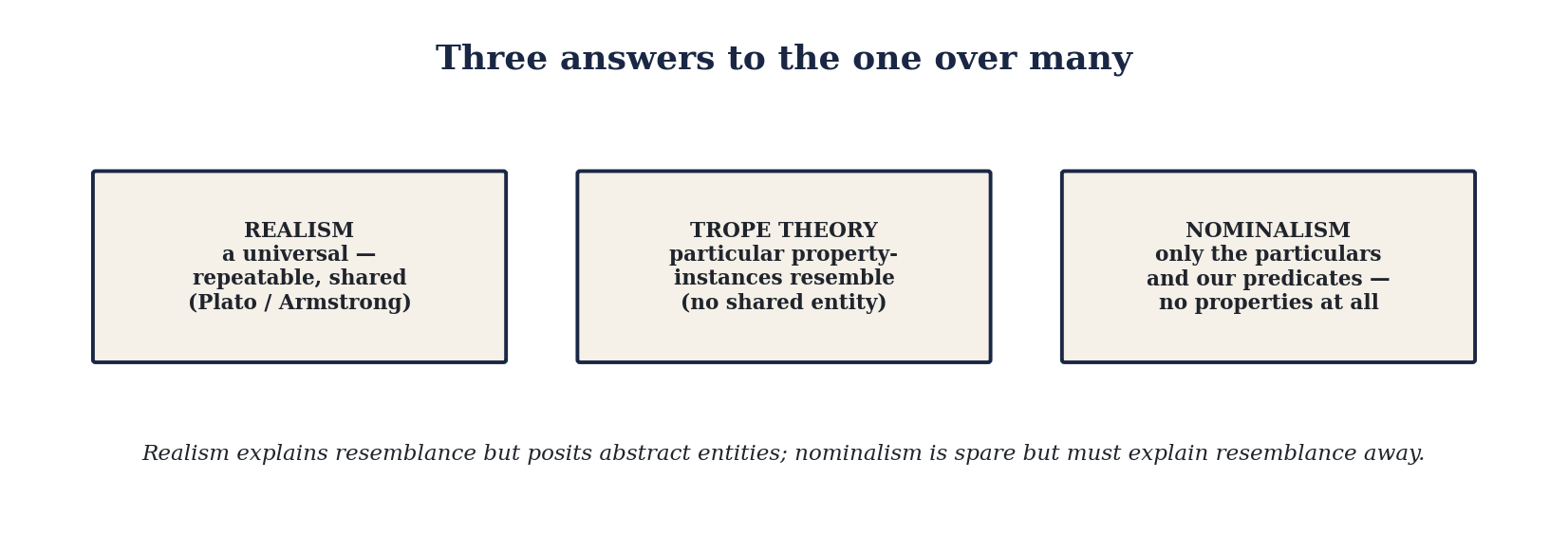
Three families of answer divide the field (Fig. 2). Realism affirms universals: for Plato they are transcendent Forms existing apart from their instances; for Armstrong [4] they are immanent, existing only in the things that instantiate them, and discoverable a posteriori. Realism explains resemblance directly — things resemble by sharing a universal — but pays in ontology, admitting a category of repeatable, abstract entities. Nominalism refuses that category: there are only particulars, and resemblance must be handled by predicates we apply, or classes things fall into, or primitive resemblance among the particulars themselves. It is economical but owes an account of why the predicates apply as they do. Trope theory splits the difference: it admits properties but as particulars — this tomato's redness is numerically distinct from that one's — and grounds talk of shared properties in the resemblance of tropes, not in a shared entity.
3. The abstract, the concrete, and mathematics
Universals, if real, are usually classed as abstract — outside space and time, causally inert — and this raises the general problem of abstract entities, of which mathematical objects are the hardest case. The indispensability argument observes that our best science quantifies ineliminably over numbers, and concludes by Quine's own criterion that we are committed to them; the Platonist takes the commitment at face value, the nominalist labours to paraphrase it away. The status of numbers is thus not a side-issue but the sharp end of the problem of universals: if there are abstract objects at all, the numbers are they.
4. The Force of Time: universals in the substance
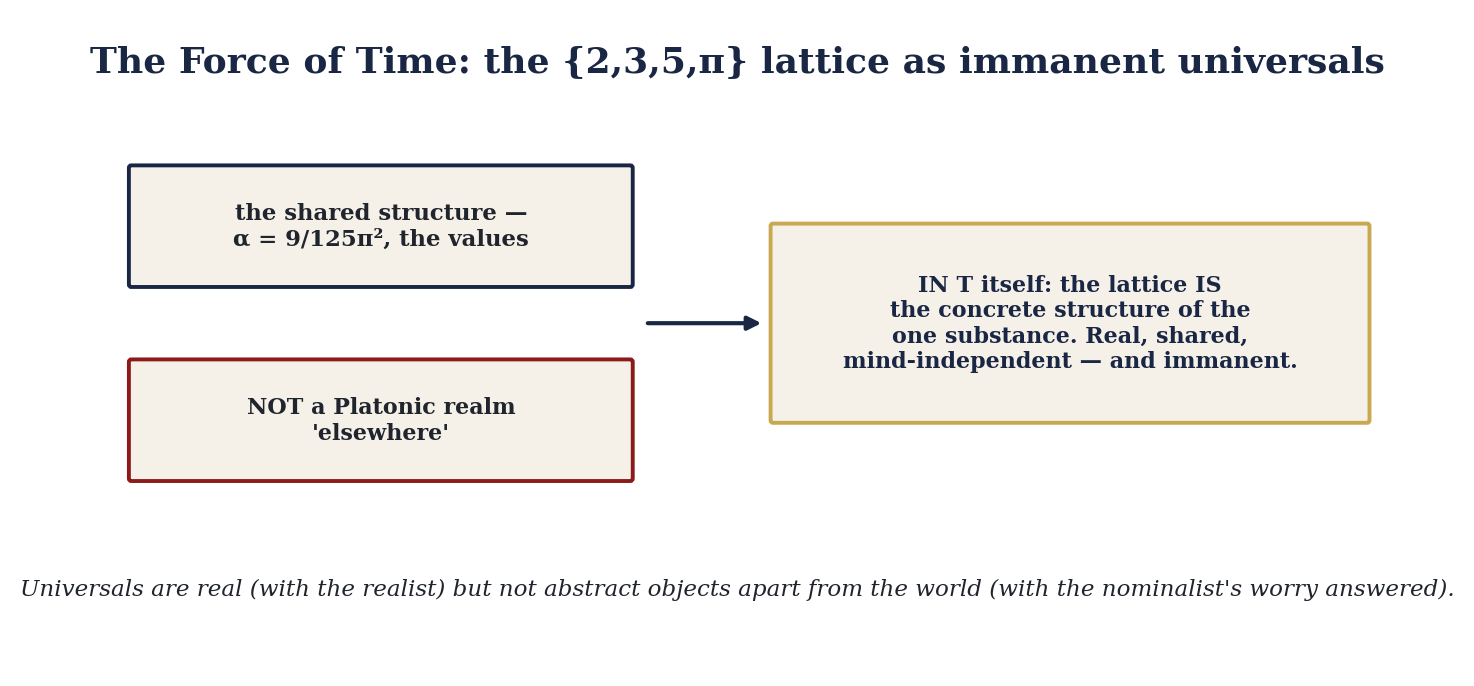
The Force of Time cuts across the realism–nominalism dispute by relocating the universals (Fig. 3). It agrees with the realist that there are real, repeatable, mind-independent structures that distinct things share: the {2,3,5,π} lattice is exactly such a system. The fine-structure ratio 9/125π², the carrier values, the geometry that fixes the water angle — these are not features we project but structures the world instantiates wherever the relevant configuration of Τ occurs, wholly and repeatably. That is realism about universals. But the theory denies what makes realism costly: that these universals form an abstract realm apart from the concrete world. The lattice is not elsewhere. It is the structure of Τ itself — the concrete substance of which everything is made. The universals are therefore immanent in the strongest possible sense, not merely present in their instances but identical with the structure of the one stuff those instances are configurations of.
5. Numbers as constituents, not describers
This dissolves the special problem of mathematics. On the Force of Time the numbers of the lattice are not abstract objects that our theories describe from outside; they are constituents of the world's fabric. To say that the fine-structure ratio is 9/125π² is not to relate a physical magnitude to a Platonic number in a separate realm; it is to state the actual lattice structure that Τ has at that address. The indispensability of mathematics to physics is then unmysterious and expected: mathematics is indispensable because the world is arithmetical in its substance, built on {2,3,5,π}. The numbers are real, as the Platonist insists, and concrete, as the nominalist wants — because they are the structure of the concrete substance.
6. Properties, truthmakers, and what this claims
A property-attribution is made true, on this account, by a configuration of Τ: 'this is red' is true in virtue of Τ being arranged, at the relevant address, in the lattice pattern that constitutes redness. Properties are neither transcendent Forms nor free-floating tropes but modes of the one substance, individuated by their lattice structure; their sharing is the recurrence of the same structure at many addresses. Truthmakers, the concern of the companion literature [7], are thus supplied uniformly: the truthmaker of any property-claim is the configuration of Τ that satisfies it. The claim of the paper is that this immanent realism keeps the explanatory advantage of realism (resemblance is the sharing of real structure) without its ontological cost (no realm of abstracta), and keeps the concreteness the nominalist prizes without its explanatory debt (the structure is really there to be shared). Its adequacy turns on whether the lattice can in fact furnish the properties the world displays — the running burden of the series.
7. Conclusion
The problem of universals is the problem of the one in the many, and the Force of Time answers it by finding the one within the many rather than above them. The shared structures are real and repeatable — the realist's insight — but they are the structure of the single concrete substance — the nominalist's scruple honoured. Redness, and the number three, are equally in the world, because the world is made of a substance whose fabric is arithmetical.
Figures
The position, in full
The one-over-many is answered by real, repeatable, mind-independent structures — the {2,3,5,π} lattice — which distinct things share. This is realism about universals.
The universals are immanent to the strongest degree: not an abstract realm apart from the world but the concrete structure of Τ itself. Realism without a Platonic heaven; concreteness without nominalism's explanatory debt.
Mathematical objects are real and concrete: the lattice numbers are constituents of the world's fabric, not descriptions of it from outside. Mathematics is indispensable to physics because the substance is arithmetical.
A property is a mode of Τ individuated by its lattice structure; property-sharing is the recurrence of the same structure at many Τ-addresses. Neither Form nor free trope.
Truthmakers are uniform: the truthmaker of any property-attribution is the configuration of Τ that satisfies it.
References
[1] Plato, Republic, Books V–VII; Parmenides — the theory of Forms and its problems.
[2] Aristotle, Categories; Metaphysics Book Ζ — immanent forms against the Platonic separation.
[3] W. V. O. Quine, On What There Is, Review of Metaphysics 2, 21 (1948) — commitment and the indispensability of numbers.
[4] D. M. Armstrong, Universals: An Opinionated Introduction, Westview (1989) — immanent realism.
[5] D. C. Williams, On the Elements of Being, Review of Metaphysics 7, 3 (1953) — trope theory.
[6] A. Ney, Metaphysics: An Introduction, Routledge (2014), ch. 2.
[7] R. C. Koons and T. H. Pickavance, Metaphysics: The Fundamentals, Wiley-Blackwell (2015), ch. 2, 4.
[8] S. Daubney, The Universal Force of Time — Master Compendium v5, The Daubney Foundation (2026); the fine-structure ratio 9/125π² and the {2,3,5,π} lattice.
A Note on Standing
The account given here is one interpretation among rivals, offered as their equal and not as their correction. Nothing in the metaphysical tradition it engages — realism or nominalism, the A-theory or the B-theory, and the rest — is established fact, and neither is the Force of Time; each is a reasoned attempt to interpret a reality none of us can step outside to check. Where these papers say a problem 'does not arise' or a question 'lapses', that holds within the theory's own premises, which are no less contestable than those of the positions set beside them. The Force of Time is advanced as a coherent alternative viewpoint, to be weighed on the merits — and, unusually among these views, to be tested where it makes contact with measurement.
A Note on the Series
This is Paper 3 of Metaphysics through the Force of Time. Paper 2 gave the single-floor ontology; this paper places the universals within that floor; Paper 4 (material objects and composition) treats the particulars that instantiate them.