Abstract
Metaphysics asks what there is, most fundamentally, and what its nature is. The discipline has been repeatedly pronounced dead — by Hume, by Kant, and most sharply by the logical positivists, for whom its claims were literally meaningless because unverifiable — and repeatedly revived, most recently in the analytic tradition of Quine, Kripke, Lewis and Armstrong. This paper sets out the methods that revival restored — Quine's criterion of ontological commitment, the method of paraphrase, and Ockham's razor — and gives the Force of Time's relation to them and to the critique. The theory is a metaphysics of the most ambitious kind: it holds that there is exactly one substance, Τ, of which everything is a configuration. Yet it answers the positivist objection that its predecessors could not, because the single substance fixes the measurable values of nature — the constants and geometries lie on a {2,3,5,π} lattice — so the theory is at once first philosophy and physics, meeting the demand for empirical contact rather than retreating from it. On Quine's criterion its ontological commitment is minimal (one entity); on Ockham's razor it is the parsimony limit. It is offered throughout as one interpretation among the tradition's rivals — advanced as their equal, not their correction, since none of these views, its own included, is established fact — with the distinguishing feature that, unlike most of them, it can be tested where it meets measurement. We state the position as numbered propositions.
1. The question, and its obituaries
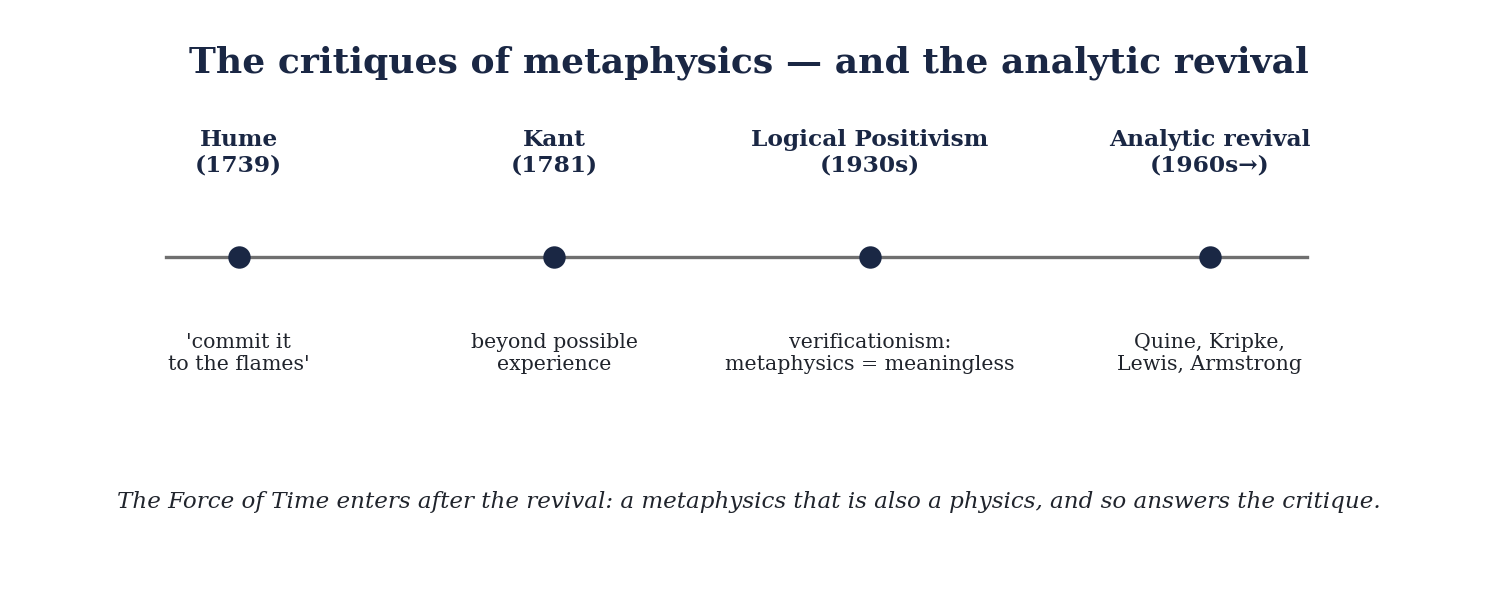
Metaphysics is the inquiry into the most general features of reality: what kinds of thing exist, what it is for them to exist, and how they depend on one another. It is, in Aristotle's phrase, first philosophy — the study prior to the special sciences because it fixes the categories they presuppose. It is also the most frequently buried subject in philosophy (Fig. 1). Hume would commit its volumes to the flames as 'sophistry and illusion'; Kant held its questions to reach beyond any possible experience; the logical positivists of the 1930s, armed with the verification principle, declared its sentences not false but meaningless, since no observation could confirm or refute them [2,5]. Each obituary was followed by a resurrection, and the most vigorous is the analytic revival of the last half-century, in which the tools of modern logic were turned back onto the old questions with new precision [3,4].
2. Quine's criterion of ontological commitment
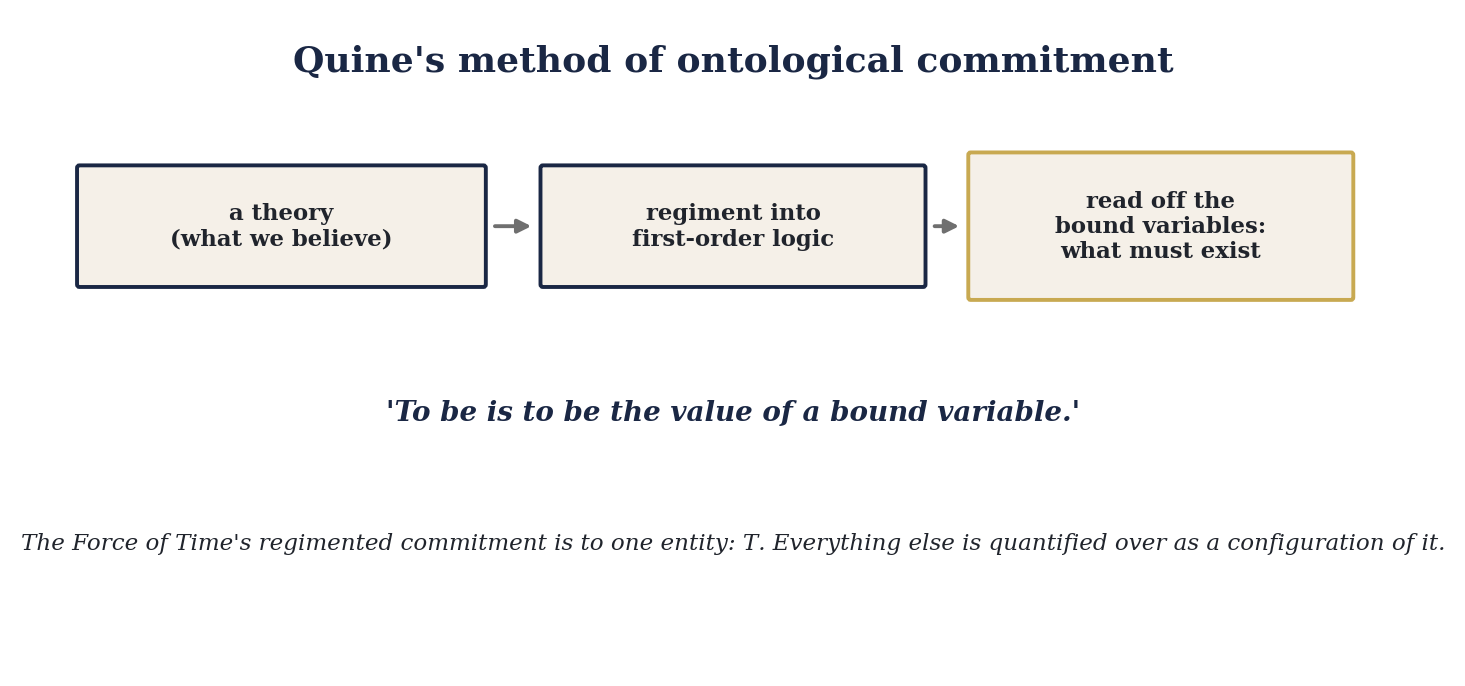
The revival's central methodological gift is Quine's criterion (Fig. 2). To find what a theory says exists, regiment it into the language of first-order logic and see what its existential quantifiers must range over: 'to be is to be the value of a bound variable' [3]. Ontology becomes disciplined — a matter of what one's best theory, made logically explicit, is committed to — rather than a clash of intuitions. The companion device is the method of paraphrase: an apparent commitment can be discharged if the sentence that carries it can be paraphrased into one that does not (talk of 'the average family' commits us to no ghostly average family). Ontology is thus a negotiation between the commitments a theory incurs and the paraphrases that can relieve them.
3. Ockham's razor and the standard of parsimony
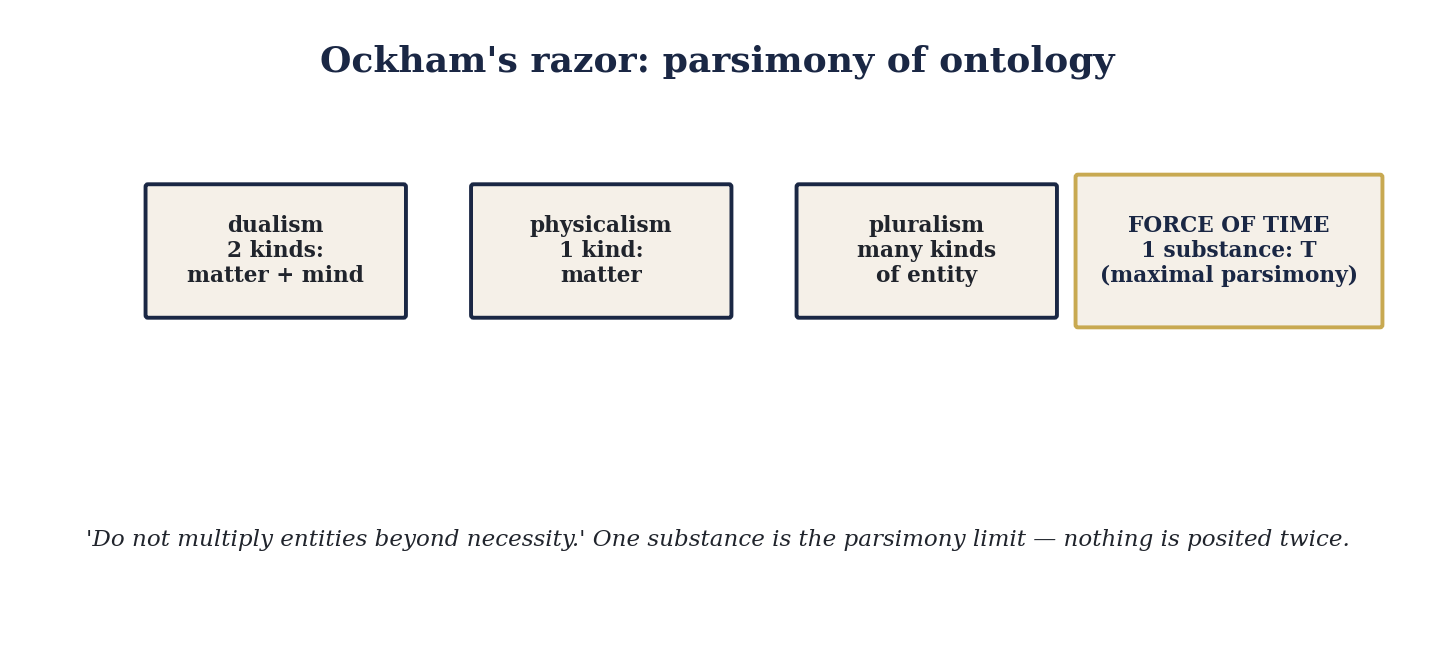
The negotiation is governed by a norm of economy — Ockham's razor: do not multiply entities beyond necessity (Fig. 3). Other things equal, the theory that posits fewer kinds of fundamental entity is to be preferred. The razor does not by itself settle any dispute, but it sets the direction of ontological ambition: the ideal terminus of inquiry is the smallest inventory of fundamental kinds from which everything else can be recovered.
4. The Force of Time as first philosophy
The Force of Time is a metaphysics in the fullest and most old-fashioned sense: it offers a single answer to the question of what there is. There is one substance, Τ — time itself — and every particle, force, wavelength and experience is a configuration of it, conserved absolutely (dΣΤ = 0). On Quine's criterion its ontological commitment is as small as a commitment can be: the regimented theory quantifies over exactly one entity, and everything else is quantified over only as a mode or configuration of that entity. On Ockham's razor it is not merely economical but at the parsimony limit — one cannot posit fewer than one substance and still have a world. This is first philosophy discharging its office: fixing, at the ground, the single category the special sciences elaborate.
5. Answering the positivist critique
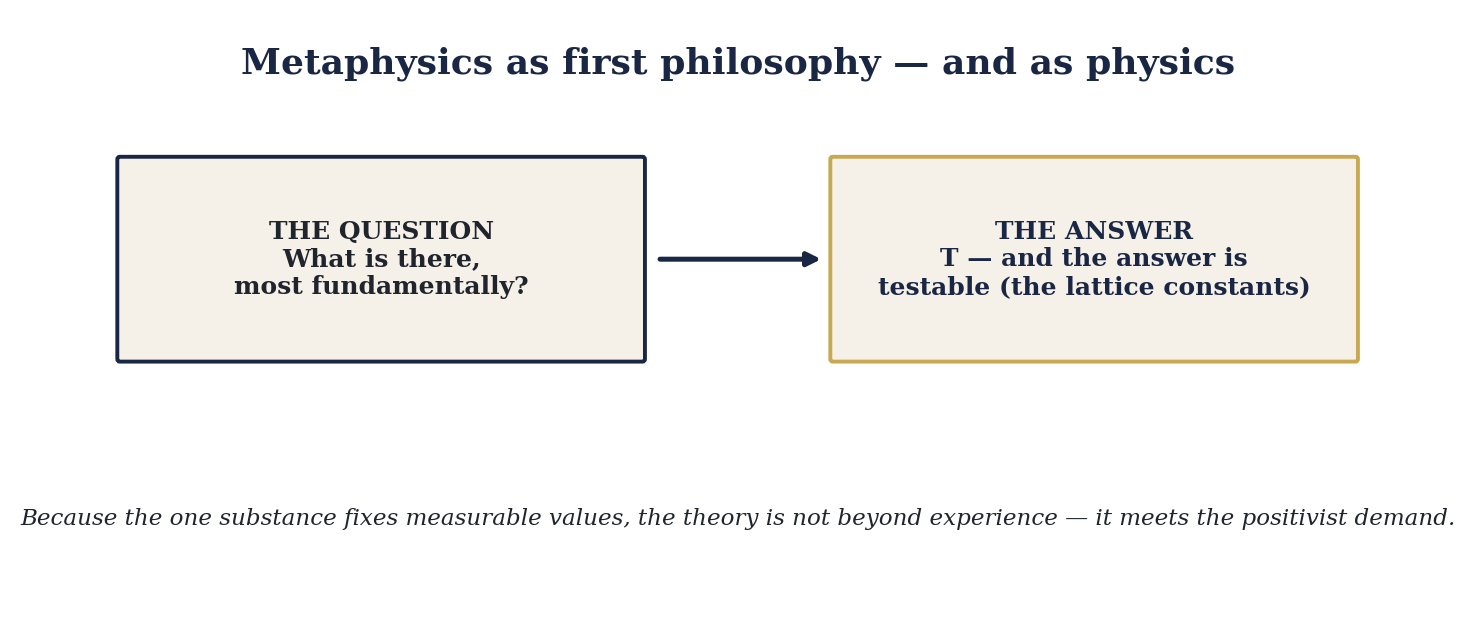
The decisive difference between the Force of Time and the metaphysics the positivists attacked is empirical contact (Fig. 4). The positivist charge was that metaphysical claims float free of observation and so say nothing. The single-substance thesis does not float free: because Τ is structured on a {2,3,5,π} lattice, it fixes the measurable values of nature — the fine-structure ratio, the spectral wavelengths, the planetary periods — to definite numbers, and those numbers can be checked. A metaphysics that entails the value of the fine-structure ratio is not beyond possible experience; it is answerable to it. The theory therefore occupies a position the tradition rarely manages: it is at once first philosophy and physics, and it meets the verificationist demand not by lowering its ambitions but by raising its content until it makes contact with measurement.
6. What this claims
The claim of this opening paper is not yet any particular result but a stance and a standard. Metaphysics is a legitimate and central inquiry; its method is the disciplined ascertaining and paring of ontological commitment; and the Force of Time is a candidate first philosophy that submits to that method, posts a minimal commitment, and — unusually — pays the empirical price the positivists demanded. Whether the single substance can in fact recover the phenomena is the burden of the special papers: universals and properties, material objects and composition, time, persistence, modality, causation, free will, and persons. Each takes a canonical problem and asks what follows once it is granted that there is only Τ.
7. Conclusion
The history of metaphysics is a history of premature funerals. What survives each is the question — what is there, and what is it? — and the demand, sharpened by every critic, that an answer be both economical and accountable. The Force of Time offers one answer — a single substance — and accepts the accounting. The remainder of the series sets that answer beside the tradition's others, as one interpretation among equals, and asks how far it reaches.
Figures
The position, in full
Metaphysics is first philosophy: the inquiry into the most general categories of what exists and their dependence, prior to the special sciences.
Method: ontological commitment is read off a theory regimented into first-order logic (Quine — 'to be is to be the value of a bound variable'), tempered by paraphrase and governed by Ockham's razor.
The Force of Time is a maximal metaphysics with a minimal commitment: exactly one substance, Τ; all else is a configuration of it. On Quine's criterion the commitment is to one entity; on Ockham's razor it is the parsimony limit.
It answers the verificationist critique by empirical contact: Τ on the {2,3,5,π} lattice fixes measurable constants, so the theory is at once first philosophy and physics — accountable to observation, not beyond it.
The series sets the one substance beside the tradition's rivals as an equal: each subsequent paper asks how far the single substance recovers a canonical metaphysical domain (universals, composition, time, persistence, modality, causation, agency, persons), on premises no less contestable than theirs.
References
[1] Aristotle, Metaphysics, Book Γ (Gamma) — first philosophy and the study of being qua being.
[2] I. Kant, Critique of Pure Reason (1781/1787) — the limits of metaphysical knowledge.
[3] W. V. O. Quine, On What There Is, Review of Metaphysics 2, 21 (1948) — the criterion of ontological commitment.
[4] D. M. Armstrong, Universals: An Opinionated Introduction, Westview (1989); S. Kripke, Naming and Necessity, Harvard (1980).
[5] A. J. Ayer, Language, Truth and Logic (1936) — the verification principle and the rejection of metaphysics.
[6] A. Ney, Metaphysics: An Introduction, Routledge (2014), ch. 1, 4.
[7] R. C. Koons and T. H. Pickavance, Metaphysics: The Fundamentals, Wiley-Blackwell (2015), ch. 1.
[8] S. Daubney, The Universal Force of Time — Master Compendium v5, The Daubney Foundation (2026).
A Note on Standing
The account given here is one interpretation among rivals, offered as their equal and not as their correction. Nothing in the metaphysical tradition it engages — realism or nominalism, the A-theory or the B-theory, and the rest — is established fact, and neither is the Force of Time; each is a reasoned attempt to interpret a reality none of us can step outside to check. Where these papers say a problem 'does not arise' or a question 'lapses', that holds within the theory's own premises, which are no less contestable than those of the positions set beside them. The Force of Time is advanced as a coherent alternative viewpoint, to be weighed on the merits — and, unusually among these views, to be tested where it makes contact with measurement.
A Note on the Series
This is Paper 1 of Metaphysics through the Force of Time, a chapter-by-chapter reading of the standard introductions (Ney 2014; Koons and Pickavance 2015) through the single-substance ontology of Τ. It sets the method and standard; Papers 2–10 apply them to ontology, universals, composition, time, persistence, modality, causation, free will, and persons.