The binding filter
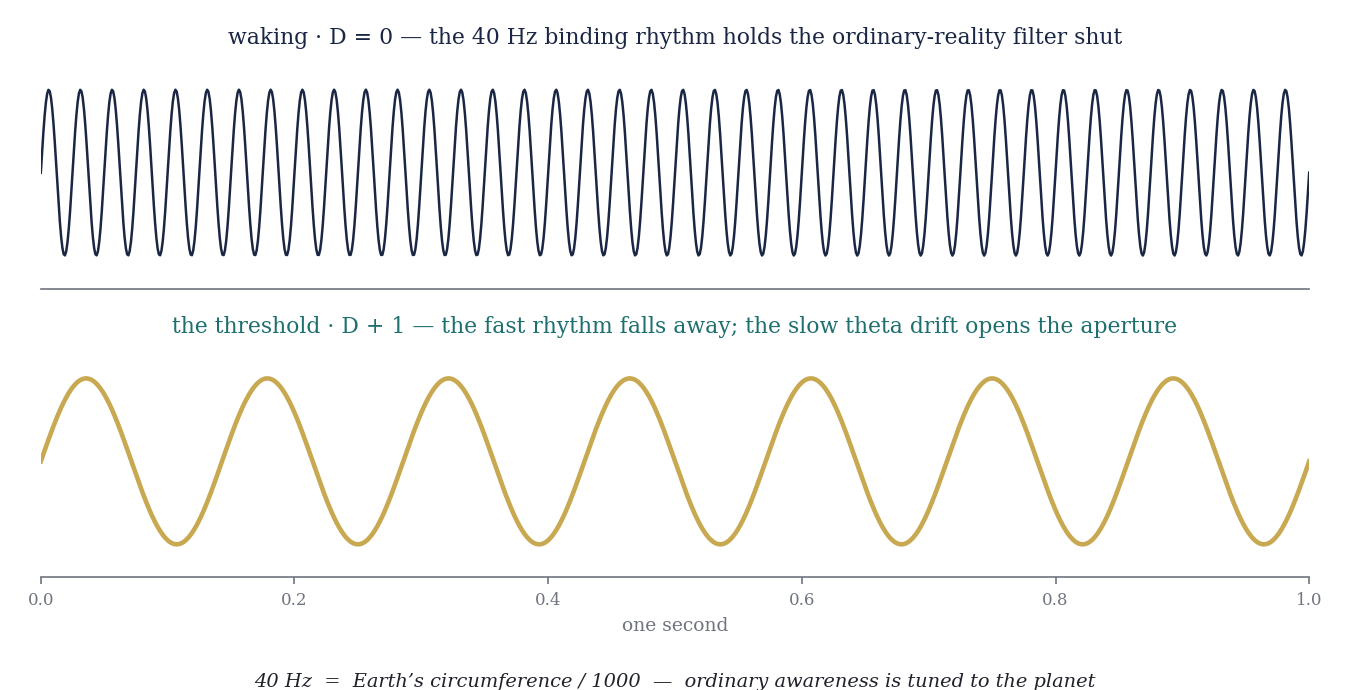
Waking awareness presents a single unified field although it integrates many separately processed signals; the leading account of that binding is synchronised gamma-band activity near 40 Hz (Crick & Koch). The framework takes this synchrony not merely as a correlate but as the constitutive mechanism of the ground register, and assigns it a value — the Earth’s circumference divided by a thousand — reading its function as a filter: it secures a stable, survivable representation by admitting only a narrow band of the field.
The consequent, testable expectation is that a relaxation of the binding rhythm should admit content otherwise excluded, rather than merely degrading the representation. It is this expectation the altered states are held to satisfy.
The aperture, and what the deeper register presents
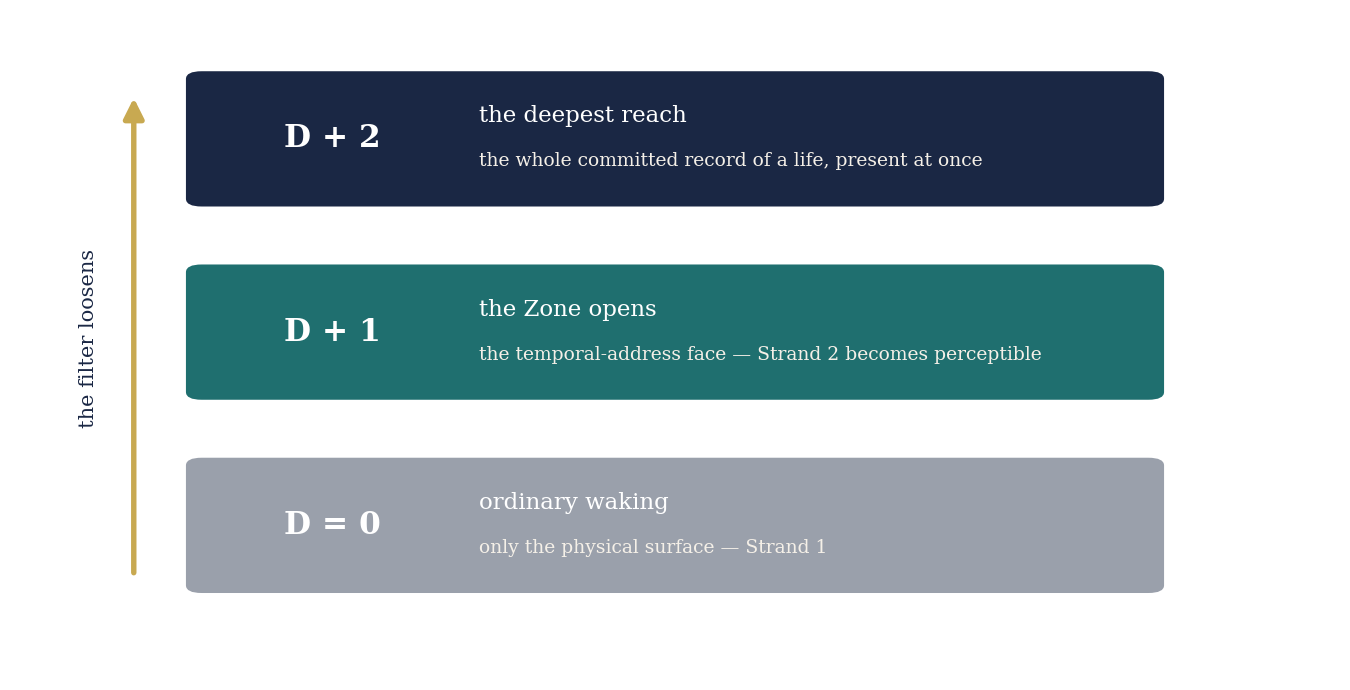
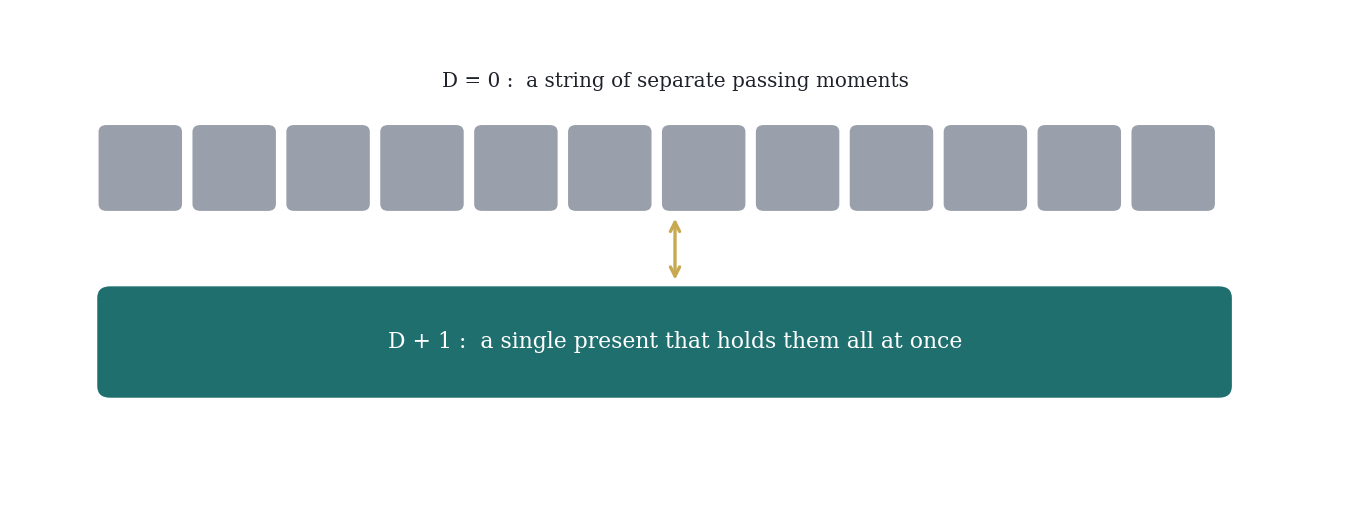
At sleep onset the gamma synchrony gives way to slow theta; the register lifts by one level, and hypnagogic content — vivid, structured — is admission of the deeper register, not endogenous fabrication. The framework distinguishes two aspects of the field: Strand 1, the spatial embedding the ground register tracks, and Strand 2, the temporal-informational aspect. The ground register reads Strand 1 almost exclusively; the elevated register admits Strand 2 — which is why dream and threshold states are not bound by ordinary spatial logic.
One phenomenon, many doorways
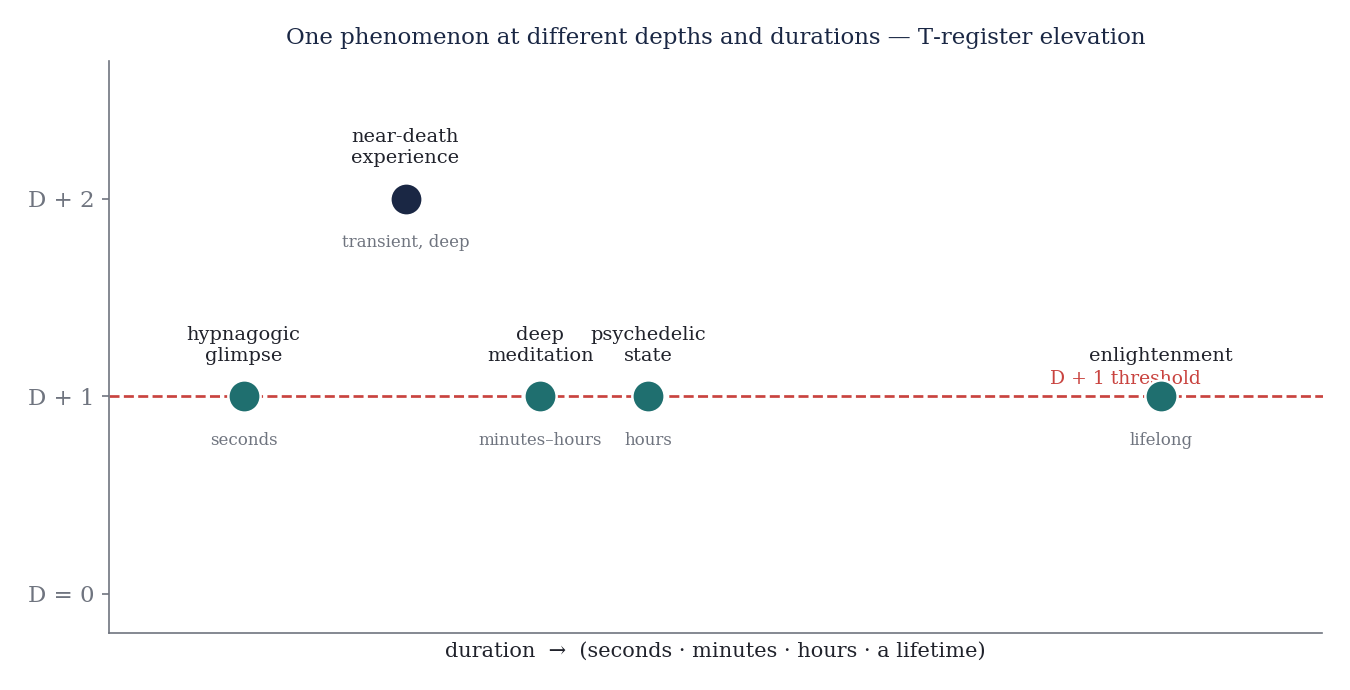
The states resolve into one spectrum, differing in depth and duration rather than in kind: the brief hypnagogic glimpse; deep meditation (the same elevation held voluntarily); the psychoactive state, reached by suppression of the default-mode network (Carhart-Harris), consistent with the observed rise in cortical entropy and integration; the near-death experience, the deepest transient access; and enlightenment, the permanent elevation. The psychoactive route is described mechanistically only; no use is recommended.
Positioned against the science
Consciousness is the inward aspect of a deep register; the hard problem (Chalmers) is dissolved — there is no non-experiential substrate to generate experience from.
Orthogonal to integrated-information (Tononi) and global-workspace (Baars, Dehaene) theories: these characterise the outward face; the framework identifies consciousness with the inward one.
Dual-register occupancy — elevated-register phenomenology with a ground-level monitor (LaBerge) — shows the two levels can be co-occupied.
Aperture content should track the collapse of gamma binding; elevation depth should track default-mode suppression — each falsifiable.