In which the thermodynamics of mixtures — chemical potential, activity, fugacity, and the difference between an ideal solution and a real one — is read as the blending of Τ-registers: mixing as the dispersal of Τ through a combined address, and the departure of a real solution from the ideal carried, step by step, by the one universal register separator, the G-bond step δG = 0.0000901506.
Introduction — Through the Force of Time
The chapter that follows is, in the conventional telling, the thermodynamics of solutions — how to handle systems of more than one component, where the chemical potential, activity and fugacity replace the simple quantities of a pure substance. Read through the Universal Force of Time it is the physics of what happens when Τ-registers blend: an ideal solution is components sharing one register, a real one is components on registers slightly offset, and the offset is measured in a single universal step.
Almost nothing in the Earth is pure. Magmas are melts of a dozen elements; the ocean is a solution of many salts; a mineral is a solid solution of substituting atoms. To do the thermodynamics of the real Earth, then, we need the thermodynamics of mixtures, and that is the business of this chapter. The tools are the chemical potential — the tendency of a component to leave a phase — and its companions, the activity and the fugacity, which correct the simple ideal picture for the messy reality of components that interact.
White’s account is the standard one: an ideal solution mixes without any heat of mixing, its components behaving as if blind to one another; a real solution departs from this, and the departure is bookkept by an activity coefficient, a fudge factor that is 1 when the solution is ideal and drifts from 1 when it is not. The whole apparatus — Raoult’s law and Henry’s law, the Gibbs–Duhem constraint, the excess free energy — is a way of describing how far, and in which direction, a real mixture strays from the ideal.
The Force of Time reads a mixture as a blend of registers. Each component carries its own Τ-address; when two are mixed, their registers combine, and the ‘entropy of mixing’ the textbooks compute is simply Τ dispersing through the joint address — the Second Law of the last chapter, acting among components. An ideal solution is the special case where the components share the same register exactly: they blend without offset, and activity equals concentration. A real solution is the general case where the registers are slightly displaced, and the activity coefficient measures that displacement.
And the displacement is not arbitrary. The Force of Time carries a single universal separator between registers, the G-bond step δG = 5¹⁰/(2⁴×3⁹×π³) − 1 = 0.0000901506 — the same step that separates the two faces of the speed of light, of the free fall, of the sodium line, and of the Moho we met in Chapter 1. A real solution departs from the ideal by this step, or by whole multiples of it: non-ideality is register offset, quantised.
The Chemistry of Mixtures
A pure substance is simple to describe; a mixture is not, and almost everything in the Earth is a mixture. The central quantity for handling them is the chemical potential — written μ — which measures the tendency of a component to leave the phase it is in, whether by reacting, evaporating, dissolving or crystallising. A component flows from where its chemical potential is high to where it is low, and a system is at equilibrium when the chemical potential of every component is the same in every phase it touches.
In the reading of this book, the chemical potential is the Τ-potential of a component — the contribution its own address makes to the Τ of the phase, and hence its readiness to move to where that Τ can settle lower. Equilibrium, where the potentials are equal across phases, is the state in which Τ can settle no lower by moving any component; it is the nodal rest of the last chapter, resolved component by component. The partial molar quantities that go with it — the share of volume, entropy or energy that each component contributes — are the way a mixture’s total Τ is divided among the addresses that make it up.
Mixing Is the Blending of Registers
Begin with mixing itself, because it is where the register picture is clearest. Take two substances, each pure, each in its own container, and let them mix. Even if nothing chemical happens — no heat given out, no bonds made or broken — something changes: the mixture will not spontaneously unmix. The textbooks capture this with an entropy of mixing, a term that is always positive and that measures the disorder gained by intermingling.
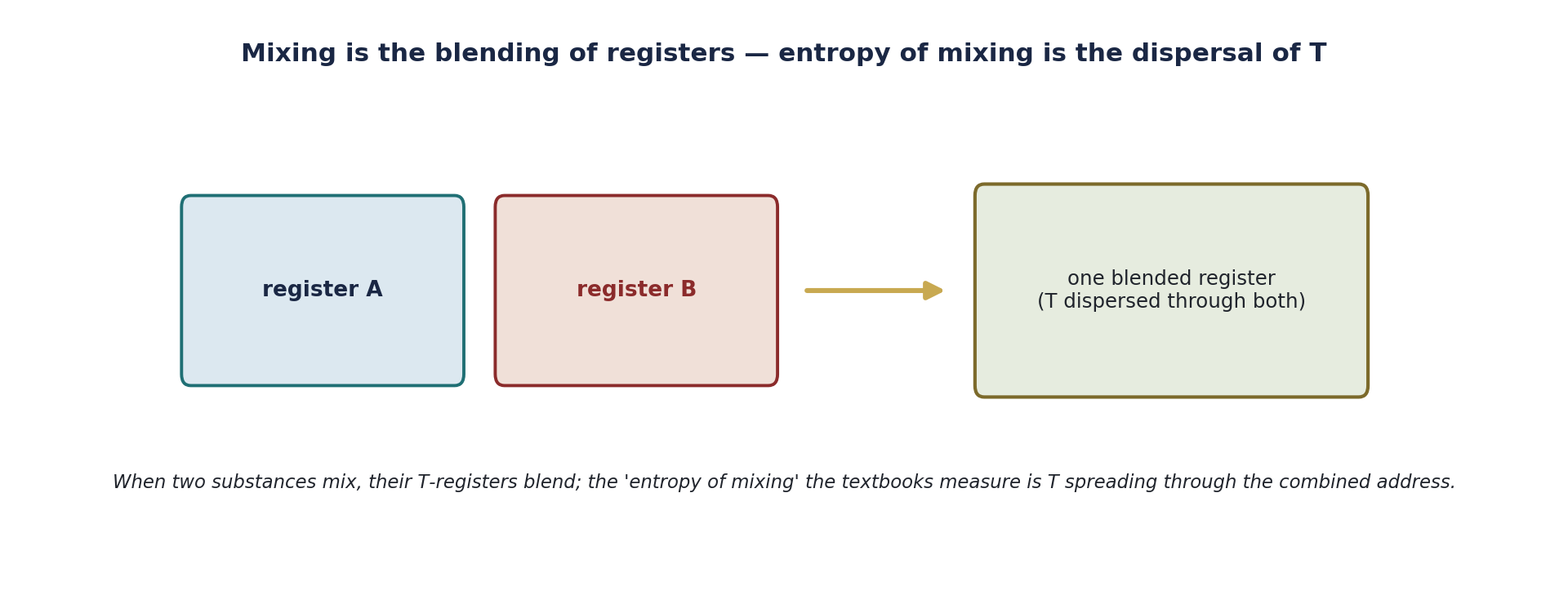
Read as the accountancy of Τ, the entropy of mixing is the dispersal of Τ through the combined address of the mixture. When the two registers blend, Τ spreads to fill the joint arrangement, and by the Second Law it will not gather itself back into two separate registers any more than heat will flow uphill. The mixture stays mixed for the same reason the arrow of time points forward: Τ, once dispersed through a wider address, does not spontaneously re-concentrate. Mixing is not a special chemical effect; it is the Second Law, seen among components.
The Ideal Solution
The simplest mixture is the ideal solution, and it is worth being exact about what makes it simple. In an ideal solution the components mix with no heat of mixing at all: each behaves as though the others were copies of itself, blind to any difference between them. Its activity — the effective concentration that enters every thermodynamic equation — is just its mole fraction, the plain proportion of it in the mix.
In the Force of Time this is the case where the components share one register exactly. If two substances sit on the same Τ-address, then to each of them the others are indistinguishable, and blending them costs nothing beyond the dispersal of mixing; activity equals concentration because there is no register offset to correct for. The ideal solution is not an idealised fiction that real solutions merely approximate; it is the exact behaviour of components that happen to share a register — the baseline from which every real departure is measured.
Real Solutions and the Register Offset
Most real solutions are not ideal. Their components do notice one another; mixing gives out or takes in heat; and the activity is no longer equal to the concentration. The textbooks handle this with an activity coefficient, γ, defined so that activity = γ × concentration: it is 1 for an ideal solution and departs from 1 by however much the solution is non-ideal, a number to be measured and tabulated.
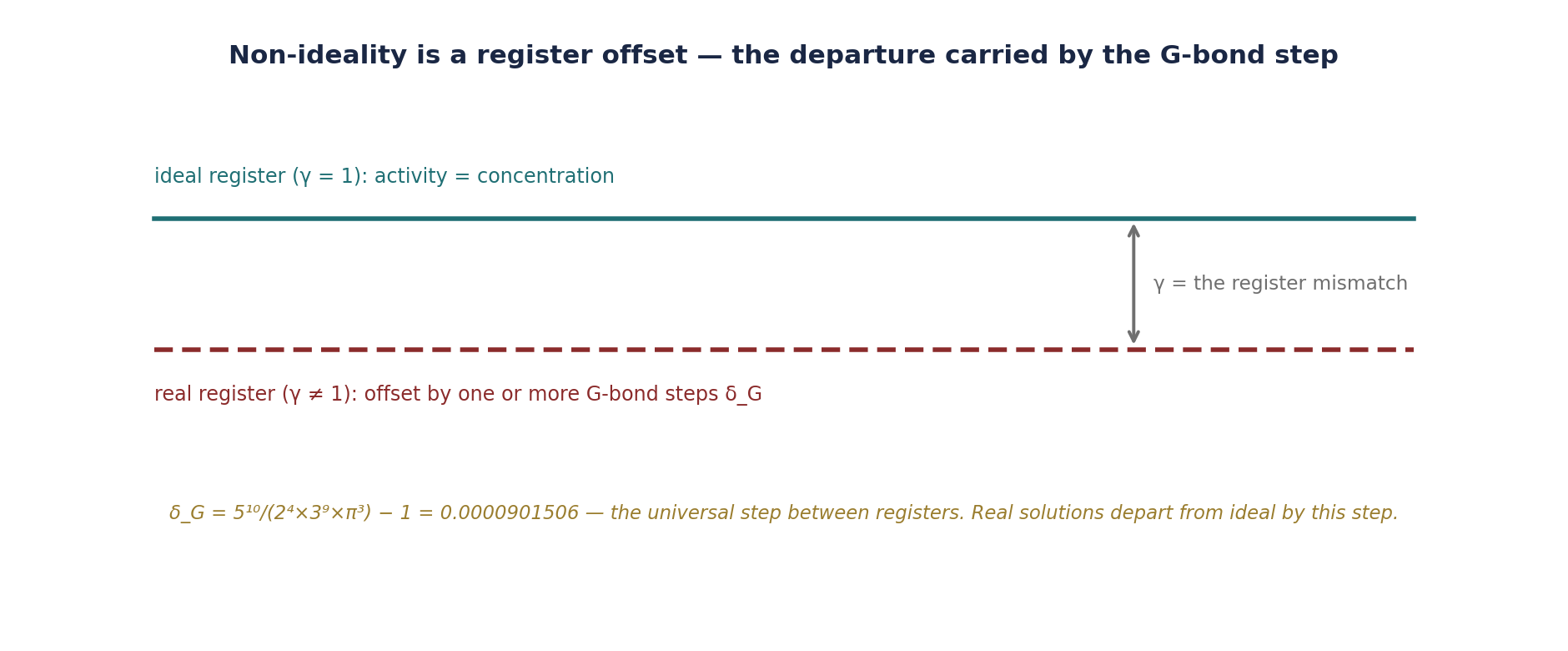
Here the Force of Time gives the activity coefficient a meaning it does not have in the standard account. γ measures a register offset: the amount by which the components’ Τ-addresses are displaced from sharing one register. And the displacement is quantised, because the theory carries a single universal separator between registers — the G-bond step δG = 5¹⁰/(2⁴×3⁹×π³) − 1 = 0.0000901506, the same step that separates the two faces of the speed of light, of the free fall, and of the Moho itself. A real solution is offset from the ideal by this step, or by whole multiples of it. Non-ideality is not disorder to be fudged; it is register mismatch, counted in G-bond steps.
Fugacity: The Escaping Tendency
For gases and for volatile components — the water and carbon dioxide dissolved in a magma, say — the corresponding quantity is the fugacity, often described as an ‘escaping tendency’: the effective pressure a component exerts in its drive to leave the phase and enter the vapour. Like activity, it corrects the simple ideal-gas pressure for the reality of interacting molecules.
Read as Τ, the fugacity is the pressure of a component to leave its register — the readiness of its Τ-address to unbind from the phase and disperse into the freer register of a gas. It is the same tendency the chemical potential measures, expressed as a pressure; and it corrects for register offset in exactly the way the activity coefficient does. When later chapters track how much water or carbon dioxide a magma can hold, or how gases partition between the Earth’s interior and its atmosphere, the fugacity is the measure of the deep Earth’s Τ straining to escape to the surface register.
Raoult and Henry: The Two Limits
Two limiting laws bracket the behaviour of a component in solution. Raoult’s law holds when a component is abundant — near its own pure state — and says its activity approaches its mole fraction. Henry’s law holds when a component is dilute — a trace lost among strangers — and says its activity is proportional to its concentration, but by a different constant. Between the two limits the behaviour bends from one line to the other.
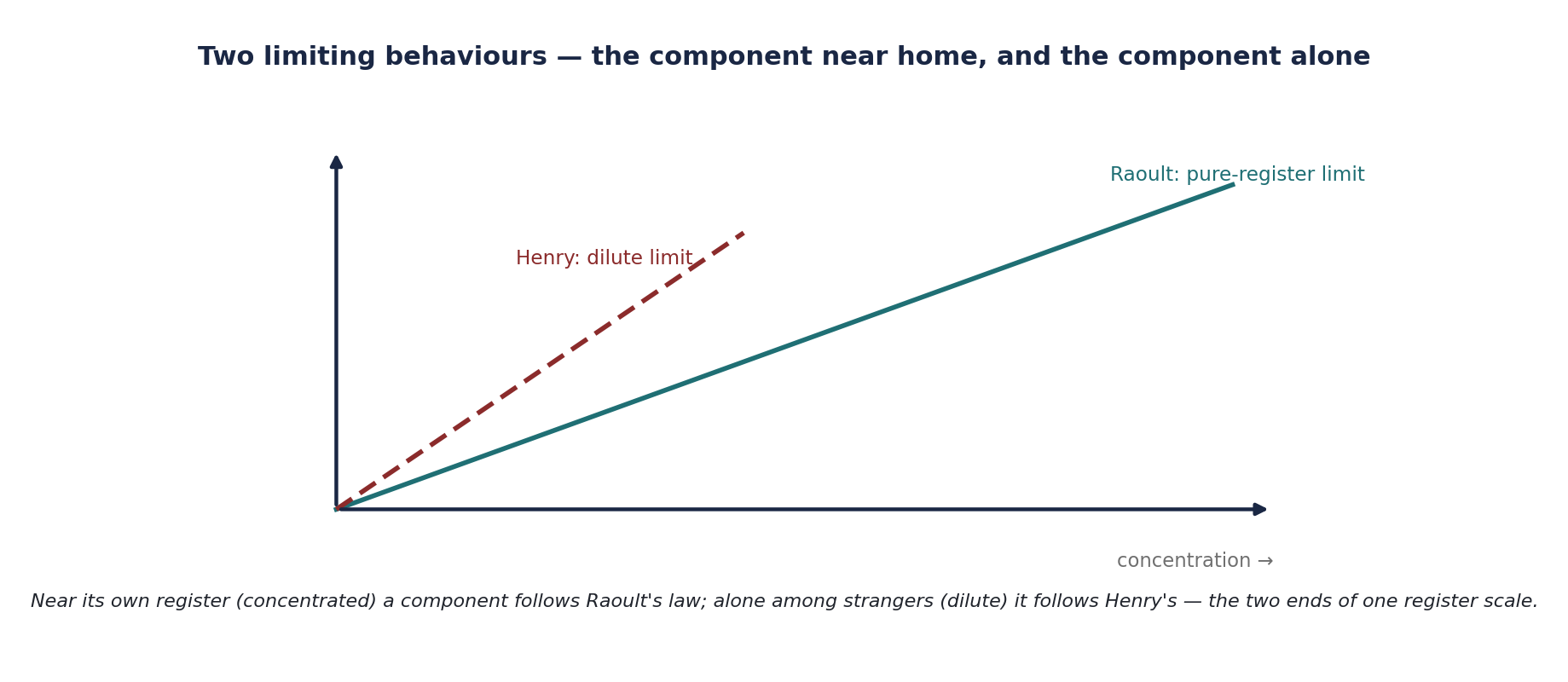
In the register picture these are the two ends of one scale. When a component is near its own register — surrounded by its own kind — it feels no offset, and its activity is simply its proportion: Raoult’s law is the pure-register limit. When it is dilute — a lone address among a crowd of foreign ones — it feels the full offset of the host register, constant with further dilution: Henry’s law is the foreign-register limit. The bend between them is the register offset growing as the component moves from its own kind into a foreign crowd. Two limiting laws, one register scale.
The Conservation Among Components
One constraint threads the whole subject: the Gibbs–Duhem relation, which says that the chemical potentials of the components of a phase cannot all change independently — if one goes up, the others must adjust so that a weighted sum stays fixed. It is what lets a geochemist deduce the behaviour of one component from measurements of the others.
This is dΣΤ=0 acting within a single phase. The total Τ of the phase is fixed, so the Τ-potentials of its components are not free to wander independently; a rise in one must be paid for by a fall in the others, the books always balancing. The Gibbs–Duhem relation is not a separate rule of solution chemistry; it is the conservation of Τ restated for a mixture, the same law that runs through every chapter, here keeping the accounts among the components of a melt or a brine.
Why This Should Matter to You
Solutions are not a corner of geochemistry; they are most of it. The magma that builds the crust is a solution; the sea is a solution; the fluids that carry metals to make ore deposits are solutions; the minerals that record the Earth’s history are solid solutions of substituting atoms. To understand the Earth’s chemistry at all is to understand how its many components share, and fail to share, their registers.
And the sharing is legible. An ideal mixture is components on one Τ-register; a real one is components a G-bond step apart; and that step, δG = 0.0000901506, is the same universal separator that sets the two faces of the speed of light and the two faces of the Moho. The thermodynamics of solutions, which can look like a thicket of coefficients, is at bottom the arithmetic of how registers blend. With it in hand we can turn, in the next chapter, to the grandest solutions of all: the melting of the deep Earth and the making of magma.
The Numbers at a Glance
The quantities of solution thermodynamics and their Force-of-Time reading. Measured behaviour is left exactly as measured; the right-hand column gives the register meaning.
| Quantity | What it is | The Force of Time reading |
|---|---|---|
| Chemical potential μ | tendency of a component to leave a phase | the Τ-potential of the component’s address |
| Entropy of mixing | disorder gained on intermingling | Τ dispersed through the blended register |
| Ideal solution | mixes with no heat of mixing | components sharing one register exactly |
| Activity coefficient γ | activity ÷ concentration | the register offset (γ = 1 ⇒ one register) |
| G-bond step δG | — | 5¹⁰/(2⁴×3⁹×π³) − 1 = 0.0000901506 |
| Fugacity | escaping tendency of a volatile | the pressure to leave the register for a gas |
| Raoult / Henry limits | concentrated / dilute laws | the pure-register and foreign-register ends |
| Gibbs–Duhem | components not all free | dΣΤ=0 within one phase |
References
- S. Daubney, The Universal Force of Time — Master Compendium v5, The Daubney Foundation (2026).
- W. M. White, Geochemistry, John Wiley & Sons, Chichester (2005; 2013 print ed.), Chapter 3.
- S. Daubney, The Universal Force of Time — Master Theory, Volume 3 (G-Bond Step and Register Structure), The Daubney Foundation (2026).
- S. Daubney, The Force of Time — Where It Departs From Current Science, The Daubney Foundation (2026).
Open the full paper as a PDF ↗
This paper, and any information drawn from it, may be used freely provided the reference attribution to Stephen Daubney and The Daubney Foundation is recognised.