In which the question thermodynamics cannot answer — not whether a change can happen, but how fast — is opened as the pace at which Τ crosses a register boundary: the activation energy read as the Τ-barrier to the crossing, the Arrhenius law read through heat-is-time, and the whole reason some of the Earth’s rocks reach equilibrium in a heartbeat while others stay frozen out of it for a billion years.
Introduction — Through the Force of Time
The chapter that follows is, in the conventional telling, chemical kinetics: reaction rates, the activation energy, the Arrhenius law, catalysis, and diffusion. Read through the Universal Force of Time it is the physics of how fast Τ can cross from one register to another — the barrier between registers, the way a denser flow of time (heat) carries the crossing, and why the pace of the Earth’s chemistry ranges from the instant to the eternal.
Thermodynamics, the last three chapters, is a science of the possible and the final: it tells you which way a reaction will go, and where it will stop, but it says nothing whatever about when. A diamond at the surface is not the stable form of carbon — graphite is — and thermodynamics says it should convert. It does not, on any human timescale, and thermodynamics cannot tell you why not. For the when, and the how-fast, you need kinetics, the subject of this chapter.
White’s account is the standard one: a reaction proceeds at a rate set by how often reactants meet and how many meetings clear the activation energy — the hump of energy that must be climbed before reactants can become products. The rate rises steeply with temperature, following the Arrhenius law, in which the fraction of successful encounters goes as e^(−E_a/RT). Catalysts speed things by lowering the hump; diffusion — the slow shuffle of atoms through a solid or a liquid — often sets the pace in the Earth, where nothing is stirred.
The Force of Time reads all of this as the pace at which Τ crosses a register boundary. Thermodynamics, from Chapter 4, decides which register is the lower place for Τ to sit; kinetics asks how quickly Τ can actually get there — how fast it can cross the boundary between the reactant register and the product one. The activation energy is the height of that boundary: the Τ-barrier that must be surmounted before the crossing can occur. A reaction is fast when the barrier is low and slow when it is high, and the diamond survives because the barrier between it and graphite is enormous.
And the Arrhenius law is heat-is-time made quantitative. Temperature, from Chapter 2, is the local density of Τ; warm the rock and the field runs denser, so more of it is available to carry reactants over the barrier, and the rate climbs steeply. The constant in the exponent is the gas constant R = 810/π⁴, the same lattice value that stood in the thermodynamics; the activation energies themselves, where they have been measured cleanly, fall on the lattice too. Kinetics is not a separate science bolted onto thermodynamics; it is the same accountancy of Τ, now timed.
The Question Thermodynamics Cannot Answer
Thermodynamics is powerful and it is blind in one direction. It will tell you, with certainty, which way a reaction must go and where it will come to rest — but it will not tell you whether that takes a microsecond or an age. The classic example is the diamond on a ring: graphite, not diamond, is the stable form of carbon at the surface, and thermodynamics says every diamond should slowly turn to graphite. None ever has, within human reckoning. Thermodynamics is right that it should; it simply cannot say when.
That gap is the whole province of kinetics. In the reading of this book it is a sharp and simple gap: thermodynamics decides which register is the lower place for Τ to sit — it locates the destination — while kinetics decides how fast Τ can actually cross to it. The diamond sits in a register that is not the lowest available, and it knows it; but the crossing to the lower register is barred by a barrier so high that, at the mild Τ-density of the surface, the crossing effectively never happens. To understand the pace of the Earth, we must understand that barrier.
The Barrier
Every reaction, however far downhill it runs in the end, must first go uphill. Before reactants can rearrange into products, they must pass through a strained, high-energy in-between state, and the energy needed to reach it is the activation energy, E_a. It is the hump on the road: low humps are crossed easily and often, and the reaction is fast; high humps are crossed rarely, and the reaction is slow, whatever the drop on the far side.
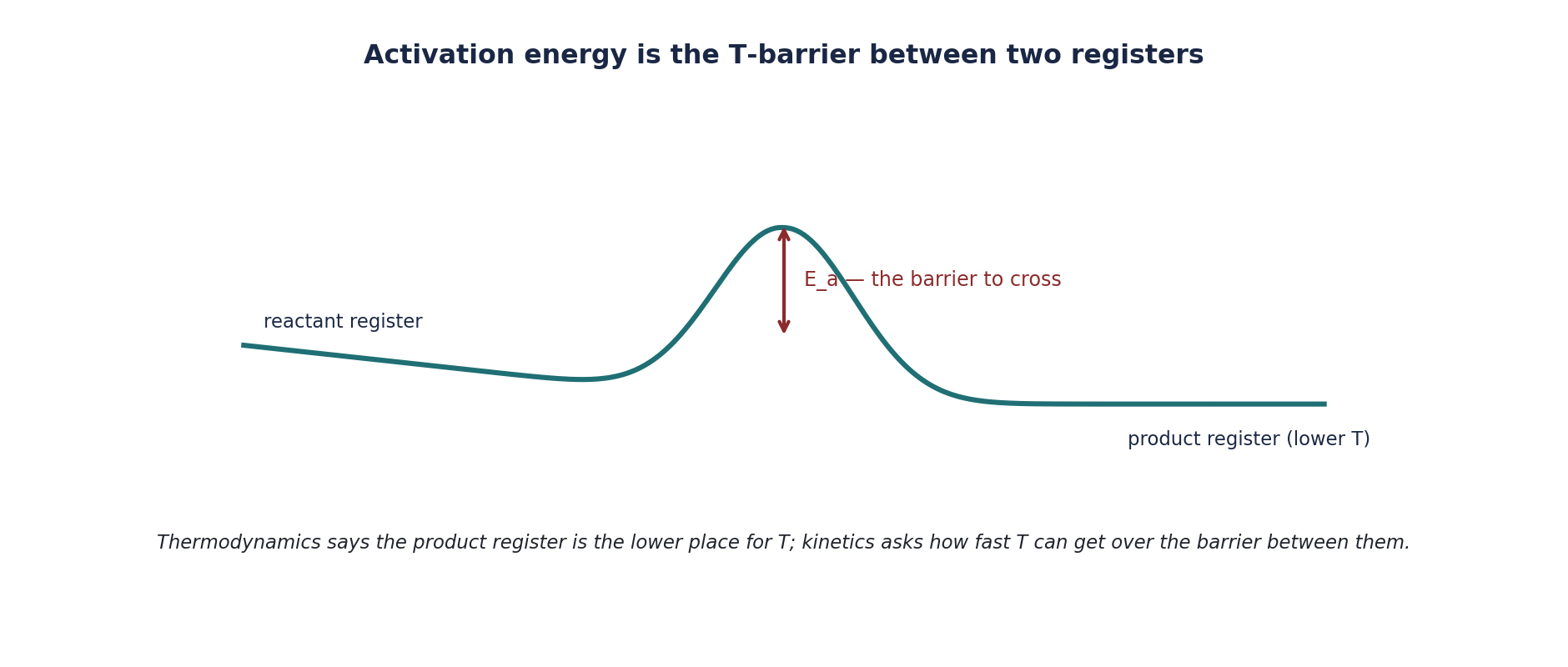
In the Force of Time the activation energy is the height of the boundary between two registers — the Τ-barrier that must be surmounted for Τ to cross from the reactant address to the product one. It is why the destination being lower is not enough: the field cannot fall to the lower register without first lifting over the barrier that separates them. And where activation energies have been measured cleanly, they are found to be quantised — sitting on the lattice, in whole steps — because a register boundary is not an arbitrary height but a lattice quantity, like every other Τ value in this book.
Arrhenius: Why Heat Speeds Everything
The single most important fact in kinetics is that rates climb steeply with temperature — a rule of thumb has many reactions doubling their speed for every ten degrees. The Arrhenius law captures it: the rate is proportional to e^(−E_a/RT), so that as the temperature T rises, an exponentially larger fraction of encounters carries enough energy to clear the barrier E_a. It is why the deep, hot Earth reaches equilibrium readily while the cold surface preserves minerals wildly out of equilibrium for aeons.
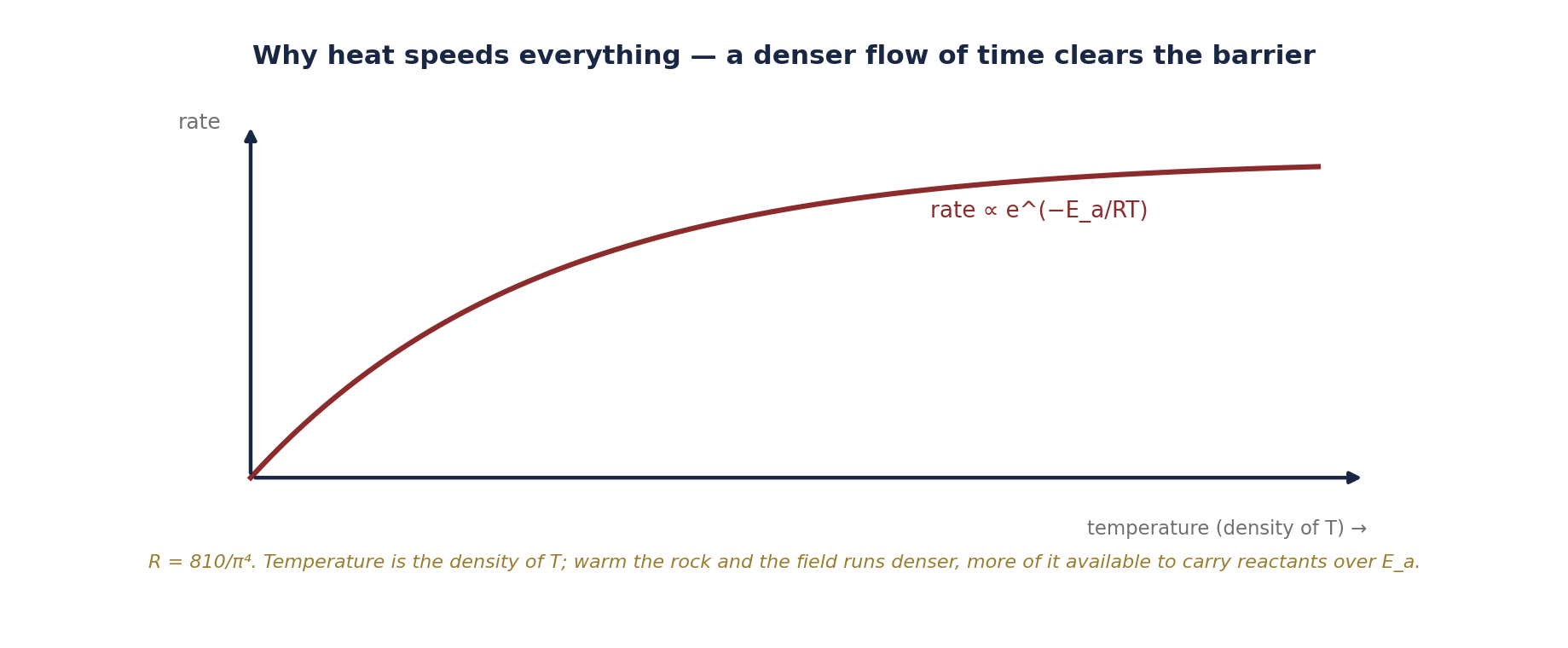
This is heat-is-time made quantitative. Temperature, we saw in Chapter 2, is the local density of Τ; to raise it is to make the field run denser. And a denser flow of Τ simply has more of itself available, at any instant, to carry a reactant over the barrier — so the fraction that makes the crossing grows exponentially with the density, exactly as the Arrhenius exponent demands. The gas constant that sets the scale is the lattice value R = 810/π⁴ from the thermodynamics. The reason the deep Earth is chemically alive and the surface chemically frozen is the same reason heat is time: where the field runs denser, the crossings come faster.
The Path and Its Slowest Step
Most reactions of interest are not single leaps but sequences — a chain of elementary steps, each an actual molecular event, adding up to the overall change we write down. And a chain runs no faster than its slowest link: the overall rate is set by the rate-limiting step, the one elementary crossing with the highest barrier. Identify that step and you understand the pace of the whole.
In the register picture, an overall reaction is a route across several register boundaries in turn, and the rate-limiting step is the highest boundary on the route — the crossing where Τ is most delayed. This is why a reaction can be thermodynamically eager yet kinetically stalled: it is not the size of the total drop that sets the pace, but the tallest single barrier along the way. To speed a reaction, you need not change its destination, only lower its highest boundary — which is exactly what a catalyst does.
Catalysis: Lowering the Barrier
A catalyst speeds a reaction without being consumed by it, and it does so in one way only: it lowers the activation energy, offering the reactants an easier path over a smaller hump. It changes nothing about the destination — a catalyst cannot make a reaction go that thermodynamics forbids — only the pace at which the allowed destination is reached. In the Earth, mineral surfaces, water, and trace metals all act as catalysts, and much of surface geochemistry runs at the rate its catalysts allow.
In the Force of Time a catalyst lowers the Τ-barrier between registers — it opens a lower crossing between the same two addresses, so that Τ can pass more freely without the destination changing. This is the clean statement of why a catalyst can accelerate but never redirect: it works on the boundary, not on the registers it divides. The lower place for Τ is fixed by thermodynamics; the catalyst only makes the path to it shorter over the top.
Diffusion: The Slow Walk of Atoms
In the Earth, where nothing is stirred, the pace is often set not by the reaction itself but by how fast the reactants can reach one another — by diffusion, the slow random walk of atoms through a solid or a viscous melt. A diffusing atom covers, on average, a mean-squared distance R̄² = 6Dt, growing only as the square root of time: to go twice as far takes four times as long, which is why diffusion in solids is glacially slow and why zoned crystals preserve their chemical rings for ages.
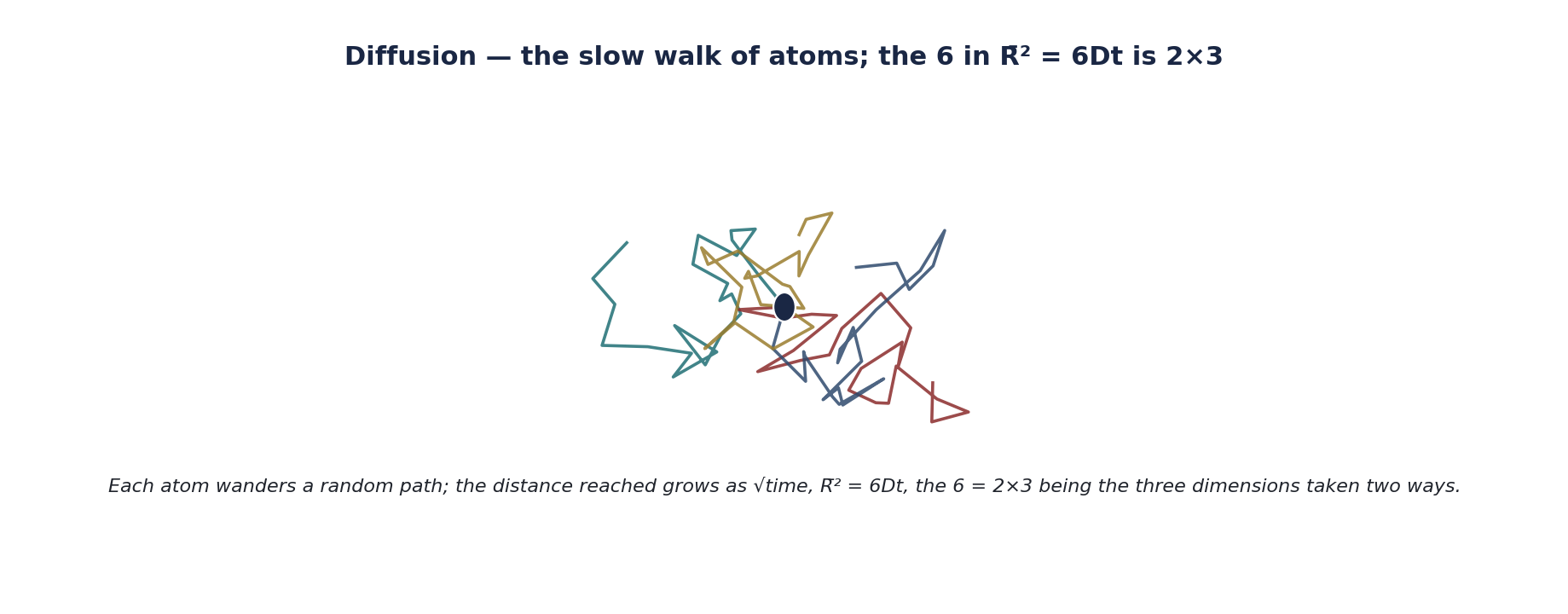
The number 6 in that law is not arbitrary; it is 6 = 2×3, the three dimensions of space taken in their two directions — the lattice primes 2 and 3 keeping the books of space itself, exactly as in the diffusion of the living cell (this is the same law that governs a protein crossing a bacterium). And the diffusion constant D depends on temperature through the same Arrhenius factor: diffusion, too, is a crossing of Τ-barriers, one hop at a time, sped by a denser flow of time. Where diffusion sets the pace, the Earth’s chemistry runs on the square root of time and the prime that measures space.
Why Some Rocks Never Reach Equilibrium
Put the chapter together and a deep feature of the Earth falls out. Two rocks of the same composition, one from the hot deep interior and one from the cold surface, can be utterly different — the first at equilibrium, its minerals the stable ones for its conditions; the second a museum of minerals long out of equilibrium, preserved only because the barriers to change are too high to cross at surface temperatures. The Earth is full of such metastable survivors: the diamond, the volcanic glass, the high-pressure mineral quenched to the surface intact.
In the register picture, these are configurations of Τ stranded on the wrong side of a barrier — the field held in a register that is not its lowest, unable to cross to the lower one because the crossing is too slow at the Τ-density it now sits in. They are the visible proof that thermodynamics and kinetics are two different questions: the surface rock knows its lower register, and cannot reach it. This is why the Earth records its history at all — because the cold has frozen the crossings, and the rock keeps the register it was made in.
Why This Should Matter to You
Whether a thing happens is one question; whether it happens in time to matter is another, and it is kinetics that decides the second. It is why a diamond lasts, why a pollutant lingers or clears, why the deep Earth churns chemically while the surface keeps its ancient rocks, why the same reaction that is instant in a furnace takes a mountain a million years. The pace of the world is not a detail; it is half of what determines what the world is like.
And the pace is legible. A reaction is a crossing of a Τ-barrier; its rate is set by heat, which is the density of Τ, through the Arrhenius law with R = 810/π⁴ in it; diffusion runs on the square root of time and the prime 6 = 2×3. The Earth is fast where it is hot and frozen where it is cold for one reason — because heat is time, and a denser flow of time makes the crossings come faster. With the pace understood, we can leave the toolbox of physical chemistry and turn to the waters of the Earth: the aquatic chemistry of the next chapter.
The Numbers at a Glance
The quantities of kinetics and their Force-of-Time reading. Measured rates and laws are left exactly as measured; the right-hand column gives the register meaning.
| Quantity | What it is | The Force of Time reading |
|---|---|---|
| Activation energy E_a | the barrier to reaction | the height of the Τ-barrier between registers |
| Arrhenius law | rate ∝ e^(−E_a/RT) | heat-is-time: denser Τ clears the barrier |
| Gas constant R | in the Arrhenius exponent | 810/π⁴ = 8.315445626 (from Chapter 2) |
| Rate-limiting step | the slowest elementary step | the highest boundary on the route |
| Catalyst | lowers E_a, unconsumed | opens a lower crossing; destination unchanged |
| Diffusion R̄² = 6Dt | the random walk of atoms | 6 = 2×3 (three dimensions, two ways) |
| Metastability | stuck out of equilibrium | Τ stranded on the wrong side of a barrier |
| Diamond → graphite | never, at the surface | the lower register barred by a huge barrier |
References
- S. Daubney, The Universal Force of Time — Master Compendium v5, The Daubney Foundation (2026).
- W. M. White, Geochemistry, John Wiley & Sons, Chichester (2005; 2013 print ed.), Chapter 5.
- S. Daubney, Reaction Rates and the Force of Time (activation energy on the lattice; heat as Τ), The Daubney Foundation (2026).
- S. Daubney, The Force of Time — Where It Departs From Current Science, The Daubney Foundation (2026).
Open the full paper as a PDF ↗
This paper, and any information drawn from it, may be used freely provided the reference attribution to Stephen Daubney and The Daubney Foundation is recognised.