In which the chemistry of natural waters — pH, acids and bases, the carbonate system, oxidation and reduction, the dissolving and depositing of minerals — is read as the workings of a single register, the register of water: a molecule bent to a lattice angle, a balance of Τ that pH measures, and a buffer that holds the ocean’s balance steady by the conservation law dΣΤ=0.
Introduction — Through the Force of Time
The chapter that follows is, in the conventional telling, aquatic chemistry: the behaviour of natural waters — acidity, the carbonate system, redox, the solubility of minerals. Read through the Universal Force of Time it is the chemistry of the Earth’s water register: water the structural molecule of this planet, bent not to one angle but to a ladder of lattice angles — one per power of π — and turning on the same Mohorovičić hub that fixes the deep Earth; pH the Τ-balance of that register; and the carbonate buffer the register holding its own balance steady, the same homeostasis we shall meet again in the living cell.
Water is where most of the Earth’s surface chemistry happens. Rivers weather the continents in solution; the ocean is one vast reaction vessel; groundwater carries metals and lays down ores; and life itself runs in water. To read the chemistry of the surface, then, is largely to read the chemistry of water — its acidity, the gases and salts dissolved in it, the minerals it takes up and gives back, and the reactions of oxidation and reduction that set which form of each element it holds.
White’s account gives the standard machinery: the pH scale and the equilibria of acids and bases; the carbonate system that dominates the acidity of natural waters and buffers them against change; the redox reactions mapped on an Eh–pH diagram; and the rules of mineral solubility and of the complexes that keep metals in solution. It is the chemistry of a single, special solvent, and everything turns on the peculiar properties of that solvent.
The Force of Time asks first why water is special at all, and answers: because water is the structural molecule of the Earth’s register. And here the theory says something the standard picture cannot: water does not have one bond angle but a ladder of them — one exact face per power of π, every one a genuine state of the same molecule. The hard, undisputed gas monomer sits at 104.4949716° ( = 3240/π³ ), the fundamental; one register up is the hydrogen-bonded face at 105.0498032° ( = 1036.8/π² = 14400 α ), which carries the fine-structure constant openly; the crystalline limit is the rational face 104.1666667° ( = 625/6, no π ); and the low liquid value neutron scattering reports is 103.9030304° ( = 16π⁴/15 ). Water is not stuck at 104.5° or 105° — it moves along this ladder as it passes from vapour to liquid to ice, and every rung is lattice-exact.
The whole molecule turns on one node: the Mohorovičić rectification value 36/π² ( = 3.647562611 ) — the same discontinuity, named for the same boundary that phase-corrects the incoming waves of time in the deep-Earth chapters. The bend, the reach, the two bond energies, and even the second electron level of water all fold back onto 36/π². And the molecule’s four photoelectron peaks — where the textbook predicts two — read out, in order of depth, light, the planet, matter and the flow of time. Read this way the rest of aquatic chemistry falls into place: an acid is a giver of protons, a base a taker, and the proton is a unit of Τ, so pH is the Τ-balance of the water; the carbonate buffer is dΣΤ=0 holding that balance steady; redox is the transfer of Τ between registers; solubility is the register-blending of Chapter 3. The chemistry of water is the register of water, working.
The Waters of the Earth
More of the Earth’s chemistry happens in water than anywhere else. The rain that falls is a dilute acid; the rivers carry the dissolved wreckage of weathered rock to the sea; the ocean is a standing solution of nearly every element, in delicate balance; groundwater ferries metals through the crust and drops them as ore. And in all of these the questions are the same: how acidic is the water, what gases and salts does it hold, which minerals will it dissolve and which deposit, and in what chemical form — oxidised or reduced — does it carry each element.
These questions are answered, in the standard science, by the equilibria of the last chapters applied to one special solvent. But the Force of Time asks a prior question that the standard account skips: why is water special? Why is this one small molecule the medium in which a planet’s chemistry runs, and the cradle of its life? The answer is the key to the whole chapter, and it is that water is the structural molecule of the Earth’s own register.
Water Is the Τ-Structural Molecule — a Ladder of Angles
A water molecule is two hydrogen atoms bonded to one oxygen, and bent — the two bonds meeting at an angle rather than lying in a straight line. That bend is the source of nearly everything water does: its lopsided charge, its stickiness to itself, its power as a solvent, its expansion on freezing. But there is a subtlety the textbooks miss, and it is the key to the whole register: water does not have one angle. It has a ladder of them.
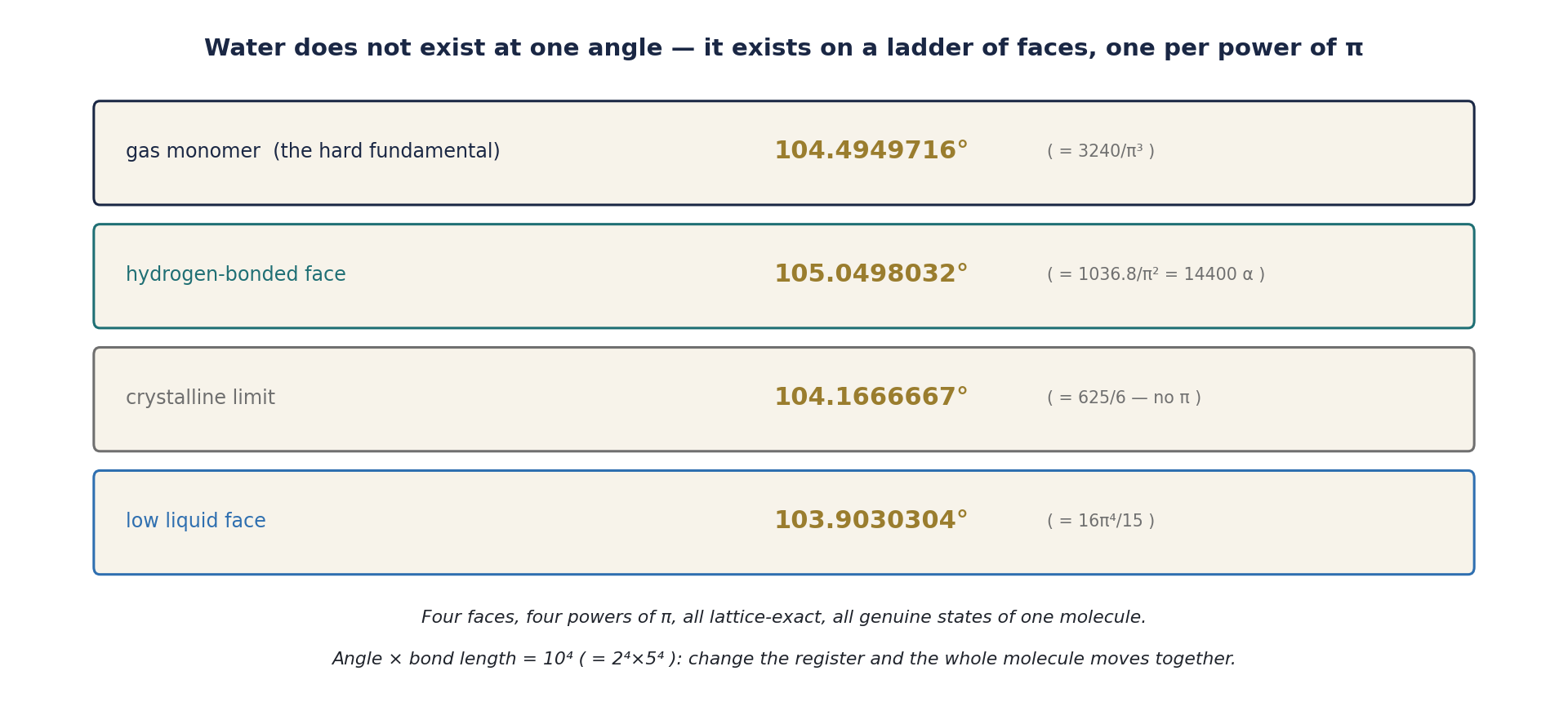
Science quotes water’s angle as ‘about 104.5°’ and leaves the liquid value in dispute across a whole degree. The Force of Time does not pick one number; it finds a ladder of exact faces, one per power of π. The hard, undisputed gas monomer is 104.4949716° ( = 3240/π³ ) — the fundamental. One register up sits the hydrogen-bonded face, 105.0498032° ( = 1036.8/π² = 14400 α ), which carries the fine-structure constant openly — its reciprocal is 137.0778389 ( = 125π²/9 = 1/α ). The crystalline limit is a purely rational face, 104.1666667° ( = 625/6, no π ); and the low liquid value neutron scattering reports is 103.9030304° ( = 16π⁴/15 ). Four faces, four powers of π, all lattice-exact, all genuine states of one molecule — and water climbs this ladder as it passes from vapour to hydrogen-bonded liquid to ice.
The reach obeys the same law and locks to the angle. The gas bond length is 95.69838482 pm ( = 250π³/81 ), and angle and length are reciprocals: their product is the bare integer 10⁴ ( = 2⁴×5⁴ ), the π³ in the one cancelling the π³ in the other exactly. Change the register and the whole molecule moves together — a molecule cannot be half in one dimension and half in another. And the hub the whole of water turns on is the Mohorovičić rectification value 36/π² ( = 3.647562611 ): the bend reduces to it, the reach reduces to it through the reciprocal lock, and the bond energies run down to it — the same rectification hub, named for the same discontinuity, that phase-corrects the incoming waves of time in the deep-Earth chapters. Water and the Moho turn on one node.
The Four Peaks of Water
Shine light of known energy on water vapour and measure the electrons it ejects, and you read the energy that held each one — the photoelectron spectrum, a direct portrait of the molecule’s levels. The textbook picture — two equal O–H bonds, two equal lone pairs — predicts two peaks. The experiment shows four, and no single bonding model reproduces them. It is one of the quiet embarrassments of conventional chemistry.
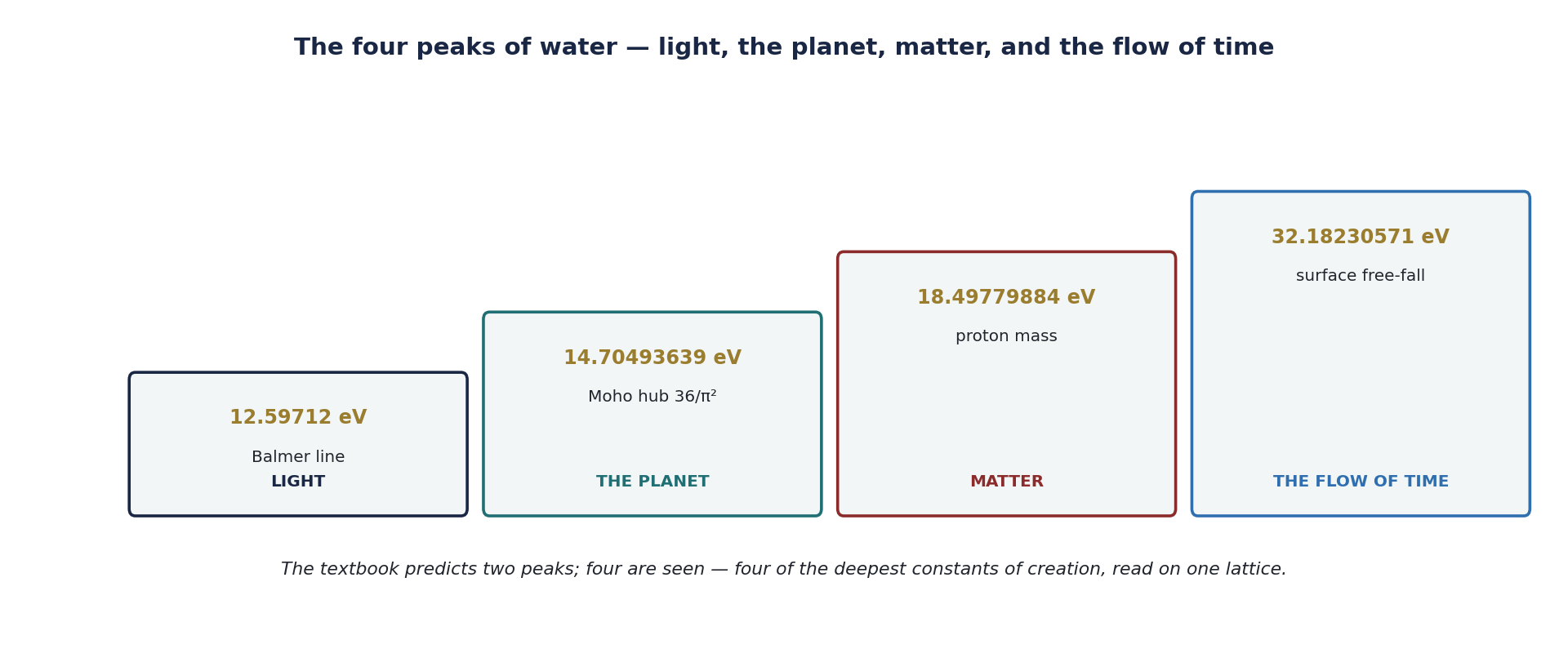
The Force of Time changes no number in the spectrum; it asks what the four energies are, and finds four readings of one lattice. The first peak, 12.59712 eV, is hydrogen’s own blue-green Balmer line converted to an energy — light. The second, 14.70493639 eV, folds back exactly onto the Mohorovičić hub 36/π² — the very node the molecule’s bend, reach and bond energies already sit on, and read as a distance it is the Earth’s perihelion, 147,049,364 km: the planet. The third, 18.49779884 eV, is the proton mass, 1.672616359×10⁻²⁷ kg, and through a second gearing the constant science calls Newton’s G — matter. The fourth, 32.18230571 eV, is the surface free-fall, the Earth’s own Τ-flow rate — the flow of time. The deeper you strip water’s electrons, the closer you come to the bare Τ-field; the spectrum reads, in order of depth, light, the planet, matter, and the flow of time. The most studied molecule in science was carrying the constants of creation all along.
Acids, Bases and the Balance of Τ
The single most important property of a natural water is its acidity, measured as pH. An acid is a substance that gives up hydrogen ions — protons — to the water; a base is one that takes them up; and pH is the measure of how many free protons the water holds, running from acidic through neutral to alkaline. Almost every reaction in water depends on it: which minerals dissolve, which metals stay in solution, which form of a dissolved gas dominates.
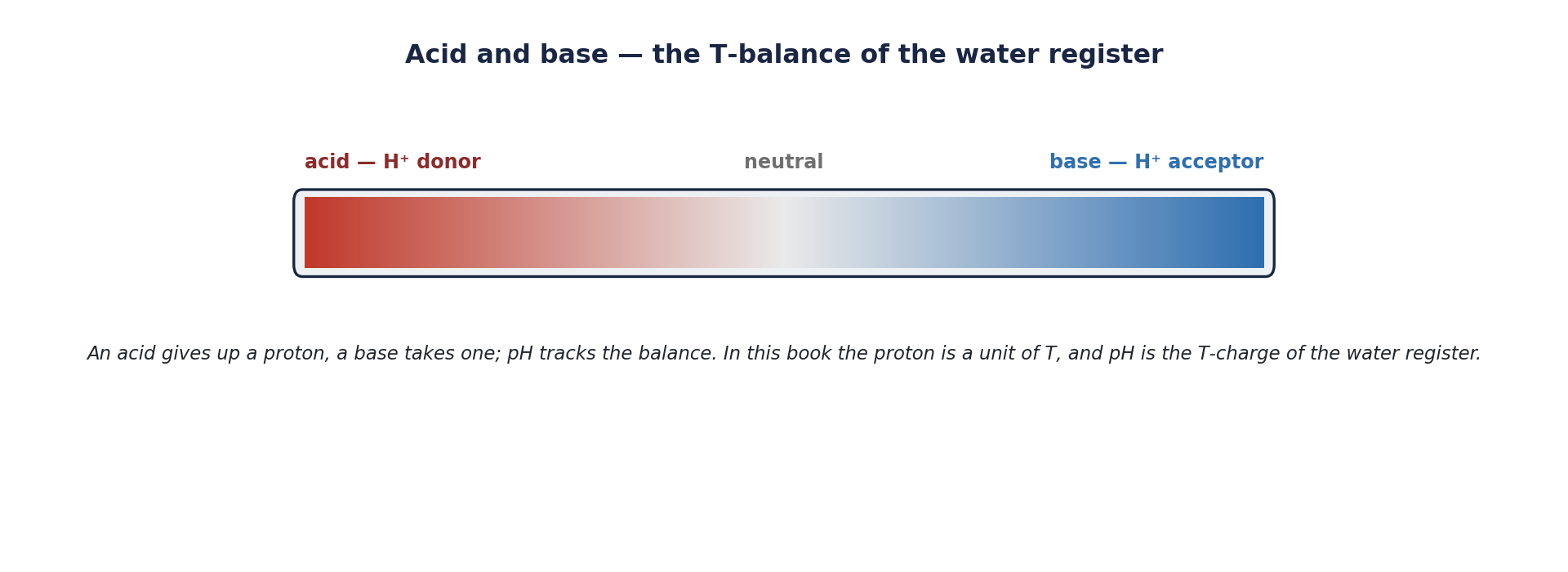
In the Force of Time the proton is a unit of Τ — the hydrogen nucleus, the simplest node of all — and so the giving and taking of protons that defines acids and bases is the giving and taking of Τ within the water register. pH, then, is the Τ-balance of the water: its charge on the register, high when the water is rich in donated Τ and low when it is poor. An acid is a Τ-donor, a base a Τ-acceptor, and a reaction driven by pH is Τ moving to where the register can hold it lowest. The master variable of aquatic chemistry is the balance of the one substance in the water.
The Carbonate System: the Earth's Buffer
One system dominates the acidity of natural waters above all others: the carbonate system, the linked equilibria of carbon dioxide dissolving in water, turning to bicarbonate, and to carbonate ion. Its great property is buffering. Throw acid at a carbonate-bearing water and the equilibria shift to absorb it; the pH barely moves. This is why the ocean holds a nearly constant pH across the globe and the ages, and why it has been able to absorb so much of the carbon dioxide humanity has added to the air.
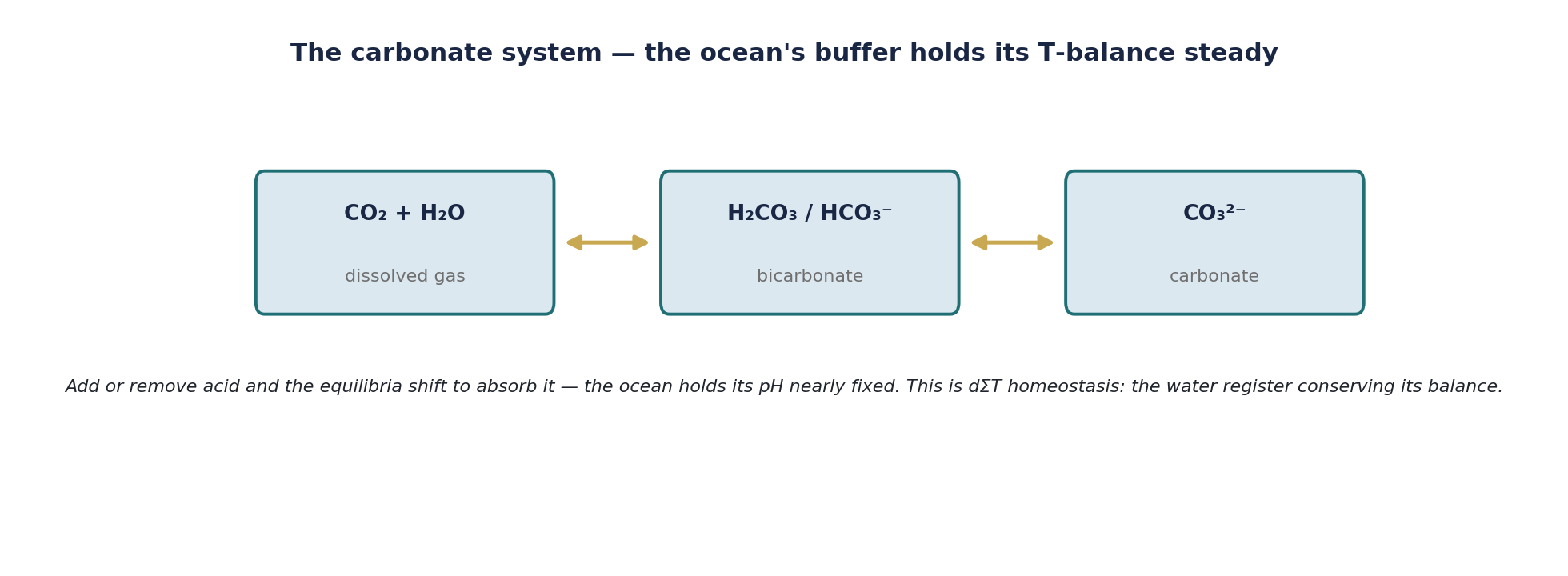
Read as the accountancy of Τ, the carbonate buffer is the water register holding its own balance steady — a homeostasis, the register conserving its Τ-charge against disturbance under the law dΣΤ=0. When acid adds Τ to the water, the linked equilibria redistribute it among the carbonate species rather than letting the balance swing; the register absorbs the blow and keeps its address. This is the very same product-sensing homeostasis that, in The Living Address, keeps a gene’s output steady and a swimming cell tuned to change rather than level. The ocean buffers its pH for the same reason a cell holds its internal balance: a register conserves the Τ it carries. The buffer is dΣΤ=0, made chemical.
Redox: the Transfer of Τ
The other great axis of aquatic chemistry is oxidation and reduction — redox — the transfer of electrons between species. An element in an oxidised state has given up electrons; in a reduced state it has gained them; and which state it takes decides whether iron stays dissolved or rusts out, whether sulphur is sulphate or sulphide, whether the water is life-giving or poisonous. The state of a water is mapped on an Eh–pH diagram, the two master variables together.
In the Force of Time the electron is a mode of Τ at the atomic register, and so redox is the transfer of Τ between registers — the field moving from one address to another as electrons pass between species. Oxidation is the loss of that Τ to another register, reduction its gain; and the Eh of a water, its oxidising power, is the Τ-potential available to drive such transfers, exactly as pH is the Τ-balance available to drive proton transfers. The two axes of the Eh–pH diagram are two faces of one accountancy: the water’s readiness to give or take Τ, as protons and as electrons.
Dissolving and Holding
The last strand is solubility: which minerals a water will dissolve, and how it holds the dissolved elements in solution. A mineral dissolves when its ions are more stable dispersed in the water than locked in the solid; and metals that would otherwise precipitate are often kept in solution by complexing — binding to ligands, molecular partners that shield them and carry them along. This is how metals travel through the crust to make ore deposits, and how nutrients move through the sea.
In the register picture, dissolving is the register-blending of Chapter 3: a mineral’s ions leave the solid register and blend into the water register when Τ can settle lower dispersed than bound, and its solubility is the balance of those two registers. Complexing is the forming of a joint address between a metal and its ligand — a shared register that holds the metal in solution against its tendency to fall out. The waters of the Earth carry their loads of dissolved matter as blended registers, and drop them where the balance tips back toward the solid.
Why This Should Matter to You
The water you drink, the ocean that steadies the climate, the rivers that carve the land and carry its chemistry to the sea — all of it runs on the register of water. That the sea can hold its acidity nearly fixed is why shelled life can build and the climate stay liveable; that it is now being pushed past what its buffer can absorb is why ocean acidification is a real and measurable danger. Aquatic chemistry is not remote; it is the chemistry of the living surface of your planet.
And it is legible. Water is the register’s own molecule, bent not to one angle but to a ladder of lattice faces — one per power of π — all turning on the Moho hub 36/π², its four photoelectron peaks reading light, the planet, matter and the flow of time; pH is the Τ-balance of that register and redox its Τ-transfer; the carbonate buffer is dΣΤ=0 holding the balance steady, the same homeostasis that keeps a cell alive. The chemistry of the Earth’s waters and the chemistry of its life are the same conservation, worked in the same register. With the waters understood, we can turn to the fine detail of how the elements sort themselves — the trace elements, and what they record of melting and crystallising deep below.
The Numbers at a Glance
The quantities of aquatic chemistry and their Force-of-Time reading. Measured behaviour is left exactly as measured; the right-hand column gives the register meaning.
| Quantity | What it is | The Force of Time reading |
|---|---|---|
| Bond angle — gas monomer | 104.4949716° | 3240/π³ (the hard fundamental) |
| Bond angle — hydrogen-bonded | 105.0498032° | 14400α = 1036.8/π² |
| Bond angle — crystalline / low liquid | 104.1666667° / 103.9030304° | 625/6 / 16π⁴/15 |
| Bond length (gas) × angle | 95.69838482 pm × angle | = 10⁴ (2⁴×5⁴) intradimensional lock |
| The hub of the molecule | 36/π² = 3.647562611 | the Mohorovičić rectification value |
| Four photoelectron peaks | 12.597 / 14.705 / 18.498 / 32.182 eV | light · the planet · matter · flow of time |
| pH | free-proton balance | the Τ-balance of the water register |
| Acid / base | proton donor / acceptor | Τ-donor / Τ-acceptor |
| Carbonate buffer | holds pH nearly fixed | dΣΤ=0 homeostasis of the register |
| Redox (Eh) | electron transfer / power | transfer of Τ between registers |
| Solubility | mineral dissolves | register-blending (solid → water) |
| Complexation | ligand holds a metal | a shared joint register |
References
- S. Daubney, The Universal Force of Time — Master Compendium v5, The Daubney Foundation (2026).
- W. M. White, Geochemistry, John Wiley & Sons, Chichester (2005; 2013 print ed.), Chapter 6.
- S. Daubney, The Universal Force of Time — Master Theory, Volume 3, §129 (Water as Τ-Structural Molecule; Earth’s Register Position), The Daubney Foundation (2026).
- S. Daubney, The Water Molecule on the Lattice (the ladder of bond angles, one per power of π), The Daubney Foundation (2026).
- S. Daubney, The Photoelectron Spectrum of Water — Four Electron Levels, Four Constants of Creation, The Daubney Foundation, Rev 2 (2026).
- S. Daubney, The Force of Time — Where It Departs From Current Science, The Daubney Foundation (2026).
Open the full paper as a PDF ↗
This paper, and any information drawn from it, may be used freely provided the reference attribution to Stephen Daubney and The Daubney Foundation is recognised.