In which the behaviour of the trace elements — the atoms present in the merest traces, whose distribution between crystal and melt records the whole history of a rock — is read as register affinity: the partition coefficient as the ratio of an element’s fit for two registers, compatible and incompatible elements as those on-node and off-node in the growing crystal, and Goldschmidt’s old rules of ionic radius and charge recast as rules of lattice fit.
Introduction — Through the Force of Time
The chapter that follows is, in the conventional telling, trace-element geochemistry: the partition coefficient, compatible and incompatible elements, Goldschmidt’s rules, and the models of melting and crystallisation that turn trace-element patterns into a record of igneous history. Read through the Universal Force of Time it is the physics of register affinity — why each element seeks the crystal or the melt, told as how well its Τ-address fits the register on offer.
Some elements make the rock — silicon, oxygen, magnesium, iron — and some are present only in traces, a few atoms in a million or far fewer. Yet it is the trace elements that geochemists prize most, because their very rarity makes them sensitive recorders: the way a trace element distributes itself between a growing crystal and the melt around it is exquisitely tuned to the conditions, and so a rock’s trace-element pattern is a fingerprint of how it melted, crystallised and evolved.
White’s account is the standard one. The key quantity is the partition coefficient, D — the ratio of a trace element’s concentration in a crystal to its concentration in the coexisting melt. Elements with D greater than one are compatible: they enter the crystal readily and stay behind in the solid. Elements with D less than one are incompatible: they are shut out of the crystal and concentrate in the melt. Which an element is depends, by Goldschmidt’s old rules, on how closely its ionic radius and charge match the site it would occupy in the crystal. From these coefficients, models of partial melting and fractional crystallisation predict how trace-element patterns evolve.
The Force of Time reads all of this as register affinity, and here the theory does real work, for the standard account has rules of thumb where it has no mechanism. Why should an element enter a crystal or shun it? Because a crystal is a register — a lattice of Τ-addresses, the fixed nodes at which atoms can sit — and a trace element enters it if, and only if, the element’s own address fits one of those nodes. A compatible element is one whose address lands on a node of the crystal register: it belongs, and it enters. An incompatible element is one whose address falls off the nodes: it does not fit, and it is excluded into the melt, where the register is loose enough to hold it.
The partition coefficient, then, is not an empirical number to be measured and tabulated with no reason behind it; it is the ratio of an element’s affinity for two registers — how well its address fits the tight crystal lattice against how well it fits the loose melt. And Goldschmidt’s rules, which say that substitution depends on matching ionic radius and charge, are lattice-fit rules in disguise: an ionic radius is itself a lattice quantity (the covalent and ionic radii sit on {2,3,5,π} nodes), and charge is the register level, so ‘radius and charge must match’ is just ‘the address must land on a node of the host register.’ The old rules were right; the reason was register fit.
What a Trace Element Is
Divide the elements of a rock into two kinds. A handful — oxygen, silicon, aluminium, iron, magnesium, calcium, sodium, potassium — make up almost the whole of it; these are the major elements, and they build the minerals. All the rest are present only in traces, from a fraction of the rock down to a few atoms in a billion. These are the trace elements, and though they build nothing, they record everything.
They record because they are sensitive. A major element is buffered by its own abundance; a trace element, present in vanishing amount, goes wherever the conditions send it, and its distribution is finely tuned to how the rock formed. Read a rock’s trace elements and you can tell how much it melted, from what source, at what depth, and how far it evolved before it froze. The trace elements are the Earth’s recording medium, and the question this chapter answers is why each one goes where it goes.
The Partition Coefficient: a Ratio of Affinities
The master quantity is the partition coefficient, D: the ratio of a trace element’s concentration in a crystal to its concentration in the melt that crystal grows from. If D is large, the element crowds into the crystal; if D is small, it is left behind in the melt. It is measured for element after element, mineral after mineral, and tabulated — and in the standard account it is just that, a table of numbers with no deeper why.
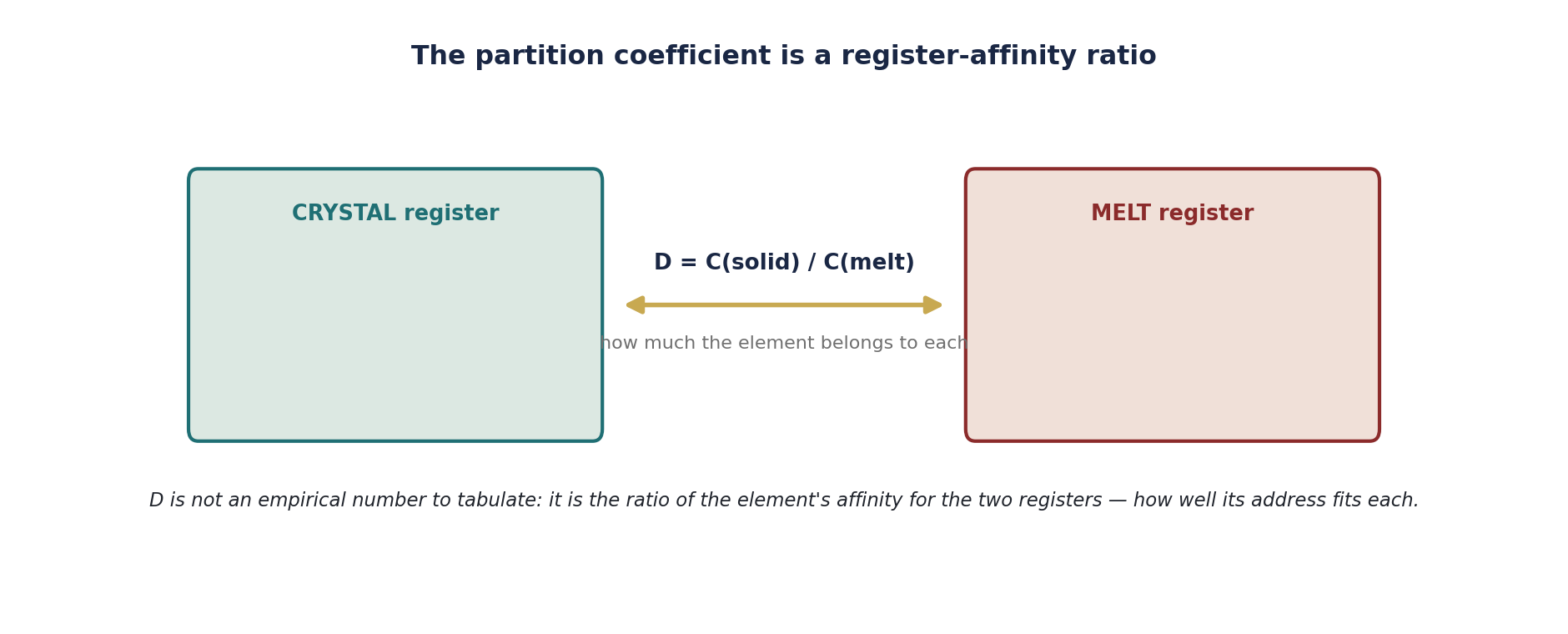
In the Force of Time the partition coefficient has a reason. A crystal is a register — a fixed lattice of Τ-addresses — and a melt is a looser register, its addresses less sharply fixed. D is the ratio of the trace element’s affinity for the two: how well its own Τ-address fits the tight crystal register against how well it fits the loose melt. A large D means the element’s address sits comfortably on a crystal node; a small D means it does not, and it is happier in the forgiving melt. The number is not arbitrary; it is a measure of fit.
Compatible and Incompatible: On-Node and Off-Node
The two great classes follow at once. A compatible element, with D above one, enters the crystal readily — nickel into olivine, chromium into spinel. An incompatible element, with D below one, is shut out and driven into the melt — the large-ion elements like potassium, rubidium and barium, and the high-charge ones like uranium, thorium and the light rare earths. The whole of igneous trace-element geochemistry turns on which elements are which.
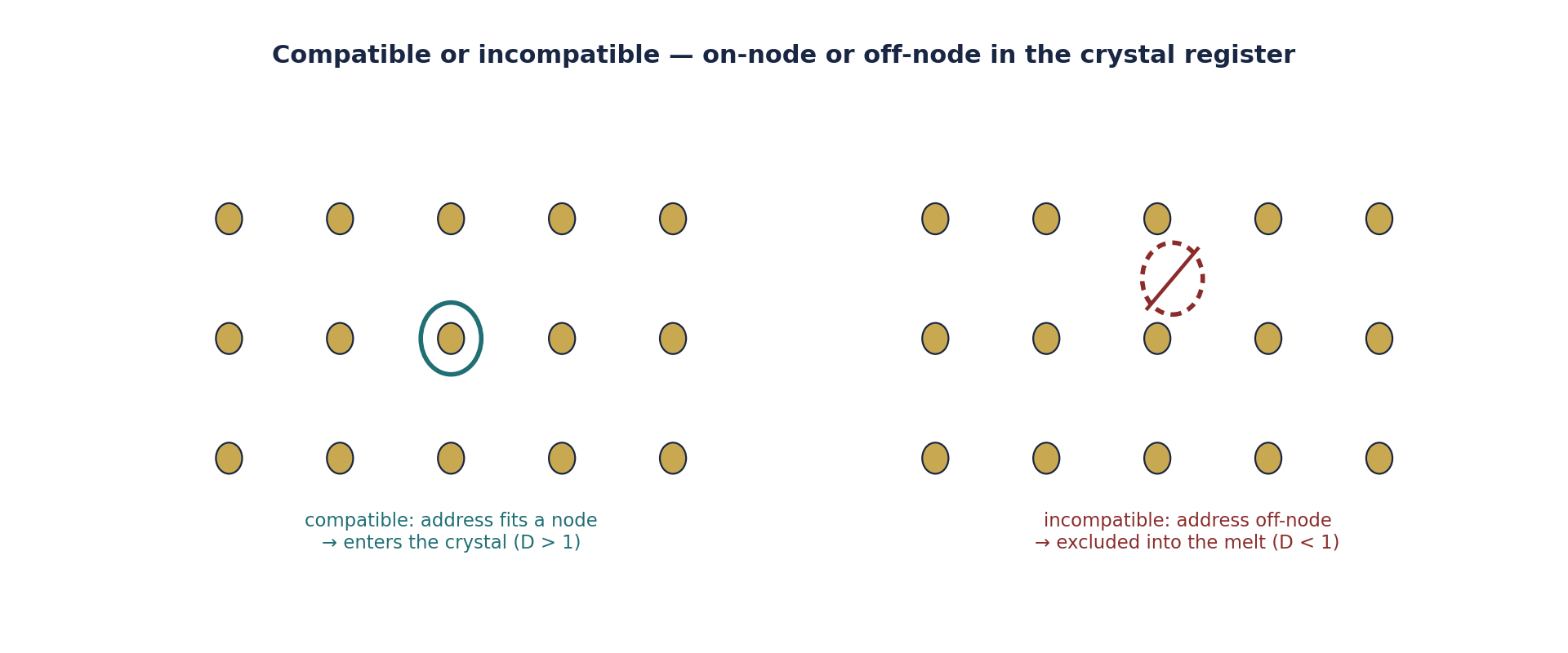
The register picture makes the division exact. A crystal register is a set of Τ-nodes — the sites its lattice allows. A compatible element is one whose address lands on such a node: it fits, and the crystal takes it in as one of its own. An incompatible element is one whose address falls between the nodes, off the lattice of the host: it cannot be accommodated without straining the crystal, so it is excluded, and it accumulates in the melt, whose looser register can hold an off-node address. Compatibility is not a chemical accident; it is whether the element’s address is on the crystal’s nodes or off them.
Goldschmidt's Rules Are Lattice-Fit Rules
Victor Goldschmidt, the founder of the science, gave the rules that still govern substitution: an ion will enter a crystal site if its radius and its charge are close enough to those of the ion it replaces. Too large or too small, too highly or too weakly charged, and it will not fit. These rules work — they predict compatibility remarkably well — but they are empirical, a description of what fits rather than an account of why fitting matters.
In the Force of Time they are lattice-fit rules. An ionic radius is not a free measurement but a lattice quantity: the covalent and ionic radii of the elements sit on {2,3,5,π} nodes, as the periodic sweep of this theory shows. Charge is the register level — which rung of the atomic register the ion sits on. So ‘radius and charge must match’ translates directly into ‘the substituting ion’s address must land near the host node on the lattice’: a matching radius puts it at the right place on the spatial part of the lattice, a matching charge on the right register level. Goldschmidt saw the fit; the Force of Time gives the lattice it is a fit to. The rules were right because substitution is the meeting of two lattice addresses.
Melting and Crystallising Sort the Elements
Put affinity to work and it sorts the elements. When a rock partially melts, the incompatible elements — shut out of the crystals — rush into the first small fraction of melt, which is therefore enriched in them; the compatible elements stay behind in the crystalline residue. When a melt crystallises, the reverse: the compatible elements are taken into the early crystals, and the incompatible ones concentrate in the last, most evolved liquid. This is why granites, the end-product of long crystallisation, are rich in incompatible elements, and why the first melts of the mantle carry its incompatible signature to the crust.
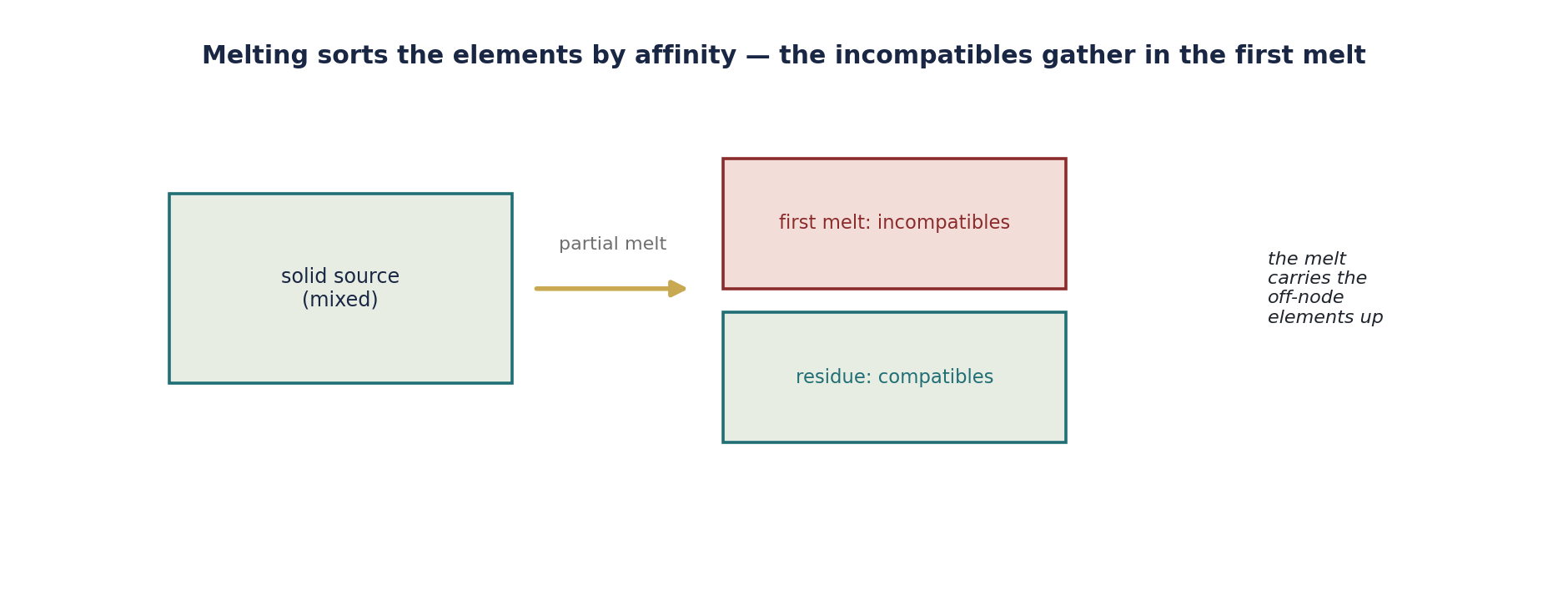
In the register picture this sorting is inevitable. Melting opens the loose melt register alongside the tight crystal register, and each element goes to the register its address fits: the on-node elements stay in the crystals, the off-node ones flood into the melt. Every episode of melting and crystallising is a register-sieve, passing the elements according to fit, and the Earth has run that sieve for four and a half billion years. The chemical differentiation of the planet — the incompatible-rich crust drawn out of an incompatible-poor mantle — is register-sorting, integrated over the age of the Earth.
The Rare Earths: a Lattice Ruler
No trace elements are more useful than the rare earths — the lanthanides, fifteen elements of almost identical chemistry that differ only in a steadily shrinking ionic radius as their atomic number climbs. Because they change so smoothly and so little, they behave as a graded ruler: a rock’s pattern of rare earths, plotted from light to heavy, bends and slopes in ways that record its history with unusual clarity.
In the Force of Time the rare earths are a stretch of the lattice laid out in order. Their addresses march in even steps — the filling of one inner register, one node at a time — so their radii shrink in a smooth lattice progression, and their partition behaviour grades smoothly with it. That is why they make so clean a ruler: they are a run of adjacent lattice addresses, and a rock’s rare-earth pattern is a reading of how its register-sieve treated one clean stretch of the lattice. The smoothness geologists exploit is the smoothness of the lattice counting off a register.
Why This Should Matter to You
The trace elements are how we read the deep history of the Earth we cannot visit. From a handful of atoms in a rock we learn the depth at which a magma was born, the source it came from, the path it took to the surface — the biography of the crust and mantle, written in traces. And the same partitioning governs where the useful and the harmful elements go: which rocks concentrate the metals we mine, where the radioactive elements gather, how pollutants distribute.
And it is legible as fit. An element enters a crystal or shuns it according to whether its Τ-address lands on the crystal’s nodes; the partition coefficient is the ratio of that fit for two registers; Goldschmidt’s rules are the lattice speaking. The Earth sorts its elements by address, and the trace elements record the sorting. With their behaviour understood, we can turn to the elements that are also clocks — the radioactive isotopes, and how the Earth tells its own time.
The Numbers at a Glance
The quantities of trace-element geochemistry and their Force-of-Time reading. Measured behaviour is left exactly as measured; the right-hand column gives the register meaning.
| Quantity | What it is | The Force of Time reading |
|---|---|---|
| Partition coefficient D | C(crystal) / C(melt) | ratio of address-fit for two registers |
| Compatible (D > 1) | enters the crystal | address lands on a crystal-register node |
| Incompatible (D < 1) | excluded into the melt | address falls off-node; melt holds it |
| Goldschmidt’s rules | radius + charge must match | lattice-fit: address must land on the host node |
| Ionic radius | the size of the ion | a {2,3,5,π} lattice quantity |
| Partial melting | first melt enriched | register-sieve: off-node elements into the melt |
| Fractional crystallisation | last liquid enriched | on-node elements taken early; misfits left |
| Rare-earth pattern | the graded ruler | a run of adjacent lattice addresses |
References
- S. Daubney, The Universal Force of Time — Master Compendium v5, The Daubney Foundation (2026).
- W. M. White, Geochemistry, John Wiley & Sons, Chichester (2005; 2013 print ed.), Chapter 7.
- S. Daubney, The Periodic Table on the Lattice (covalent and ionic radii as {2,3,5,π} nodes), The Daubney Foundation (2026).
- S. Daubney, The Force of Time — Where It Departs From Current Science, The Daubney Foundation (2026).
Open the full paper as a PDF ↗
This paper, and any information drawn from it, may be used freely provided the reference attribution to Stephen Daubney and The Daubney Foundation is recognised.