In which radioactive decay — the transformation that lets us date the rocks and read the age of the Earth itself — is read as a Τ-address adjustment: an unstable nucleus stepping from an off-node address onto a stable one, the half-life as the fixed tick of a nuclear clock set by the depth of that step, and the isochron as a straight register line whose slope counts the ticks elapsed.
Introduction — Through the Force of Time
The chapter that follows is, in the conventional telling, radiogenic isotope geochemistry: radioactive decay, the law of the half-life, and the isotopic systems — rubidium–strontium, samarium–neodymium, the uranium–lead pair — by which geologists date rocks and trace the evolution of the Earth. Read through the Universal Force of Time it is the theory of the nuclear clock: why an unstable nucleus decays, why it decays at a rate nothing can alter, and why that rate makes so faithful a timepiece.
There is no more consequential measurement in all of geology than the age of a rock, and no measurement rests on a stranger fact: that certain atoms, left entirely to themselves, transform into other atoms at a rate so steady that nothing — not heat, not pressure, not chemistry — can hurry or slow it. A uranium atom in a crystal will, on average, wait hundreds of millions of years and then, without warning or cause the standard account can name, become lead. Count the lead and you have counted the years. It is by this clock that we know the Earth is four and a half billion years old.
White’s account gives the mechanics with great precision. A radioactive parent isotope decays to a stable daughter at a rate set by its decay constant, so that after one half-life exactly half remains, after two a quarter, and so on down the exponential. Measure how much daughter has accumulated relative to how much parent survives — correcting for daughter that was there at the start by the elegant device of the isochron — and the decay law returns the age. Rubidium becomes strontium; samarium becomes neodymium; two isotopes of uranium become two of lead, giving a clock that checks itself. The arithmetic is impeccable. What it does not contain is a reason.
For the standard account, radioactive decay is acausal — a nucleus decays for no reason at a random moment, and only the aggregate rate is fixed. This is precisely where the Force of Time supplies what is missing. A nucleus is a configuration of Τ sitting at an address in the nuclear register. A stable nucleus sits on a node of that register — a permitted address, where it can rest indefinitely. An unstable nucleus sits off a node: its address is a strained one, not permitted to endure, and decay is the step by which it moves onto a stable node, shedding the excess Τ as the particle and the ray we detect. Decay is not causeless. It is the register relaxing an off-node address onto an allowed one.
And that reframes the half-life. The rate of decay is fixed because it is set by the depth of the register step — how far off-node the parent sits, how large a Τ-adjustment the move requires. That geometry is a property of the lattice, not of the environment, which is exactly why no amount of heat or pressure can shift it: heat and pressure act within a register, but the step between register addresses is fixed by the lattice itself. The half-life is the fixed tick of a nuclear Τ-clock, and the isochron — the straight line on which co-formed samples lie — is a register line, its slope the number of ticks that have passed. The Earth tells its own time because the lattice keeps time.
The Fact That Founds the Science
Some nuclei are stable and will sit unchanged forever; others are unstable, and sooner or later transform — emitting a particle or a ray and becoming a different nucleus. This is radioactivity, and its one indispensable property is constancy of rate: a given kind of unstable nucleus decays at a rate that never varies. Chill it to near absolute zero, heat it in a furnace, crush it under the pressure of the deep Earth — the rate holds. It is the most reliable clock in nature.
On that constancy the whole of geochronology is built. But it is also the deepest puzzle in the standard account, which can describe the rate exquisitely and explain it not at all: decay is held to be causeless and random, each nucleus transforming at a moment nothing determines. A clock with no mechanism keeps perfect time. The Force of Time takes that puzzle as its starting point, and gives the mechanism.
Decay Is a Τ-Address Adjustment
A nucleus, in this book, is a knot of Τ sitting at an address in the nuclear register. The stable nuclei sit on the nodes of that register — the permitted addresses, where a configuration of Τ can rest without strain. These are the atoms that endure. The unstable nuclei sit off the nodes: their addresses are strained, not among those the register permits to last, and such an address cannot hold forever.
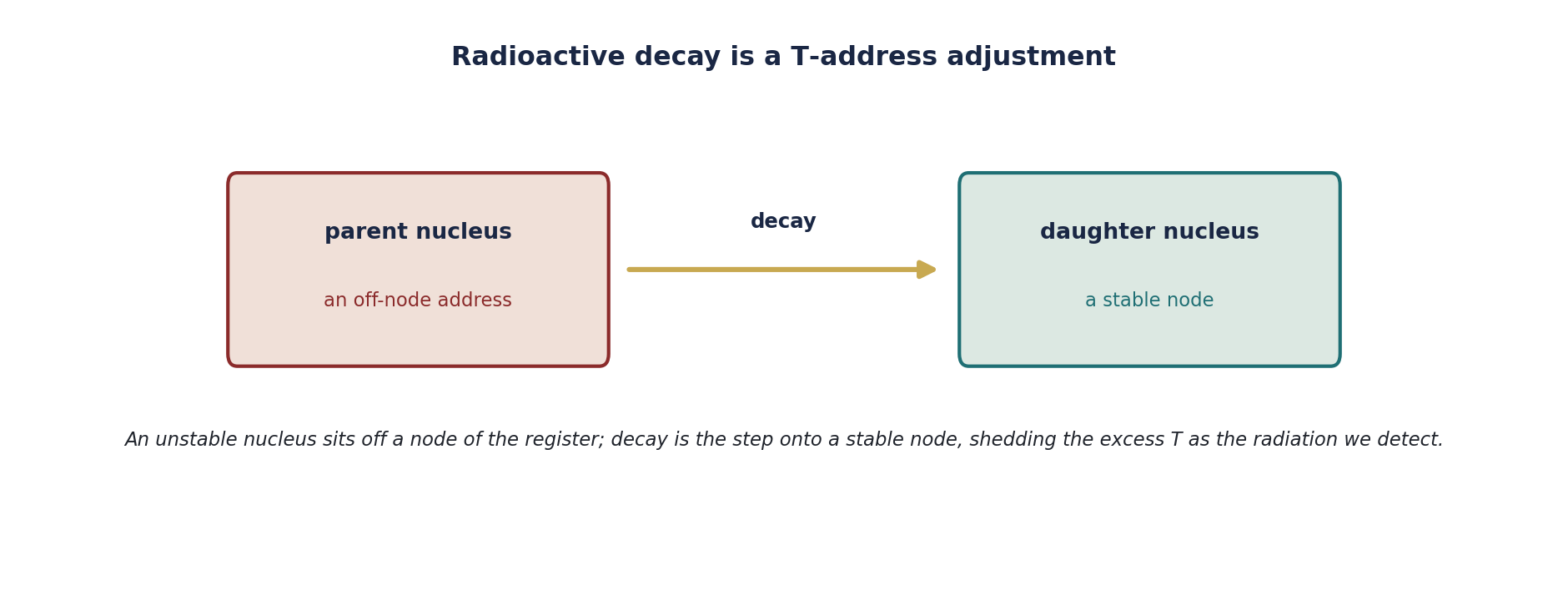
Decay is the resolution of that strain. The nucleus steps from its off-node address onto a stable node — becoming the daughter — and the Τ it can no longer hold is released as the alpha particle, beta particle or gamma ray we detect. What the standard account calls a causeless, random event is, in the Force of Time, a lawful one: an address the register does not permit relaxing onto one it does. The apparent randomness of the moment is the randomness of when the strained configuration finds its step, but that the step will come, and where it leads, is fixed.
The Half-Life Is the Tick of a Τ-Clock
Left to itself a population of a radioactive isotope thins in a fixed rhythm: after one half-life half remains, after two a quarter, after three an eighth, and so on along the exponential curve. That half-life is a constant of the isotope — a few days for one, billions of years for another — and it is utterly indifferent to conditions. This is what makes the clock trustworthy: its tick cannot be tampered with.
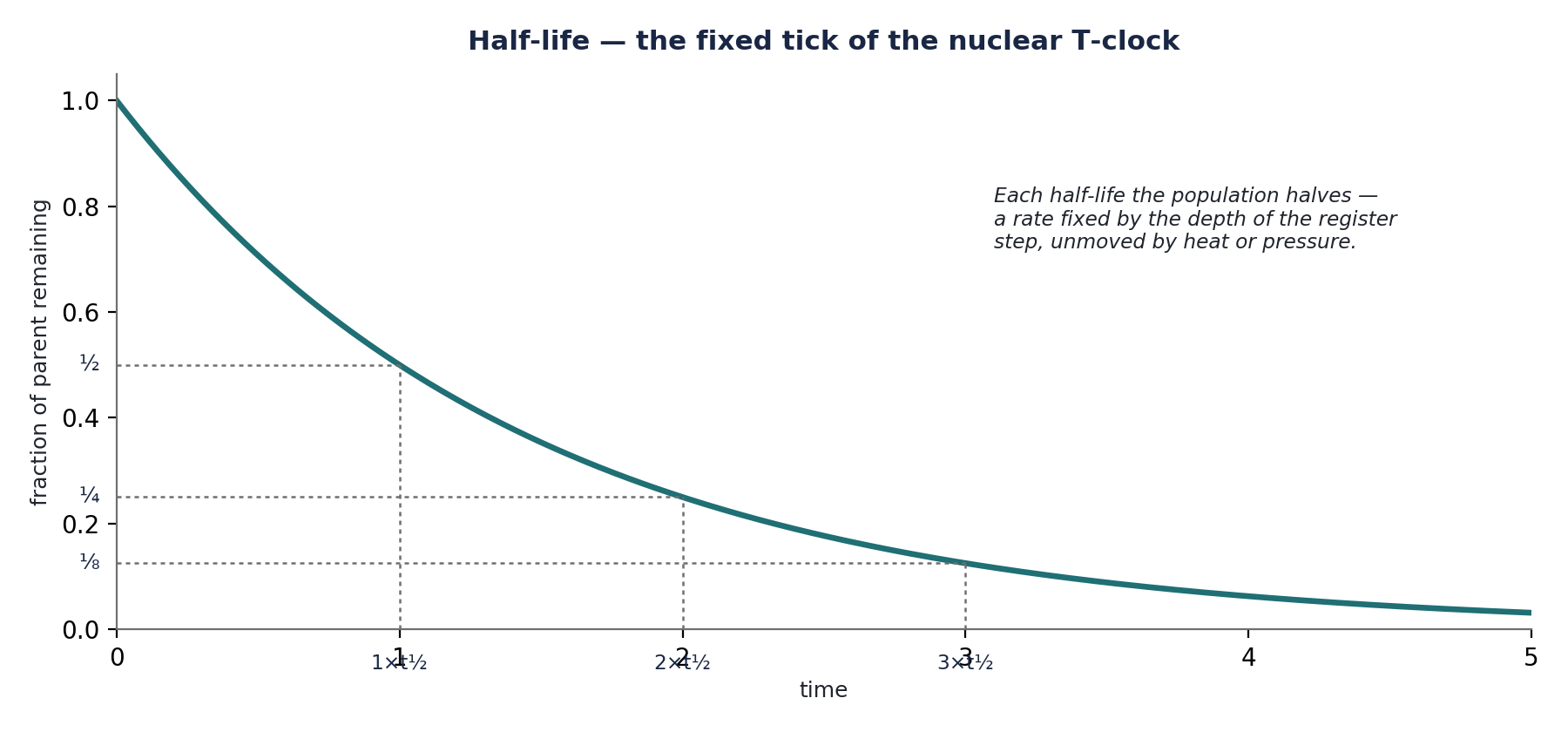
In the Force of Time the reason for that indifference is exact. The rate of decay is set by the depth of the register step — how far off-node the parent sits and how large a Τ-adjustment the move onto a stable node demands. That depth is a property of the lattice, fixed by the geometry of the register itself; and heat and pressure act only within a register, redistributing Τ among addresses, never altering the spacing between them. So the tick is untouchable: you cannot change the step by warming the room. The half-life is the fixed tick of a nuclear Τ-clock, and it keeps time because the lattice keeps time.
The Isochron Is a Register Line
To read the clock, geologists face one obstacle: some of the daughter isotope was present when the rock formed, before any decay. The isochron solves it beautifully. Plot the daughter against the surviving parent for several minerals that crystallised together, each normalised to a stable reference isotope, and the points fall on a straight line — a line that pivots upward as the rock ages, its slope giving the time elapsed and its intercept the daughter present at the start.
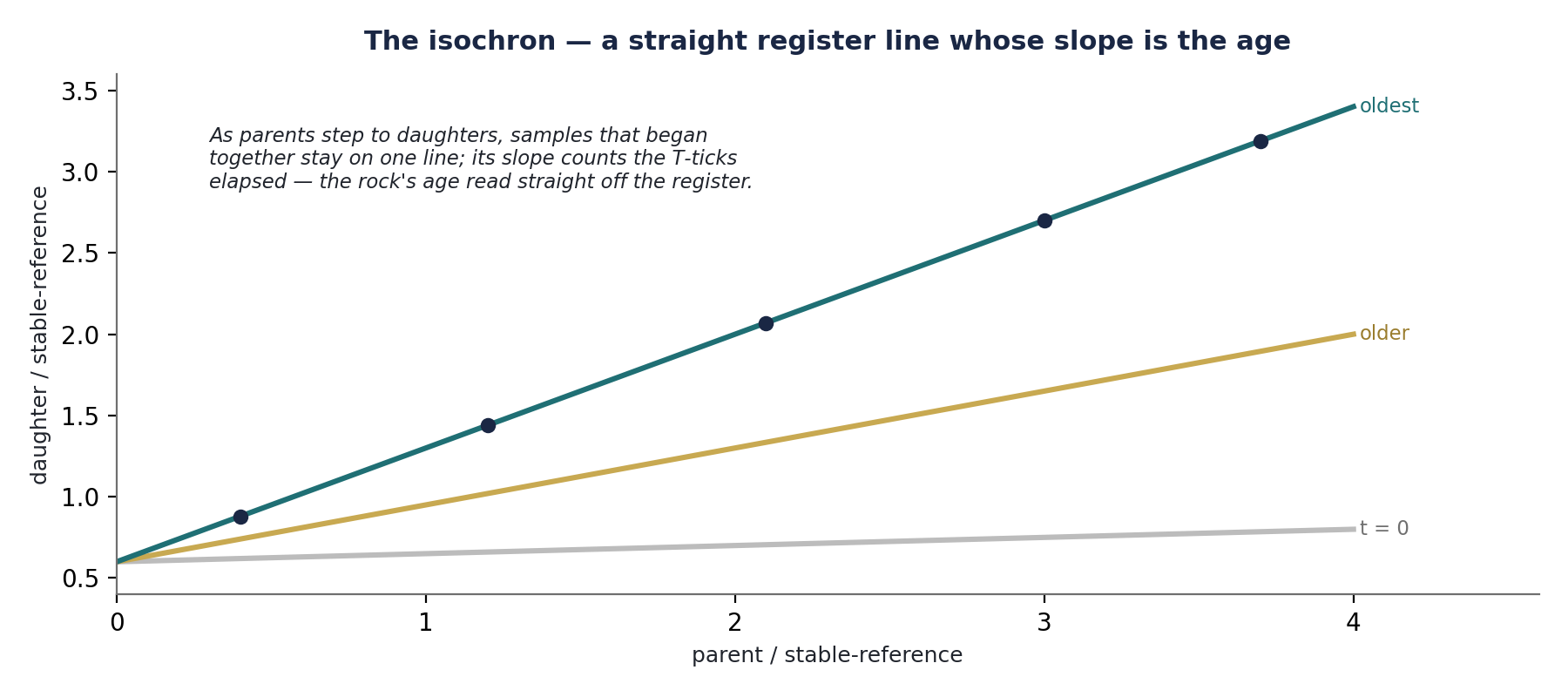
The register picture makes the straightness inevitable. Samples that formed at one moment began at one register address for the daughter; as each parent atom takes its step and adds a daughter, every sample climbs by the same proportion of ticks, so they stay collinear — a register line, tracing the shared advance of the clock. Its slope is the count of ticks that have passed since they formed. The isochron is not a statistical convenience; it is the register displaying, as a straight line, that these rocks have kept one common time.
The Systems and Why They Agree
Geology uses several such clocks. Rubidium decays slowly to strontium, ideal for the oldest rocks; samarium to neodymium, slower still and unusually robust; potassium to argon, catching a gas as its daughter; and above all the two uraniums, which decay by separate chains to two separate leads, providing two clocks in one mineral that must agree if the age is true. That the systems, run on different elements at different rates, return the same age is the great internal check of geochronology.
The Force of Time explains the agreement without effort. Each system is a different off-node parent stepping onto its own stable node, ticking at its own lattice-fixed rate; but all of them are counting the same thing — the one flow of Τ that is time itself. Different clocks, different mechanisms, one time being measured. They agree because there is one time for them to agree upon, and the lattice sets each of their ticks against it. The paired uranium–lead clocks agree for the same reason two well-made watches agree: not because they are the same watch, but because there is one hour of the day.
Why This Should Matter to You
This is how we know the age of the Earth, of the oldest mountains, of the meteorites that record the birth of the Sun’s family. It is how we date the extinctions, the ice ages, the first stone tools. A science that seemed to promise only the composition of rocks turned out to hand us the calendar of deep time — the age of everything — and it did so by trusting a clock whose ticking no one could explain.
The Force of Time explains it. Radioactive decay is a nucleus stepping from an address the register forbids to endure onto one it allows, shedding its excess Τ; the half-life is the fixed depth of that step, a lattice quantity beyond the reach of heat or pressure; the isochron is the register drawing, as a straight line, the common time a set of rocks has kept. The Earth tells its own age because the lattice keeps a clock in every unstable nucleus. With the clocks understood, we can turn to the isotopes that do not decay but still shift — the stable-isotope record, and what its fractionations reveal.
The Numbers at a Glance
The quantities of radiogenic geochemistry and their Force-of-Time reading. Measured behaviour is left exactly as measured; the right-hand column gives the register meaning.
| Quantity | What it is | The Force of Time reading |
|---|---|---|
| Radioactive decay | parent → daughter + radiation | Τ-address step: off-node → stable node |
| The emitted radiation | α, β, γ | the excess Τ shed in the step |
| Half-life | time for half to decay | fixed tick set by the depth of the step |
| Rate constancy | unmoved by heat/pressure | step-depth is a lattice property |
| Isochron | straight line of co-formed samples | a register line of shared time |
| Isochron slope | gives the age | the count of Τ-ticks elapsed |
| Multiple systems agree | Rb-Sr, Sm-Nd, U-Pb concord | different ticks, one time being counted |
| Age of the Earth | ~4.5 billion years | ticks of the nuclear Τ-clock since formation |
References
- S. Daubney, The Universal Force of Time — Master Compendium v5, The Daubney Foundation (2026).
- W. M. White, Geochemistry, John Wiley & Sons, Chichester (2005; 2013 print ed.), Chapter 8.
- S. Daubney, The Nuclear Register — Stability as Lattice Address, The Daubney Foundation (2026).
- S. Daubney, The Force of Time — Where It Departs From Current Science, The Daubney Foundation (2026).
Open the full paper as a PDF ↗
This paper, and any information drawn from it, may be used freely provided the reference attribution to Stephen Daubney and The Daubney Foundation is recognised.