In which the stable isotopes — the atoms that do not decay, yet split in ratio wherever water freezes, rock forms or life breathes — are read as one register address carrying different amounts of Τ: fractionation as the register sorting that mass-offset between phases, the δ-notation as the measure of the offset, and the isotope thermometer as sorting that weakens as the Τ-density we call heat rises.
Introduction — Through the Force of Time
The chapter that follows is, in the conventional telling, stable isotope geochemistry: the fractionation of the isotopes of oxygen, hydrogen, carbon and sulphur, the δ-notation that measures it, the distinction of equilibrium from kinetic fractionation, and the use of isotope ratios as thermometers and tracers of past climate and past life. Read through the Universal Force of Time it is the physics of Τ-mass sorting — why atoms identical in chemistry but differing in mass part company, and what their parting records.
Take the oxygen in a snowflake and the oxygen in the sea it came from, and they are not quite the same. Both are oxygen — identical in every chemical respect — but a few atoms in every thousand carry an extra unit of mass, and the snow holds slightly fewer of these heavy atoms than the sea does. That whisper of a difference, a fraction of a per cent, is one of the most powerful signals in all of Earth science: from it we read the temperature of vanished summers, the size of ancient ice sheets, the diet of extinct animals, the breathing of the early ocean. The stable isotopes keep the Earth’s diary.
White’s account lays out the mechanism. Isotopes of an element share its chemistry but differ in mass; when atoms move between two phases or two bonds, the heavier and lighter isotopes partition slightly differently — this is fractionation. It comes in two kinds: equilibrium fractionation, where the heavy isotope settles preferentially into the stiffer bonds, and kinetic fractionation, where the lighter isotope, moving faster, runs ahead in one-way processes like evaporation. The split is measured as a δ-value — a deviation in parts per thousand from a standard — and because equilibrium fractionation depends on temperature, isotope ratios serve as thermometers.
The Force of Time reads this as the sorting of Τ-mass, and here the theory sharpens a picture the standard account leaves oddly bare. Why should mass alone, with chemistry held identical, cause atoms to part? Because in this book an atom’s mass is a count of its Τ-units, and its isotopes are the same register address carrying different amounts of Τ: the heavy isotope is the same node with more Τ packed into it. More Τ means a configuration that moves a little more sluggishly and binds a little more tightly, because it has more of the substance of time to shift. Fractionation is the register sorting that mass-offset — letting the heavy, Τ-rich atoms settle into the stiff phase and the light ones escape to the loose.
And that reframes the thermometer. Equilibrium fractionation weakens as temperature rises — the hotter the system, the smaller the split — and in the standard account this is a fact of statistical mechanics with the temperature simply plugged in. In the Force of Time it has a plain cause: heat is Τ-density, the local abundance of time itself, and a denser register sorts the mass-offset less, because the surplus Τ of the environment swamps the small surplus that distinguishes the isotopes. Read the size of the offset and you read the Τ-density — the temperature — at which the two phases last spoke to each other. The isotope thermometer works because it is reading the density of time.
One Address, Different Τ-Mass
The isotopes of an element are its atoms with differing numbers of neutrons: oxygen-16 and the rarer oxygen-18, hydrogen and its heavy twin deuterium, the light and heavy carbons and sulphurs. They are chemically identical — they make the same molecules, enter the same reactions — and differ only in mass. The stable ones, unlike the parents of the last chapter, do not decay; they simply persist, in fixed proportion, wherever their element goes.
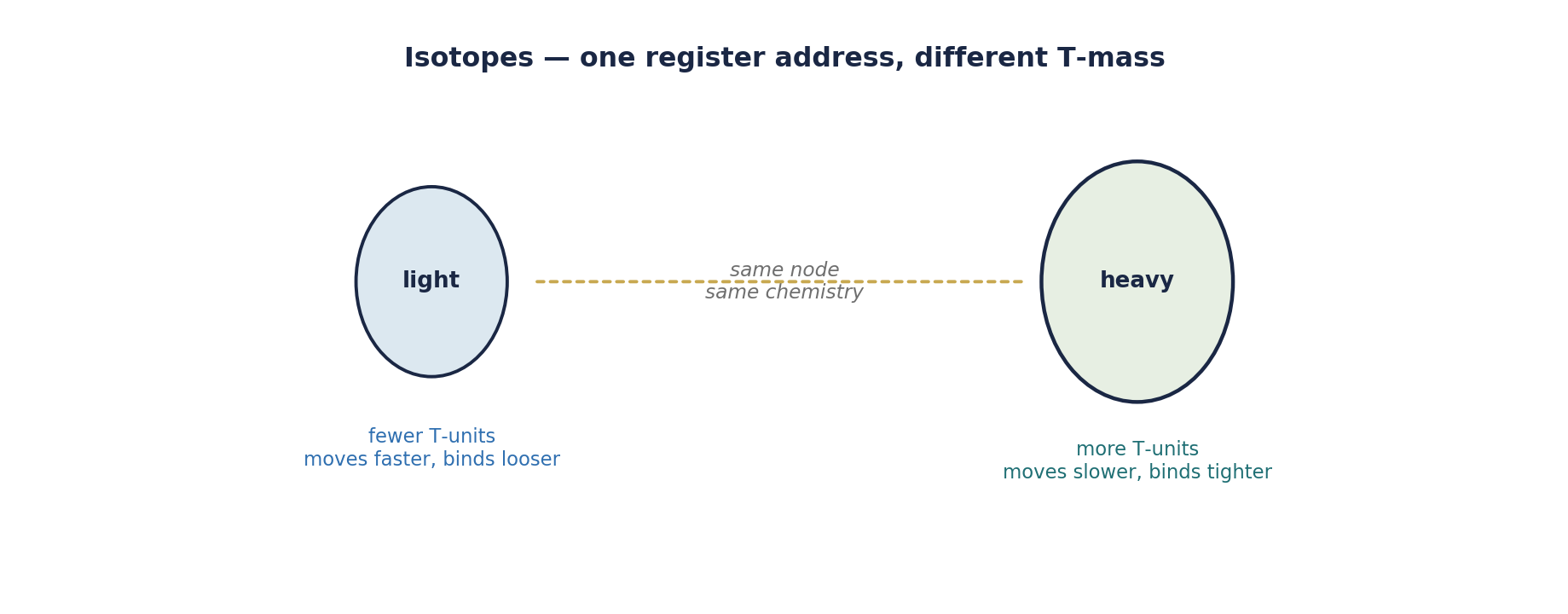
In the Force of Time the extra neutrons are extra Τ-units at the same node. The isotopes share a register address — hence their identical chemistry — but the heavy one carries more Τ, and a configuration holding more of the substance of time responds a little more sluggishly and settles a little more firmly. Everything that follows — the whole of the isotopic record — grows from that single small difference in how much Τ an atom carries at one shared address.
Fractionation Is Sorting by Mass-Offset
When an element’s atoms distribute themselves between two phases — water and vapour, mineral and melt, dissolved and precipitated — the heavy and light isotopes do not divide evenly. The heavy isotope favours one side, the light the other, by a small but definite margin. This unequal division is fractionation, and it happens every time the element crosses a boundary in the Earth.
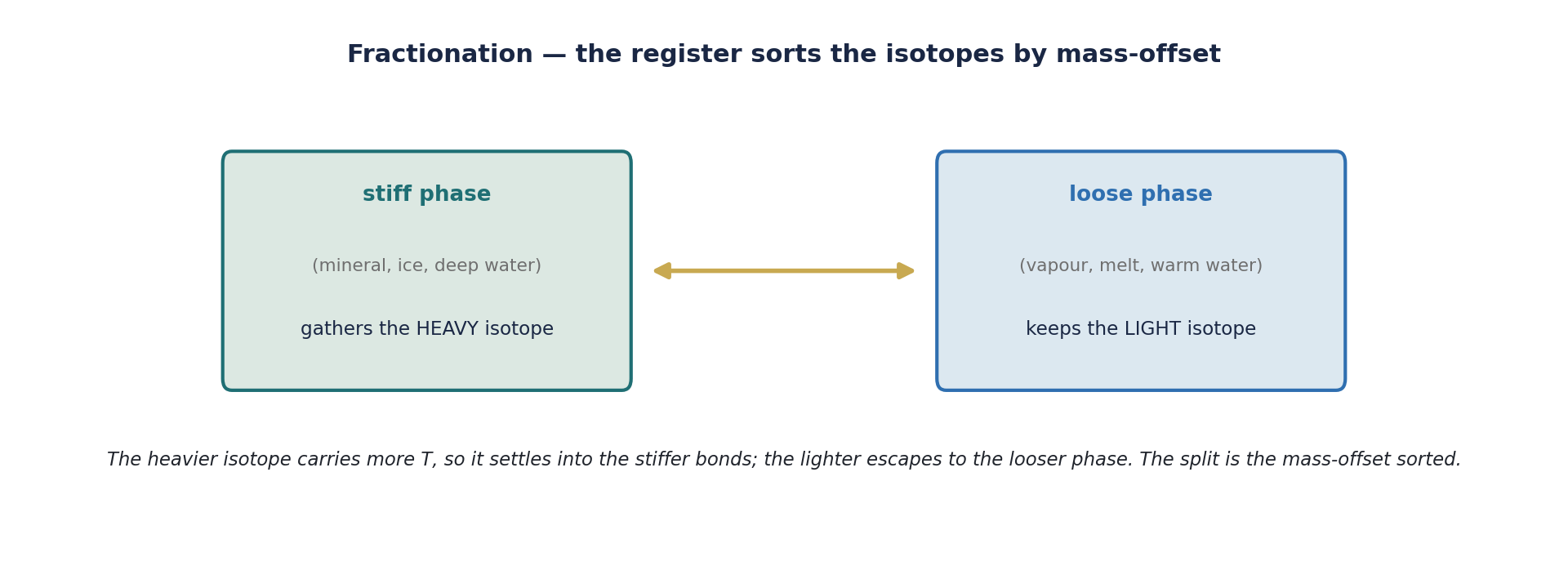
The register sorts the offset. The heavy isotope, carrying more Τ, sits more comfortably where the bonds are stiffest — in the mineral rather than the melt, the ice rather than the vapour, the cold deep rather than the warm surface — because a stiff bond rewards the extra Τ it holds still. The light isotope, with less to hold, escapes more readily to the looser phase. Fractionation is not a chemical preference, since the chemistry is identical; it is the register dividing the atoms by how much Τ each carries, and the small mass-offset is the whole of what it has to sort on.
The Delta Notation: Measuring the Offset
Because the differences are tiny, geochemists measure them not absolutely but as deviations from a standard, in parts per thousand — the δ-value. A positive δ means a sample is enriched in the heavy isotope relative to the standard; a negative δ means it is depleted. Ocean water, ocean carbonate and a meteorite sulphur serve as the zeroes against which snow, shell, bone and rock are read.
In the Force of Time the δ-value is simply the size of the register’s mass-offset sorting, expressed as a deviation from a chosen reference address. It is small because the surplus Τ that distinguishes the isotopes is small; it is measurable to great precision because the sorting, though slight, is lawful and repeatable. A δ-value is a reading of how far a given phase has been pushed along the register’s mass-sorting, relative to where the standard sits — a ruler laid against the offset.
Equilibrium and Kinetic Fractionation
Fractionation comes in two modes. Equilibrium fractionation acts where the two phases exchange freely and settle into balance — the heavy isotope accumulating in the stiffer-bonded phase, the split set purely by that balance. Kinetic fractionation acts in one-way processes — evaporation into dry air, diffusion through a barrier, the rush of a fast reaction — where the lighter isotope, moving faster, runs ahead and the residue is left heavy.
Both are Τ-mass sorting seen from two sides. Equilibrium fractionation is the register at rest dividing the offset by bond stiffness — the outcome of the last chapter’s balance of Τ between phases. Kinetic fractionation is the register in motion: as we saw in the chapter on kinetics, a lighter configuration — less Τ to move — crosses a barrier faster, and where a process runs one way and does not reverse, that speed difference sorts the isotopes by how quickly each can carry its Τ across. The same mass-offset, sorted once by stillness and once by speed.
The Isotope Thermometer
The single most useful property of equilibrium fractionation is that it depends on temperature: the colder the system, the larger the split between the phases; the hotter, the smaller. Measure the δ-difference between two phases that formed together — the calcite of a shell and the water it grew in, two minerals in a rock — and you can read the temperature at which they equilibrated. It is by this thermometer that the temperature history of the oceans and the ice ages is known.
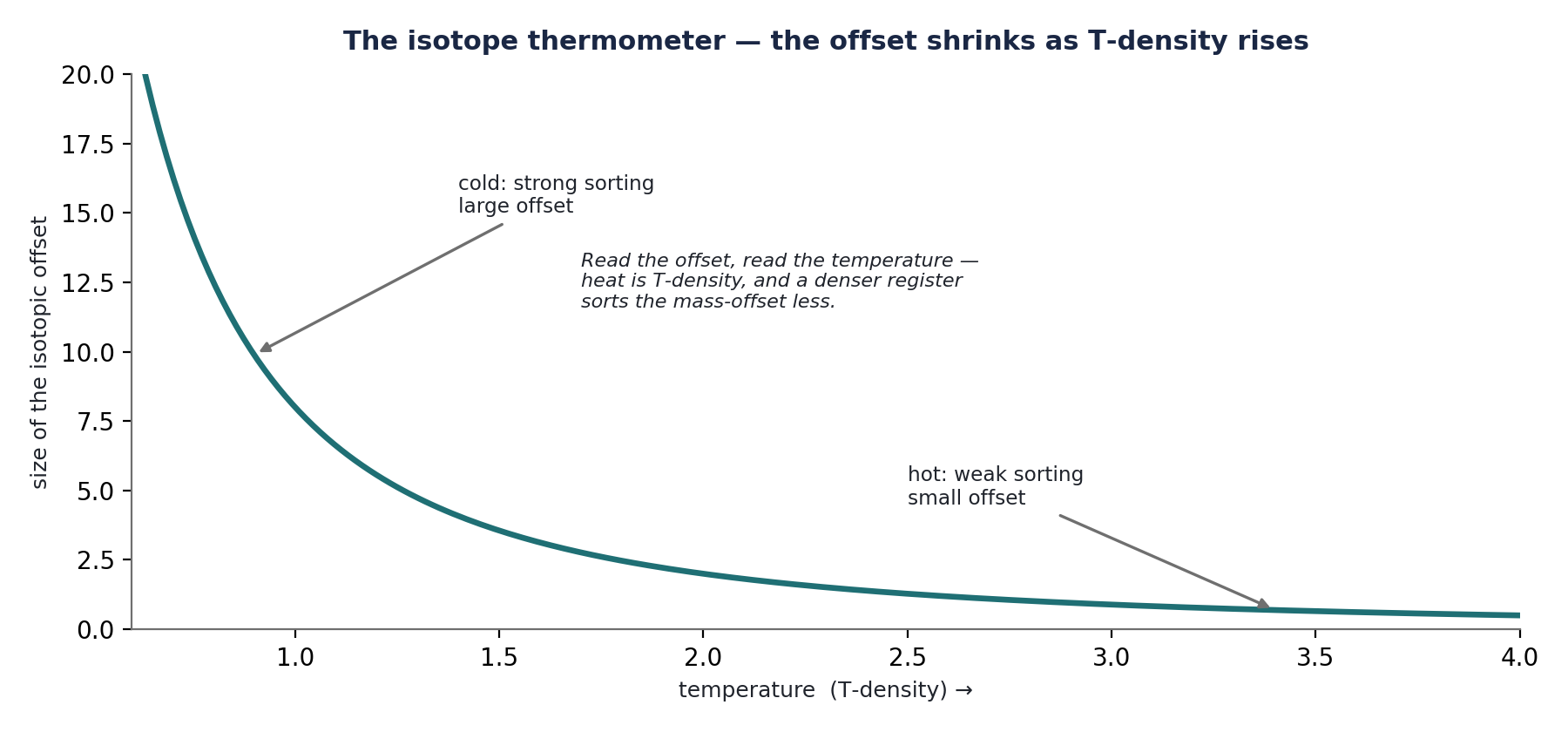
The Force of Time gives the thermometer its mechanism. Heat is Τ-density — the local abundance of the substance of time — and the register sorts the mass-offset less when it is dense with Τ, because the environment’s surplus swamps the small surplus that sets the isotopes apart. Cold means sparse Τ, where the isotopes’ own difference stands out and the sorting is strong; hot means dense Τ, where it is drowned and the sorting is weak. The offset therefore falls as temperature rises, exactly as measured. The isotope thermometer reads the density of time at which two phases last exchanged.
Reading Past Climates and Past Life
With that thermometer and those tracers, the stable isotopes open the Earth’s past. The oxygen in ancient shells and ice cores charts the temperatures and ice volumes of hundreds of thousands of years; the carbon in old carbonates and organic matter records the pulse of the biosphere and the great upheavals of the carbon cycle; the sulphur tracks the oxygenation of the early ocean. Life itself fractionates strongly — photosynthesis prefers the light carbon — so the isotopes even carry a signature of when living things began to breathe.
Every one of these records is Τ-mass sorting, laid down and preserved. A cold sea sorted its oxygen isotopes one way and froze the record into a shell; a photosynthesising cell sorted its carbon by the speed of its uptake and left a light signature in the rock; the register wrote the temperature and the life of each age as a mass-offset, and the rock kept it. To read stable isotopes is to read where the Earth’s registers stood — how dense with Τ, how alive — at the moment each sample formed.
Why This Should Matter to You
Almost everything we know about the climate before thermometers existed — the ice ages, the warm epochs, the abrupt swings that shaped human history — we know from stable isotopes. They are how we test what the climate can do, by seeing what it has done. And they carry the fingerprint of life reaching back billions of years, the isotopic trace of the first cells that learned to breathe the light.
And the whole record is legible as the sorting of Τ-mass. An element’s isotopes are one address carrying different amounts of Τ; the register sorts that offset between phases; the δ-value measures it; and because the sorting weakens as the density of time rises, the offset is a thermometer reading the Τ-density of the past. The Earth kept its diary by sorting the substance of time by mass. With the stable isotopes read, we can lift our eyes from the Earth to the matter it was made from — the cosmic abundances, and how the elements came to be.
The Numbers at a Glance
The quantities of stable-isotope geochemistry and their Force-of-Time reading. Measured behaviour is left exactly as measured; the right-hand column gives the register meaning.
| Quantity | What it is | The Force of Time reading |
|---|---|---|
| Stable isotopes | same element, different mass | one register address, different Τ-mass |
| Heavy isotope | extra neutrons | the same node carrying more Τ-units |
| Fractionation | unequal isotope split | register sorting the Τ-mass-offset |
| Equilibrium mode | heavy into stiff bonds | offset sorted by bond stiffness at rest |
| Kinetic mode | light runs ahead | lighter = less Τ to move = faster across |
| δ-value | deviation from a standard | the mass-offset sorting, as a reading |
| Thermometer | offset falls as T rises | denser Τ-register sorts the offset less |
| Biological signature | life prefers light C | fast Τ-uptake sorts carbon kinetically |
References
- S. Daubney, The Universal Force of Time — Master Compendium v5, The Daubney Foundation (2026).
- W. M. White, Geochemistry, John Wiley & Sons, Chichester (2005; 2013 print ed.), Chapter 9.
- S. Daubney, Heat Is Time — Temperature as Τ-Density, The Daubney Foundation (2026).
- S. Daubney, The Force of Time — Where It Departs From Current Science, The Daubney Foundation (2026).
Open the full paper as a PDF ↗
This paper, and any information drawn from it, may be used freely provided the reference attribution to Stephen Daubney and The Daubney Foundation is recognised.