In which the origin of the elements — the matter of which the Earth and everything on it is built — is read not as the piling-up of nuclei in stellar furnaces but as a sweep of the lattice: each element the next node the register reaches as the rotational Τ-address steps on, the cosmic abundances as the depths of those nodes, and the oldest meteorites as a sample of the register at the moment the Sun’s family first condensed.
Introduction — Through the Force of Time
The chapter that follows is, in the conventional telling, cosmochemistry: the origin of the elements by nucleosynthesis, the pattern of cosmic abundances, and the record of the early Solar System preserved in meteorites. Read through the Universal Force of Time it is the account of how the register generates the elements — a sweep of the lattice rather than a stacking of nuclei — and why they are as common or as rare as they are.
Every atom in your body was, we are told, made in a star. The carbon in your cells, the oxygen in your breath, the iron in your blood — each was assembled, the standard story runs, in the crushing heart of some sun, nucleus fused onto nucleus, and scattered by its death into the cloud that became the Earth. It is a beautiful story, and it contains a great deal of truth about where matter has been. But on the question of how the elements are made, the Force of Time tells a different story, and it begins not in a furnace but in the lattice.
White’s account is the standard one, told with care. The elements, it holds, are built by nucleosynthesis: hydrogen and helium from the birth of the universe, the heavier elements forged in stars by fusion — light nuclei rammed together against their mutual repulsion in the heat of stellar cores — up to iron, beyond which fusion no longer pays and the heaviest elements are made by the capture of neutrons in the violence of exploding and colliding stars. The cosmic abundances, falling steeply from hydrogen with a conspicuous peak at iron, are read as the ledger of what those furnaces could and could not make.
The Force of Time reads the same abundances, but denies the mechanism. The elements are not stacked together nucleus by nucleus; they are generated by rotational time-incrementation — the register stepping its address on, one node at a time, and each step being the next element. As the earlier sweep of this theory across the whole periodic table showed, every element’s mass and structure sits on a {2,3,5,π} node, reached from the one before by a definite increment of the rotational Τ-address. Hydrogen is the first node; helium the next; and so on up the table, not by fusion but by the lattice counting. A star is where conditions let the register run that sweep quickly and far — but the sweep is a stepping-on of addresses, not a welding of nuclei.
That reframes everything the abundances say. The elements are common or rare according to the depth of their nodes — how deeply the register settles at each address. Hydrogen and helium are the shallowest, most-occupied nodes, and so overwhelmingly the most abundant; iron sits at a specially deep node, and so stands up as a peak; the run of the table falls away as the nodes grow harder for the register to hold. The odd-even alternation, the iron peak, the steep decline — all of it is the profile of node depth along the sweep, not the reach of a furnace. And the oldest meteorites, which never melted, preserve the register’s node-occupancies as they stood when the Solar System condensed: a sample of the primordial sweep.
The Question of Where the Elements Come From
There are ninety-odd elements in nature, from hydrogen the lightest to uranium the heaviest, and they are not evenly common. Hydrogen and helium make up almost the whole of the visible universe; the elements of rock and life — oxygen, carbon, silicon, iron — are a minor remainder; gold and the rest of the heavy elements are vanishingly rare. Any account of the elements must explain both that they exist in this particular set and that they occur in these particular proportions.
The standard answer is nucleosynthesis in stars, and it is one of the triumphs of twentieth-century science. The Force of Time honours what that account got right — the history of where matter has travelled, the role of stars in spreading it — while giving a different answer to the deeper question of how an element is made at all. That answer is the lattice.
Not Fusion, but Rotational Time-Incrementation
State it plainly: the elements are not built by fusing light nuclei into heavy ones. They are generated by rotational time-incrementation — the register advancing its rotational Τ-address by one definite step, and each step standing as the next element. There is no welding of particles against their repulsion; there is a counting-on of addresses, and the atoms are what the register finds at each.
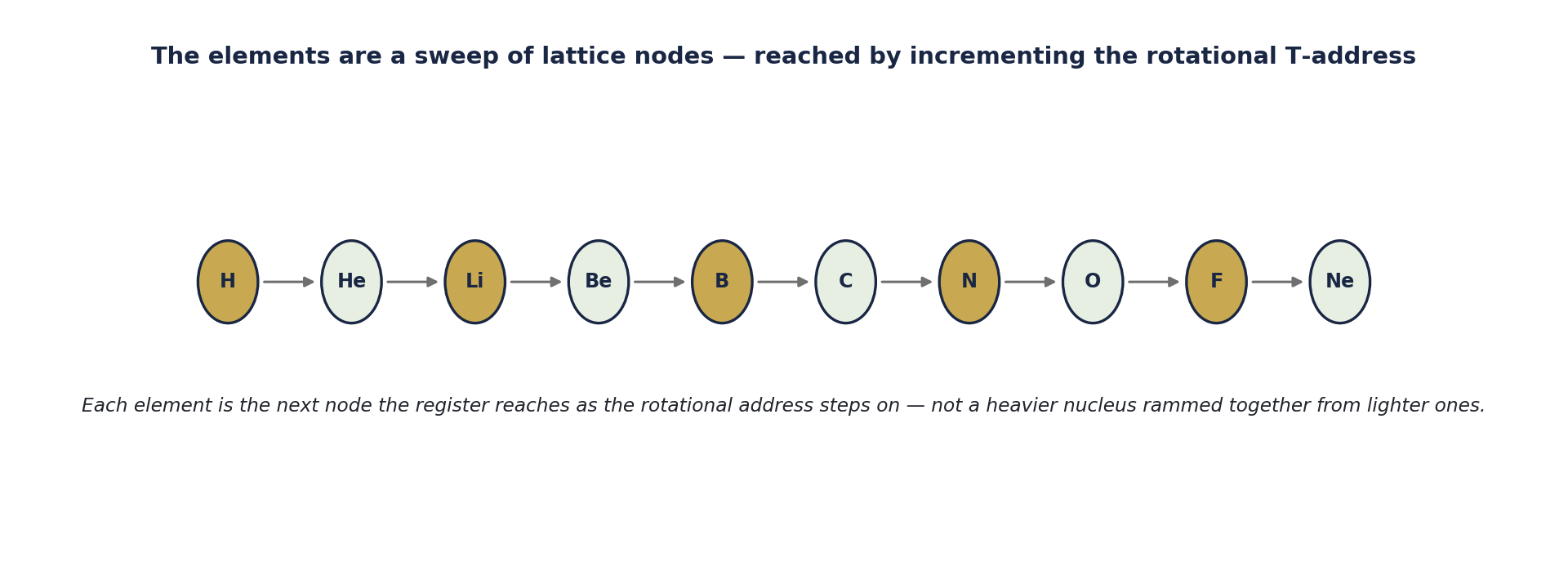
This is not a hopeful reinterpretation; it is what the periodic table shows when it is laid on the lattice. Element by element, across all ninety-odd, each mass and structure falls on a {2,3,5,π} node, and each is reached from its predecessor by a fixed increment of the rotational address. The table is a sweep of the lattice, read off in order. A stellar core is a place where the register can run that sweep — fast, hot, and far up the table — but what happens there is the stepping-on of Τ-addresses, not the fusion the standard account pictures. The heat of a star is the condition for the sweep, not the hammer that forges the nuclei.
The Periodic Table Is a Lattice Sweep
Why does the periodic table have the shape it has — the rows that close, the columns that repeat, the families that share their chemistry? Because it is a sweep of the lattice, and the lattice repeats. As the rotational address increments, it passes through the same kinds of node again and again at longer intervals, and elements that land on the same kind of node share their properties: that is the periodicity Mendeleev found.
So the table is not a filing cabinet drawn up after the fact; it is the register’s own itinerary. Each element is a stop on the sweep; the periods are the returns of the sweep to a like node; the chemical families are the sets of stops that share an address-type. The order of the elements is the order the register counts them in, and the pattern of the table is the pattern of the lattice it counts along. Read this way, the periodic law is not an empirical regularity awaiting explanation — it is the shape of the sweep.
Cosmic Abundances Follow the Register
Plot how common each element is against its place in the table and a definite shape emerges: a steep fall from hydrogen and helium, an alternation in which even-numbered elements beat their odd neighbours, and a pronounced peak at iron before the long decline into the heavy elements. This curve is one of the central facts of cosmochemistry, the same wherever in the universe we can measure it.
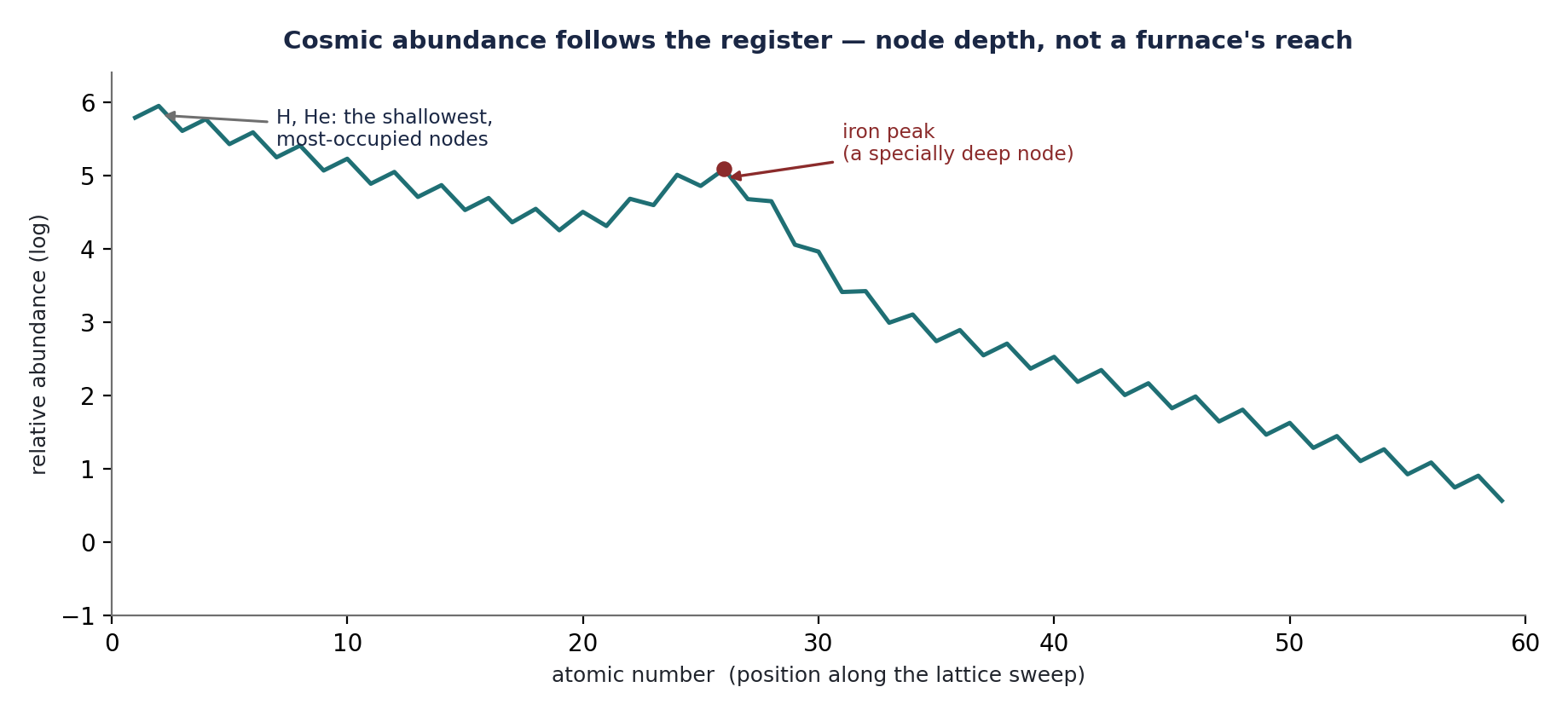
In the Force of Time the curve is the profile of node depth along the sweep. An element is abundant when its node is shallow and easily held, rare when its node is deep and hard for the register to settle at. Hydrogen and helium, the first and shallowest nodes, are held everywhere and dominate the universe; iron sits at a specially deep, stable node and stands up as the peak; the heavy elements occupy nodes so hard to reach that they are made only where the register is driven hardest, and remain rare. The odd-even sawtooth is the finer grain of the lattice, some nodes sitting a little deeper than their neighbours. The abundance curve is not the accounting of a furnace’s reach; it is the register’s node-depth, read straight off the sky.
Meteorites: the Primordial Register Sample
The oldest meteorites — the stony chondrites — are older than any rock on Earth, and some of them have never been melted since they formed. They are loose aggregates of primordial grains, and their composition is astonishingly close to that of the Sun itself, minus only the gases a small body cannot hold. For this reason they are treated as the reference for the raw material of the whole Solar System.
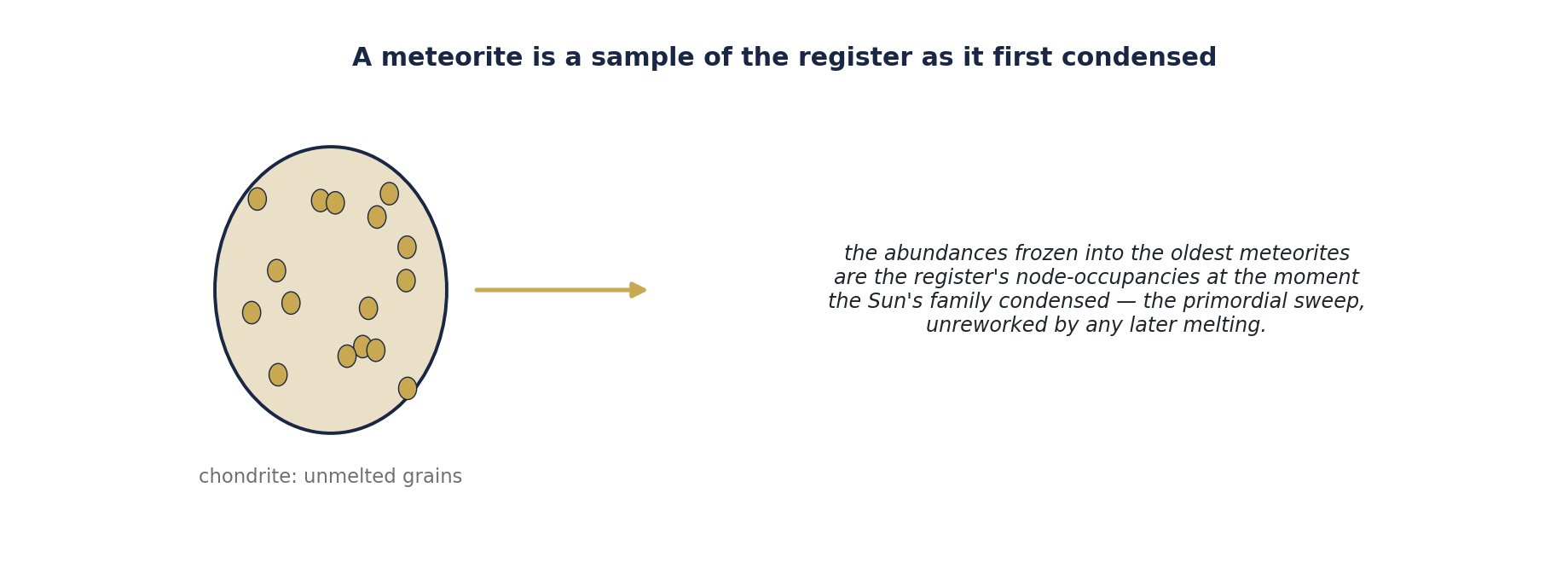
In the Force of Time a chondrite is a sample of the register as it first condensed — the node-occupancies of the sweep frozen in before any planet reworked them. Because it never melted, it never re-sorted its elements by the register-sieving of the earlier chapters; it holds the sweep raw. That is why it matches the Sun: both are the primordial sweep, one still burning it, the other having caught it in stone. To read a chondrite is to read the register’s starting inventory for the Solar System — the elements as first counted out.
The Solar System as a Condensed Register
From that primordial material the Sun and its planets condensed, sorting themselves as they cooled: the metals and rock-formers gathering into the inner worlds, the ices and gases held only in the cold outer reaches. The compositional map of the Solar System — rocky planets near, giants far — follows the temperature at which each substance could condense out of the cooling cloud.
This condensation is the register settling. As the cloud cooled — as its Τ-density fell — each element and compound came onto its node at its own point along the falling temperature, the refractory ones first and near the warm centre, the volatile ones only far out in the cold. The layout of the Solar System is that settling made permanent: a condensed register, sorted by where along the cooling each node could be held. The Earth’s own place in it — a rocky inner world, made of the refractory nodes — is set by the same sorting. We are built from the elements that condensed close and warm.
A Confirmation from the Sky: the First Interstellar Sugar
This chapter’s central claim — that molecules and elements occupy nodes of the lattice rather than being built up one piece at a time — is not idle. It makes a prediction the sky can test, and in the summer of 2026 the sky answered. An international team reported the first detection of a sugar in interstellar space: erythrulose, the only four-carbon (C4) sugar of its kind, found in a molecular cloud near the centre of the Galaxy. What they found is exactly what the register predicts, and it startled them.
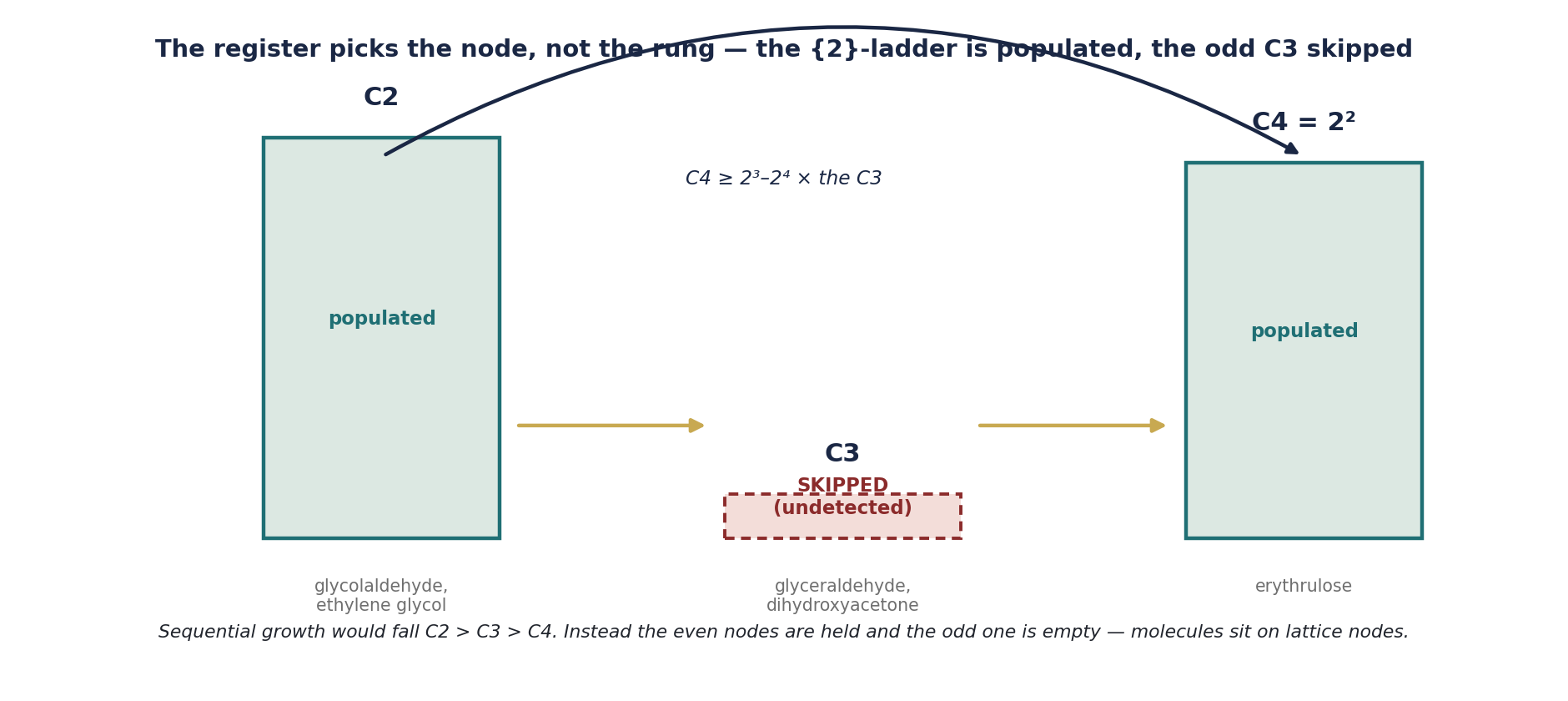
The reigning assumption in astrochemistry is that interstellar molecules grow by the sequential addition of carbon atoms — two, then three, then four — so the abundances should fall smoothly with size. They do not. The four-carbon sugar is found between 2³ and 2⁴ times more abundant than the three-carbon sugars, which are not detected at all, while the two-carbon species sit at comparable abundance to the four. Read the carbon numbers in order: C2 populated, C3 skipped, C4 populated. The register did not build up rung by rung; it settled on the nodes of the {2}-ladder — two and four (= 2²) — and passed over the odd number between. The very formula carries the stamp: the four-carbon sugar is C₄H₈O₄ = ( 2², 2³, 2² ), all powers of two, where the three-carbon sugar C₃H₆O₃ carries a bare 3. The lead author calls the result ‘unexpected.’ It is exactly the sweep of this chapter, caught in the act: molecules occupy lattice nodes, they are not stacked in sequence.
Why This Should Matter to You
The elements in you have a pedigree that reaches to the beginning of things. Whatever the mechanism, the atoms of your body are as old as matter, and were gathered into the Earth from the same cloud that made the Sun. That much the standard story and this one share, and it is worth holding: you are made of the oldest things there are.
But the Force of Time tells you more than where your atoms have been. It tells you what they are: nodes on a lattice, each element the next stop on a sweep the register counts out, as common or as rare as its node is shallow or deep. The elements were not forged; they were counted into being, and the same counting runs in every atom of you — and, as the interstellar sugar now shows, in the very molecules of life. With the origin of the matter understood, we can descend into the Earth that matter built — the mantle and the core, and the great boundaries of the deep register.
The Numbers at a Glance
The facts of cosmochemistry and their Force-of-Time reading. Measured abundances are left exactly as measured; the right-hand column gives the register meaning.
| Fact | What it is | The Force of Time reading |
|---|---|---|
| Origin of elements | nucleosynthesis by fusion | rotational time-incrementation along the lattice |
| Each element | a heavier nucleus | the next {2,3,5,π} node on the sweep |
| Periodic table | chart of the elements | the register’s itinerary along the lattice |
| Periodicity | repeating chemistry | returns of the sweep to a like node |
| Abundance curve | steep fall + iron peak | the depth-profile of the nodes |
| H, He dominant | commonest elements | the shallowest, most-occupied nodes |
| Iron peak | local abundance maximum | a specially deep, stable node |
| Chondrite meteorite | primitive Solar material | a sample of the register as it condensed |
| First interstellar sugar (2026) | erythrulose, a C4 sugar | the register picks the node (C4 = 2²), not the rung |
| C4 vs C3 sugars | C4 ≥ 2³–2⁴× the C3 | the {2}-ladder populated, odd C3 skipped |
References
- S. Daubney, The Universal Force of Time — Master Compendium v5, The Daubney Foundation (2026).
- W. M. White, Geochemistry, John Wiley & Sons, Chichester (2005; 2013 print ed.), Chapter 10.
- I. Jiménez-Serra et al., Detection of a four-carbon sugar in interstellar space, Nature Astronomy (2026), DOI 10.1038/s41550-026-02905-7.
- S. Daubney, The Periodic Table on the Lattice — the Element Sweep, The Daubney Foundation (2026).
- S. Daubney, The Force of Time — Where It Departs From Current Science, The Daubney Foundation (2026).
Open the full paper as a PDF ↗
This paper, and any information drawn from it, may be used freely provided the reference attribution to Stephen Daubney and The Daubney Foundation is recognised.