In which the interior of the Earth — the mantle and the core, and the great discontinuities that divide them — is read as the register set out in depth: the Moho as the phase-correction boundary that squares the incoming waves of time, the mantle’s own layers standing in the ratio 3 : 2 : 5, the transition zone spaced by 250 kilometres, and the core–mantle boundary ringing at a circumference of 21,870 kilometres — the lattice numbers written into the body of the planet.
Introduction — Through the Force of Time
The chapter that follows is, in the conventional telling, the geochemistry and structure of the deep Earth: the layered interior revealed by seismology, the mineralogical transitions of the mantle, the composition of the core and the geodynamo that makes the magnetic field. Read through the Universal Force of Time it is the register displayed in depth — every great boundary of the interior falling on a {2,3,5,π} value, the Earth layered because the lattice is layered.
We have never been more than a few kilometres into the Earth, yet we know its interior in remarkable detail — a thin crust, a vast rocky mantle, a metal core with a solid heart — because earthquake waves pass through it and bend and echo at every boundary, mapping the layers the way an ultrasound maps a body. And what they map is not a smooth gradient but a set of sharp divisions, each at a definite depth, the same all around the world. The question is why the Earth is divided just where it is.
White’s account gives the structure with the authority of seismology. Beneath the crust lies the Mohorovičić discontinuity — the Moho — and below it the mantle, itself divided: an upper mantle, a transition zone bounded by abrupt changes near 410 and 660 kilometres depth where minerals collapse into denser forms, and a lower mantle reaching down to the core–mantle boundary at some 2,900 kilometres. Below that is the liquid outer core, whose churning generates the magnetic field, and at the centre the solid inner core. The boundaries are read as changes of composition and of mineral structure under rising pressure.
The Force of Time reads the same interior and finds the lattice in it. The boundaries are not placed by accident of pressure; they fall on {2,3,5,π} values, because the Earth is the register set out in depth. The Moho sits at a radius of 6366.197724 km ( = 20000/π ), its circumference exactly 40,000 km ( = 2⁶×5⁴ ); and, as the opening chapter showed, it is no mere change of rock but the phase-correction boundary, the layer just over half a kilometre thick that squares the incoming linear and orbital waves of time as they enter the node of the Earth. Deeper still, the mantle’s own layers stand in the ratio 3 : 2 : 5, the transition zone is spaced by 250 km ( = 2×5³ ), and the core–mantle boundary rings at a circumference of 21,870 km ( = 2×3⁷×5 ) — the very same 3⁷ that sets the cosmic background of the universe.
So the layering of the Earth is the layering of the register. Each discontinuity the seismic waves find is a boundary between register levels, placed on the lattice; the mantle’s divisions ring on the lattice numbers themselves; the core is the deepest, densest node, turning to wind the magnetic field. To read the interior of the Earth is to read the register in its most literal form — the numbers {2,3,5,π} laid out, kilometre by kilometre, from the crust to the centre.
The Deepest Register We Can Read
No one has been to the mantle, let alone the core; the deepest borehole scratches only the upper crust. Yet the interior is not unknown, because every earthquake sends waves through the whole Earth, and those waves bend, speed up, slow down and reflect at each change of material. From millions of such passages seismologists have built a map of the inside as sharp as an anatomy: crust, mantle, outer core, inner core, divided by boundaries that are the same the world over.
Those boundaries are the subject of this chapter. In the standard account they mark changes of composition and of mineral structure under pressure. In the Force of Time they mark something more orderly: the divisions of the register, laid out in depth and placed on the lattice. The Earth is layered because the register is layered, and the depths of its boundaries are lattice values we can name.
The Moho: the Phase-Correction Boundary
The first great boundary, a few tens of kilometres down, is the Moho — the floor of the crust, where the seismic waves abruptly quicken as they pass into the denser mantle. It is usually described simply as the crust–mantle contact. It is far more than that.
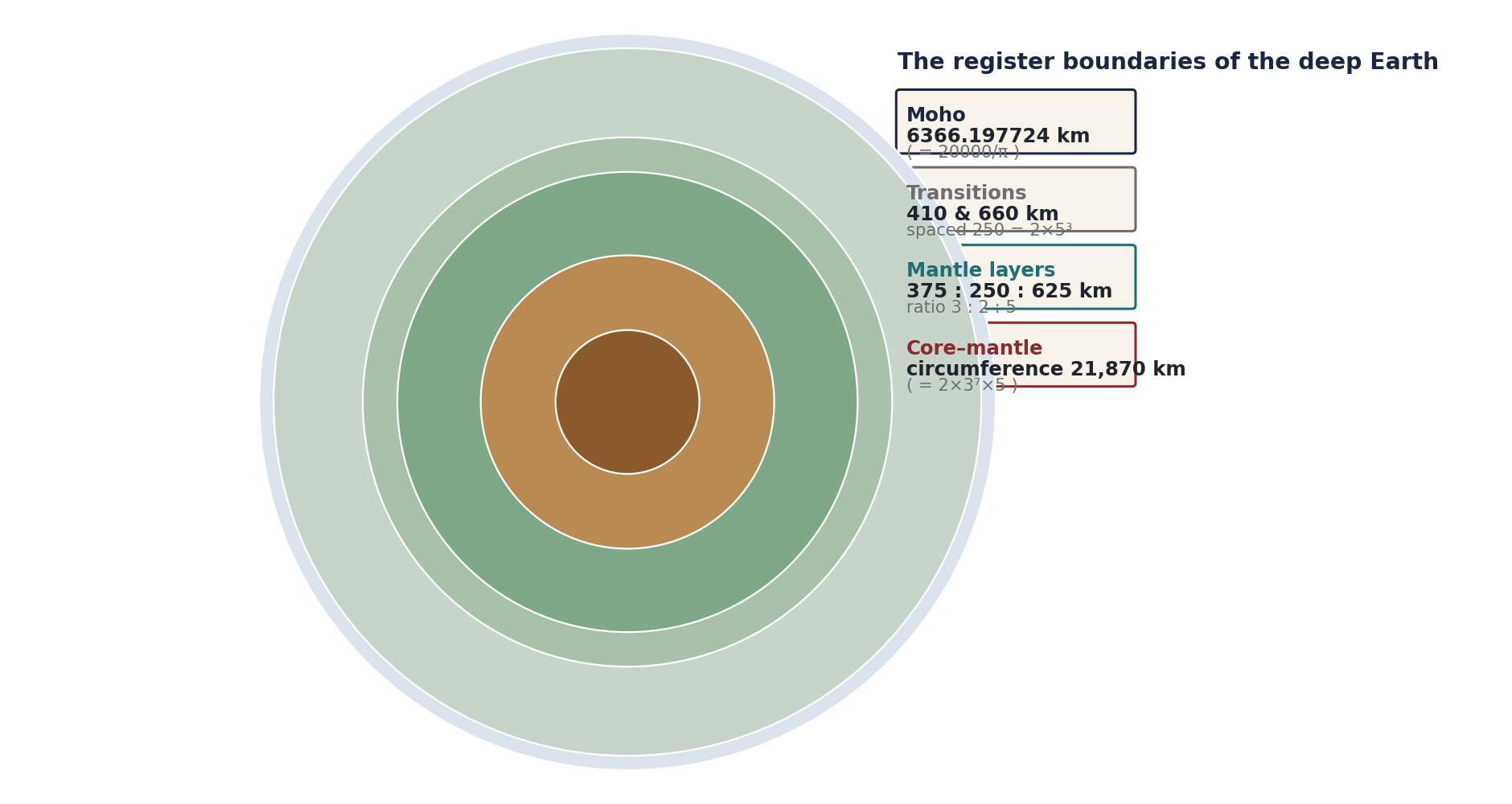
The Moho sits at a radius of 6366.197724 km ( = 20000/π ), and its circumference is therefore exactly 40,000 km ( = 2⁶×5⁴ = 2π × Moho ) — a whole, round lattice number ringing the Earth at that depth. And its role, set out in the opening chapter, is to phase-correct the waves of time that enter the planet. Two waves arrive at the node of the Earth: an orbital wave, curved, carrying a factor of π r, and a linear wave, straight, carrying 2 r. They arrive out of step by the mismatch π − 2, and the Moho — a layer just over half a kilometre thick — is where that mismatch is corrected, by the factor 0.0636619772368 ( = 1/5π ), so that the two register waves are brought into phase before they pass into the body of the Earth.
And the boundary has two faces. Its upper face, presented to the celestial register above, sits at 6366.197724 km ( = 20000/π ); its lower face, presented to the atomic register below, sits at 6365.623859 km ( = 2⁹×3⁹×π²/5⁶ ). Between them lies the transition zone, just 573.865 m thick — the physical thickness of the phase-correcting layer, the half-kilometre skin in which the incoming waves are squared. The Moho is not a passive contact; it is the Earth’s tuning boundary, and it sits, on both faces, exactly on the lattice.
The Mantle Rings on 3 : 2 : 5
Below the Moho the mantle reaches down almost halfway to the centre — the great bulk of the Earth, rocky and slowly churning. It is not uniform: seismology divides it into an upper mantle, a transition zone, and a lower mantle, each a distinct shell. In the standard account these are set by the pressures at which the mantle minerals rearrange.
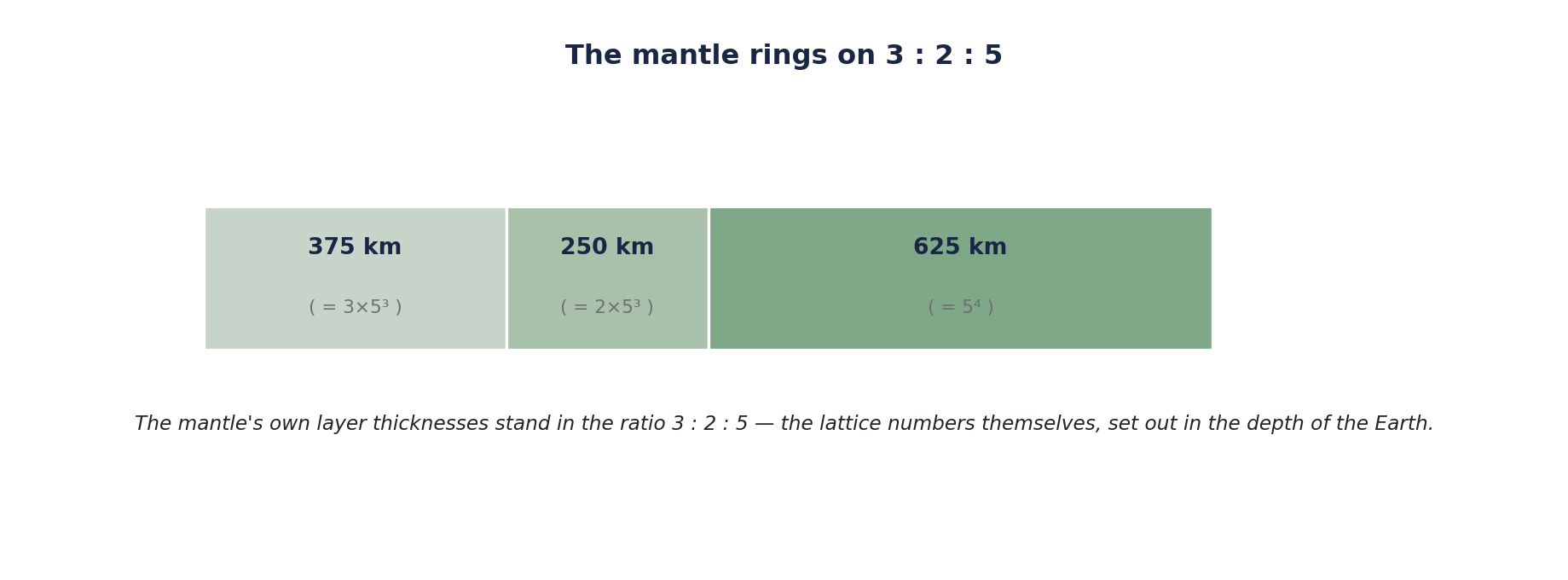
In the Force of Time the mantle’s divisions are lattice-placed. Its layer thicknesses stand in the ratio 3 : 2 : 5 — 375 km ( = 3×5³ ), 250 km ( = 2×5³ ) and 625 km ( = 5⁴ ) — the numbers 3, 2 and 5 of the lattice themselves, written into the shells of the mantle. The mantle is not divided by the accidents of mineral physics; it is divided the way the register is divided, on the small whole numbers that build everything in this theory. The rock rearranges where it does because the register level changes there.
The Transition Zone: 410 and 660
Within the mantle lie two of the sharpest boundaries in the whole Earth: sudden jumps in seismic speed near 410 and 660 kilometres depth, where the common mantle mineral olivine collapses into denser and denser structures. Between them is the transition zone; the 660 boundary in particular is so sharp and so global that it nearly divides the mantle in two.
The spacing of these two boundaries is exact: 660 − 410 = 250 km ( = 2×5³ ) — the same 250 that sets the middle shell of the mantle. In the Force of Time the transition zone is a register step, and its width is a lattice quantity; the minerals collapse to denser forms at those depths because the register moves to a denser level there, and the collapse is the rock following the register down. The 410 and 660 discontinuities are the visible signature of a register step, spaced by the lattice number 250.
The Core-Mantle Boundary: 2 x 3^7 x 5
At about 2,900 kilometres down comes the most dramatic boundary of all: the base of the rocky mantle and the top of the liquid metal core. Here the seismic shear waves stop dead, because the outer core is liquid and cannot carry them; the density leaps; the material changes from rock to iron. It is the sharpest compositional divide in the Earth.
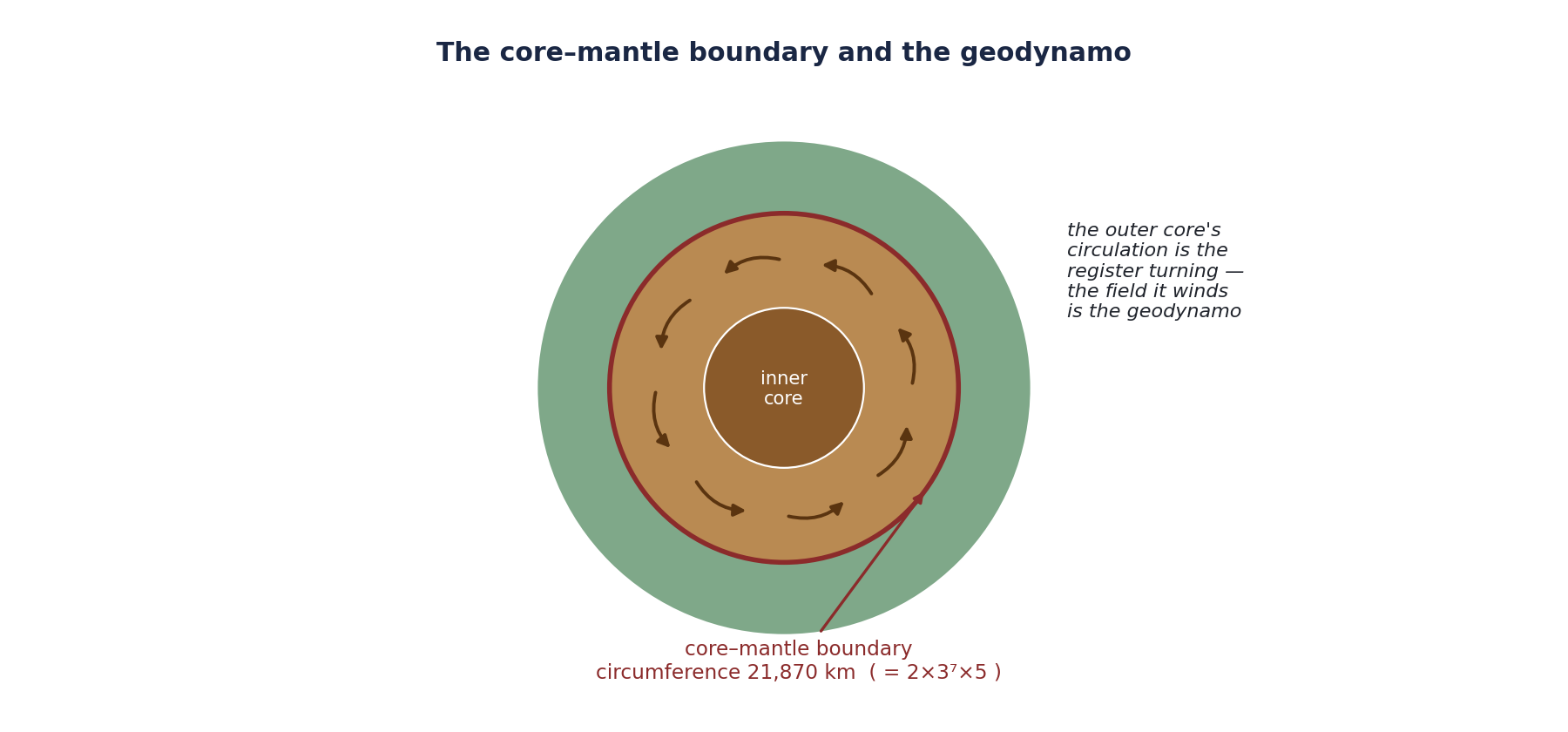
The core–mantle boundary rings at a circumference of 21,870 km ( = 2×3⁷×5 ) — and the factor 3⁷ that sets it is the very same power of three that fixes the cosmic microwave background of the whole universe, and the absolute-zero floor of temperature. The deepest boundary within the Earth is set by the same lattice number as the largest structure in the cosmos. This is the register speaking at two ends of the scale of size in one voice: the core–mantle boundary and the background of the universe are struck on the same note, 3⁷.
The Core and the Geodynamo
The outer core is liquid iron in ceaseless motion, and that motion is what gives the Earth its magnetic field — the geodynamo, the churning of conducting metal winding a magnetism that reaches far into space and shields the planet. The inner core, under the greatest pressure of all, is frozen solid, and grows slowly as the Earth cools.
In the Force of Time the core is the deepest, densest node of the terrestrial register, and its circulation is the register turning. The magnetic field is not a thing apart; it is another register of the single Τ-field, wound by the turning of the core the way the earlier chapters wound the other so-called forces from the one force of time. The geodynamo is the deep register in motion, and the field that shelters every living thing on the surface is the outward reach of the Earth’s turning heart. The core keeps the planet habitable by keeping the register turning.
Why This Should Matter to You
The layered Earth is not remote from you. The core’s turning makes the magnetic field that turns aside the solar wind and lets an atmosphere survive; the mantle’s slow churning drives the plates, builds the continents, raises the mountains and opens the oceans; the whole restless interior is the engine of the world you live on. Without these boundaries doing their work, there would be no surface fit for life.
And every one of those boundaries is on the lattice. The Moho at 6366.197724 km ( = 20000/π ), phase-correcting the incoming waves of time; the mantle ringing on 3 : 2 : 5; the transition zone spaced 250 km ( = 2×5³ ); the core–mantle boundary at 21,870 km ( = 2×3⁷×5 ), struck on the same 3⁷ as the background of the universe. The Earth is the register set out in depth, and you live on the thin bright skin of it. With the interior read, we can rise to the crust itself — the register at the surface, where rock meets air and water and life.
The Numbers at a Glance
The great boundaries of the Earth’s interior and their Force-of-Time reading. The physical number leads; the lattice form follows in brackets.
| Boundary | The value | The lattice form |
|---|---|---|
| Moho radius (upper face) | 6366.197724 km | 20000/π |
| Moho circumference | 40,000 km | 2⁶×5⁴ = 2π×Moho |
| Moho lower face | 6365.623859 km | 2⁹×3⁹×π²/5⁶ |
| Phase-correction layer | 573.865 m thick | squares πr & 2r by 1/5π |
| Mantle layer ratio | 375 : 250 : 625 km | 3×5³ : 2×5³ : 5⁴ = 3:2:5 |
| Transition-zone spacing | 250 km (660−410) | 2×5³ |
| Core–mantle circumference | 21,870 km | 2×3⁷×5 |
| The 3⁷ factor | also sets the cosmic background | the register at both ends of scale |
References
- S. Daubney, The Universal Force of Time — Master Compendium v5, The Daubney Foundation (2026).
- W. M. White, Geochemistry, John Wiley & Sons, Chichester (2005; 2013 print ed.), Chapter 11.
- S. Daubney, The Moho Phase-Equalisation Boundary, The Daubney Foundation (2026).
- S. Daubney, The Earth Data Sheet — Radii, Circumferences and the Lattice, The Daubney Foundation (2026).
- S. Daubney, The Force of Time — Where It Departs From Current Science, The Daubney Foundation (2026).
Open the full paper as a PDF ↗
This paper, and any information drawn from it, may be used freely provided the reference attribution to Stephen Daubney and The Daubney Foundation is recognised.