In which the crust — the thin bright skin on which all life is lived — is read as the surface register: the place where the body of the Earth meets the incoming waves of the sky, the layer drawn out of the mantle as the concentrate of its off-node, incompatible elements, and the reason the continents float high and endure while the ocean floor is thin, dense and forever renewed.
Introduction — Through the Force of Time
The chapter that follows is, in the conventional telling, the geochemistry of the crust: the contrast of continental and oceanic crust, the process by which crust is extracted from the mantle, the composition of the continents, and the recycling of crust through the plate cycle. Read through the Universal Force of Time it is the surface register — the crust as the concentrate the mantle has sieved to its top, drawn up register-step by register-step over the age of the Earth.
Everything you have ever seen is the crust. The mountains and the seabed, the soil and the stone, the ground beneath every city and the floor of every ocean — all of it is the crust, the outermost shell of the Earth, and it is astonishingly thin: a few tens of kilometres beneath the continents, less than ten beneath the seas, a skin no thicker on the globe than the skin on an apple. On that skin the whole of life is lived. It is worth asking why it is there at all, and why it is made as it is.
White’s account gives the picture with precision. There are two crusts. Oceanic crust is thin, dense and young — nowhere much older than the dinosaurs — made fresh at the mid-ocean ridges from melted mantle and swallowed back at the trenches. Continental crust is thick, light and old — some of it nearly as old as the Earth — and it is chemically quite different, enriched in exactly the incompatible elements the mantle sheds: potassium, the light rare earths, uranium, thorium. The crust, and above all the continents, is understood as the extract the mantle has yielded up through billions of years of partial melting.
The Force of Time reads the crust as the surface register — and it draws together two threads already laid down in this book. First, the crust is where the body of the Earth meets the sky: the layer just above the Moho, the phase-correction boundary, where the incoming waves of time we followed in the opening chapters arrive and are received. It is the register’s outermost face, turned to the celestial register above. Second, the crust is the register’s concentrate. When the mantle partially melts, as the chapter on trace elements showed, its off-node, incompatible elements are driven into the melt and carried upward, while the on-node elements stay below. The crust is billions of years of that sieving, gathered at the top — the off-node elements the mantle could not hold, floated to the surface and left there.
That single idea explains the crust’s strangeness. The continents are enriched in incompatible elements because they are the incompatible concentrate — the register’s scum, risen and stayed. They are light, and so they float high and cannot be pushed back down, which is why they endure while the dense ocean floor is recycled within a geological moment. And their composition, element for element, is the tally of what the mantle’s sieve rejected — a lattice quantity, the off-node inventory of the deep register made visible as the ground we stand on. The crust is the register turned inside-out: everything the depths would not keep, kept at the surface for us.
The Skin of the Register
The crust is the thinnest of the Earth’s shells and the only one we touch. Beneath the deepest mine, the tallest mountain’s root, the floor of the deepest trench, it gives way at the Moho to the mantle below. Everything above that boundary — the entire theatre of human life and of nearly all life — is the crust, a film on the surface of a world whose bulk we never reach.
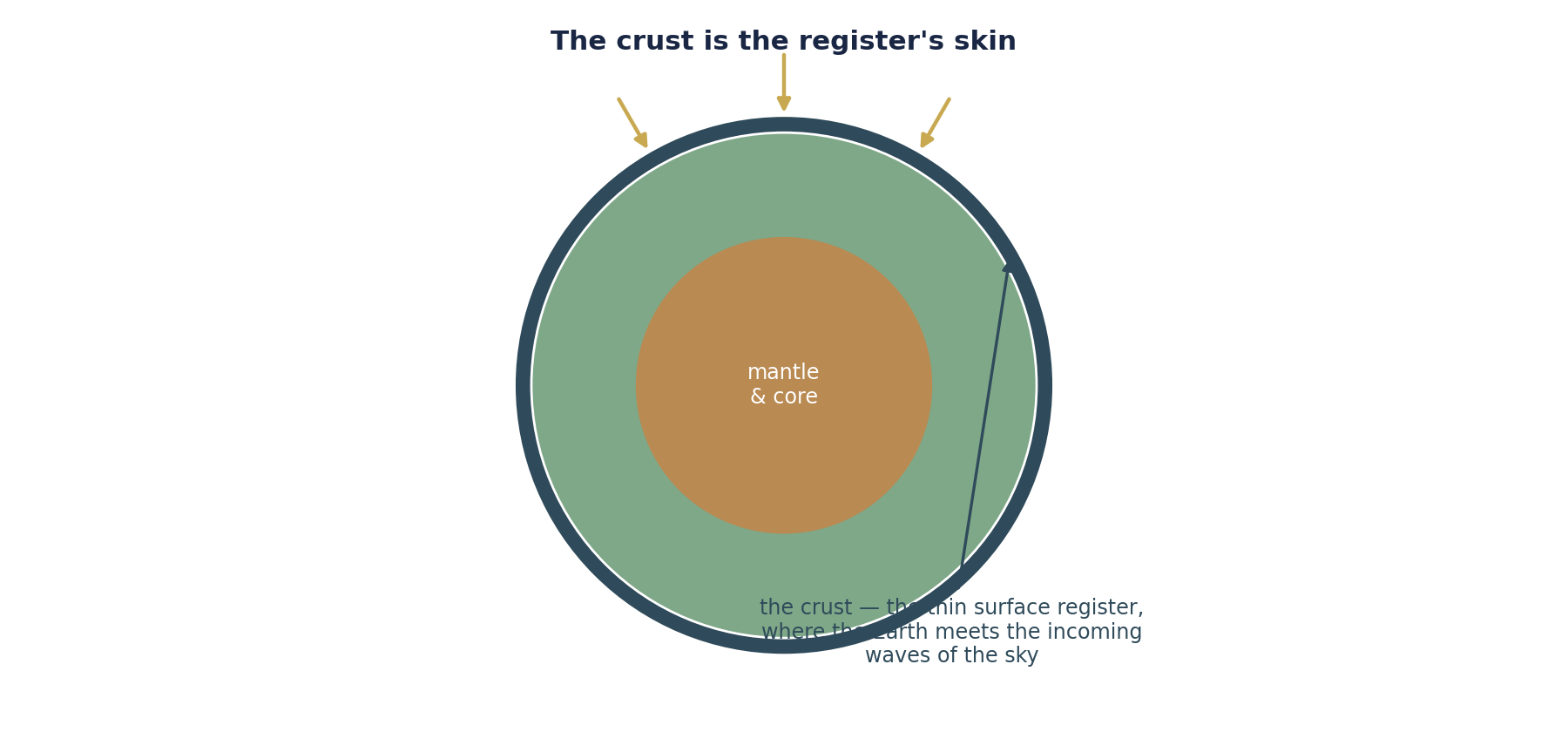
In the Force of Time the crust is the surface register: the Earth’s outermost face, the layer just above the Moho where the register meets the sky. The waves of time that the opening chapters followed inward — the orbital and linear waves the Moho squares — arrive here first; the crust is where the terrestrial register is turned to the celestial one above. It is a skin in more than thickness: it is the interface of the Earth, the surface at which the planet is in contact with everything beyond it.
Two Crusts
There is not one crust but two, and they could hardly be more different. Oceanic crust is thin — a mere few kilometres — dense, dark, and young, made continuously at the mid-ocean ridges and destroyed at the trenches, so that no part of the ocean floor is very old. Continental crust is thick, light, pale, and ancient, standing high above the ocean floor and carrying the oldest rocks on Earth.
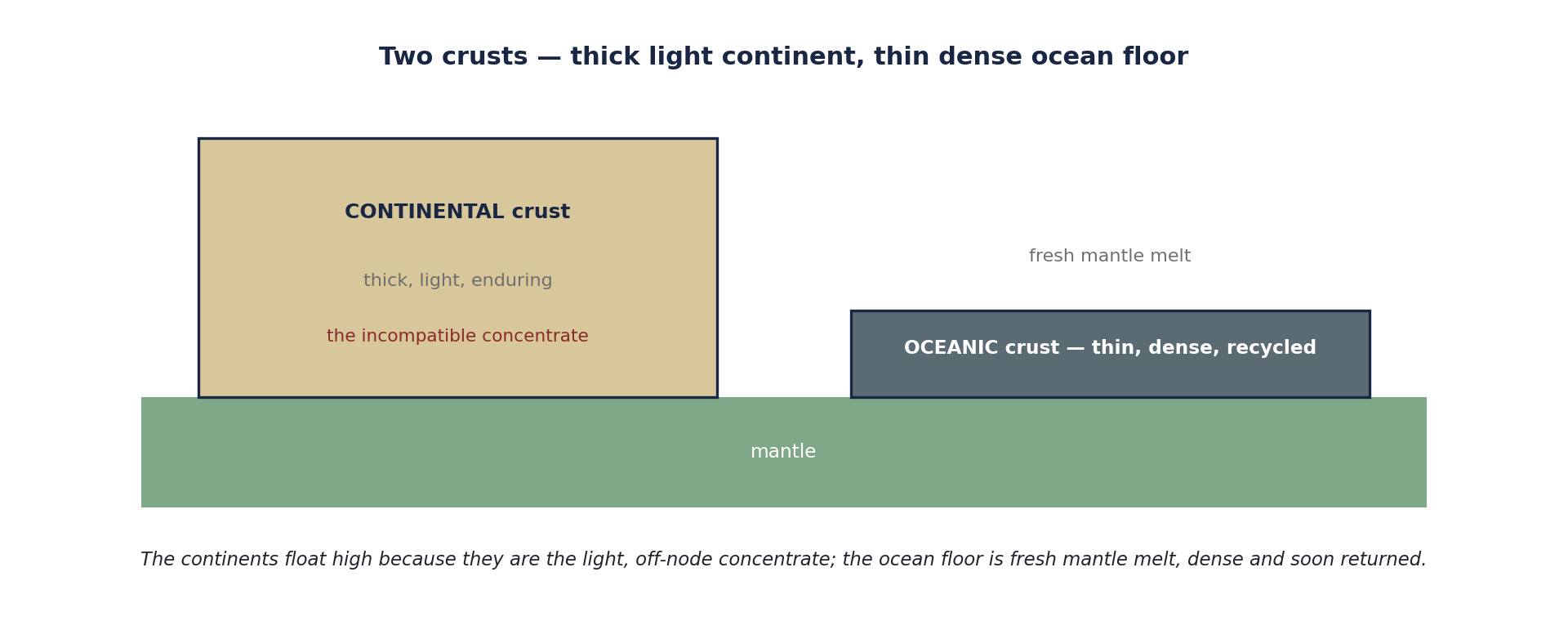
The Force of Time reads the difference as a difference of register history. Oceanic crust is fresh mantle melt, tapped straight from below and barely sieved — dense, and so soon pulled back down and returned to the mantle. Continental crust is the long-accumulated concentrate, sieved and re-sieved over billions of years until it is thoroughly enriched in the off-node elements and thoroughly light. One is the register’s newest exhalation, quickly reabsorbed; the other is its permanent residue, floated up and kept.
The Crust Is the Register's Concentrate
Why is the continental crust enriched in just those elements — potassium, rubidium, uranium, thorium, the light rare earths — that the mantle is poor in? The standard account answers: because these are the incompatible elements, shed by the mantle when it melts and carried upward into the crust. It is the right answer, and the Force of Time gives it its mechanism.
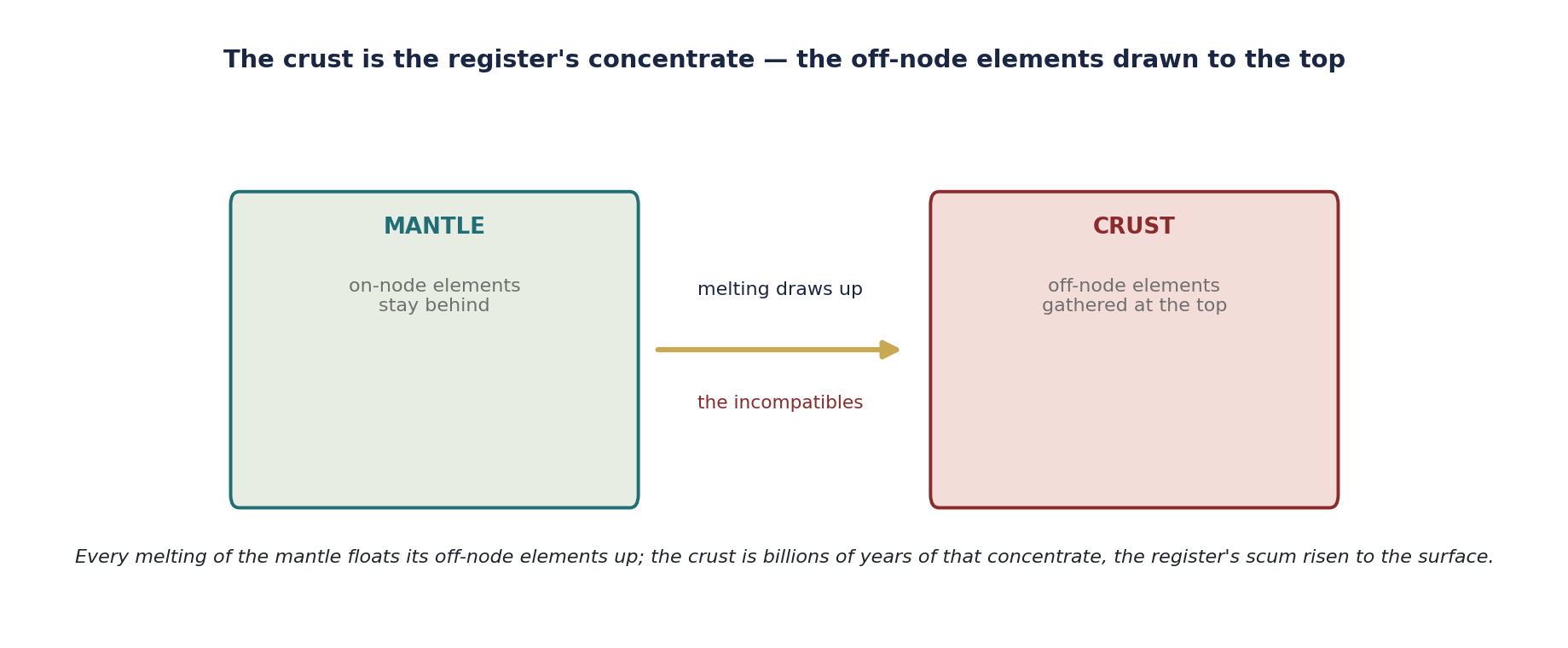
As the chapter on trace elements showed, an incompatible element is one whose Τ-address falls off the nodes of the crystalline mantle; when the mantle melts, such elements are excluded from the crystals and swept up in the rising melt. Every melting is a register-sieve, and every sieving carries the off-node elements a little higher. The crust is the sum of all those sievings — the off-node inventory of the mantle, drawn to the top over the age of the Earth and left there. It is enriched in the incompatible elements because it simply is them: the register’s concentrate, gathered at the surface.
Why the Continents Float and Endure
The continents ride high above the ocean floor and have done for billions of years; the oldest continental rocks are nearly as old as the Earth itself. The ocean floor, by contrast, is nowhere ancient — it is made and unmade on a cycle of a couple of hundred million years. The continents persist; the ocean floor is forever renewed.
In the Force of Time this permanence follows from what the continents are. Being the light, off-node concentrate, they are less dense than the mantle beneath them and cannot be pushed back down — they float, buoyant, on the register below, and once formed they stay. The dense oceanic crust, by contrast, is heavy enough to sink back and be reabsorbed. So the register keeps its concentrate at the surface and recycles its fresh melt: the continents are the permanent record of the sieving, the ocean floor its passing breath. We live on the enduring part because it is the light part, and it is light because it is the off-node residue of the deep.
The Crust's Composition on the Lattice
The average composition of the continental crust is one of the most quoted quantities in geochemistry: so much oxygen, so much silicon, so much aluminium, iron, calcium, sodium, potassium, and the long tail of the trace elements. It is the reference against which every rock and every ore is measured, the baseline of the surface world.
In the Force of Time that composition is a lattice quantity — the tally of what the mantle’s sieve rejected. Each element’s abundance in the crust is set by how off-node it is in the mantle: the more incompatible, the more thoroughly it has been swept up and concentrated here. The crustal abundances are therefore not an arbitrary mixture but a reading of the deep register’s node-structure, turned inside-out and laid at the surface. The ground beneath us is the mantle’s off-node inventory, and its composition counts out, element by element, what the lattice would not hold below.
The Cycle: Making and Unmaking Crust
Crust is not made once and left. Oceanic crust is born at the ridges and returned at the trenches; where it dives back down it drags water and sediment into the mantle, melts, and feeds new continental crust above the subduction zones. Continental crust is built, eroded, buried, remelted and rebuilt. The whole surface is a slow forge, running for the age of the Earth.
In the Force of Time this cycle is the register breathing at its surface: exhaling fresh melt at the ridges, inhaling dense crust at the trenches, and at every turn sieving a little more of the off-node concentrate up into the continents. The making and unmaking of crust is the surface register at work, endlessly refining its separation of what floats from what sinks, what is kept above from what is drawn below. The continents grow, over aeons, because the breathing always leaves a little of the light residue behind. The cycle is the register sorting itself, at the skin of the world.
Why This Should Matter to You
You live on the concentrate. The soil that grows your food, the stone that builds your cities, the metals you mine, the very ground that holds up the sea — all of it is the crust, the light residue the Earth has spent four and a half billion years sieving to its surface. The continents are high and dry and lasting for one reason: they are the part the depths could not keep.
And it is all legible as the register. The crust is the Earth’s outermost face, meeting the incoming waves of the sky; it is the concentrate of the mantle’s off-node elements, floated up by every melting; the continents endure because that concentrate is light; and its composition is the off-node inventory of the deep, counted out at the surface. We are, quite literally, standing on what the register set aside. With the solid Earth read from core to crust, we can turn to where that crust meets air and water — the weathering of the surface, and the register at its most restless.
The Numbers at a Glance
The facts of the crust and their Force-of-Time reading. Measured features are left as measured; the right-hand column gives the register meaning.
| Feature | What it is | The Force of Time reading |
|---|---|---|
| The crust | Earth’s thin outer shell | the surface register, above the Moho |
| Its outward face | meets the sky | turned to the incoming waves of time |
| Continental crust | thick, light, ancient | the accumulated off-node concentrate |
| Oceanic crust | thin, dense, young | fresh mantle melt, soon recycled |
| Incompatible enrichment | K, U, Th, light REE | the off-node elements sieved upward |
| Continents float | stand high, endure | light concentrate, cannot sink back |
| Crustal composition | the reference average | the mantle’s off-node inventory on the lattice |
| The crustal cycle | made and unmade | the surface register breathing |
References
- S. Daubney, The Universal Force of Time — Master Compendium v5, The Daubney Foundation (2026).
- W. M. White, Geochemistry, John Wiley & Sons, Chichester (2005; 2013 print ed.), Chapter 11.
- S. Daubney, The Moho Phase-Equalisation Boundary, The Daubney Foundation (2026).
- S. Daubney, The Force of Time — Where It Departs From Current Science, The Daubney Foundation (2026).
Open the full paper as a PDF ↗
This paper, and any information drawn from it, may be used freely provided the reference attribution to Stephen Daubney and The Daubney Foundation is recognised.