In which the breakdown of rock at the surface of the Earth — the weathering that makes soil, the streams that carry the freed elements down to the sea — is read as the register re-sorting: rock made in the hot, dense deep finding itself off-node in the cool, sparse register of the surface, and relaxing onto the minerals that are stable there, while the elements it releases are carried by the rivers to close the great cycle of the surface.
Introduction — Through the Force of Time
The chapter that follows is, in the conventional telling, the geochemistry of the Earth’s surface: the weathering of rock by water and air, the formation of soils, and the chemistry of the streams that drain the land. Read through the Universal Force of Time it is the register re-sorting at the surface — why rock breaks down where the land meets the sky, why it re-forms into the minerals it does, and where the elements it frees are carried.
Leave a fresh rock at the surface of the Earth and it will not last. Rain finds it, air works at it, frost prises it apart; in time the hardest granite crumbles to sand and clay, its substance carried off by streams or gathered into soil. This is weathering, the slow undoing of stone, and it is the source of every grain of soil that feeds the world, every dissolved salt the rivers bear to the sea. It is also, quietly, one of the great chemical engines of the planet — the reaction of the whole solid surface with its own air and water.
White’s account gives the chemistry. Rock weathers because the minerals formed at depth — feldspars, micas, the dark iron-magnesium minerals — are not stable at the low temperatures and in the presence of the water and acids of the surface; they react, breaking down into new minerals, above all the clays, and releasing their soluble elements — sodium, calcium, potassium, silica — into solution. Soils are the worked residue of that breakdown; streams carry the dissolved and suspended products off the land; and the composition of river water is the ledger of what the continents are losing to the sea.
The Force of Time reads all of this as the register re-sorting at the surface, and it turns on a single idea already established in this book: heat is Τ-density. The deep Earth, where rock forms, is hot — a dense-Τ register; the surface is cool — a sparse-Τ register. A mineral crystallised in the dense deep sits on a node of the deep register; but lift it to the surface, into the sparse register, and that same address is no longer a node — it is off-node, strained, not permitted to endure. Weathering is the mineral relaxing from its deep-register address onto the addresses that are nodes at the surface: it breaks down and re-forms into the clays and oxides that are stable in the low-density register of the open air.
That reframes the whole surface. Rock does not weather because water is corrosive or air aggressive; it weathers because it is out of register — made for one Τ-density and now sitting in another. The clays that form are simply the surface-stable nodes; the elements released into the streams are those with no surface node to hold them, swept off in solution as the incompatible elements were swept up into the crust. And the rivers carry that freed material down to the sea, where the next chapter’s register — the ocean — receives it. Weathering, soil and streams are one process: the register re-sorting the surface of the Earth to match the sparse density of the sky it meets.
Where the Rock Meets the Sky
The surface of the Earth is a frontier: the one place where solid rock is in direct contact with air, water and life. Everywhere else — down through the crust, the mantle, the core — rock meets only rock. But at the surface it meets the atmosphere and the rain, and there it cannot simply endure; it reacts. The land is slowly dissolving into its own sky and sea.
This frontier is where weathering happens, and in the Force of Time it is a boundary between registers — between the dense-Τ world of the deep, where rock is made, and the sparse-Τ world of the surface, where it is unmade. The whole chemistry of weathering, soil and streams is what happens when material formed in one register is left standing in another. It is the register re-sorting the skin of the Earth.
Weathering Is the Register Re-Sorting
Weathering is often split into two: physical weathering, which breaks rock into smaller pieces without changing its chemistry, and chemical weathering, which transforms the minerals themselves into new ones. It is chemical weathering that matters most for the composition of the surface — the conversion of hard, deep-formed minerals into soft clays and the release of soluble elements into water.
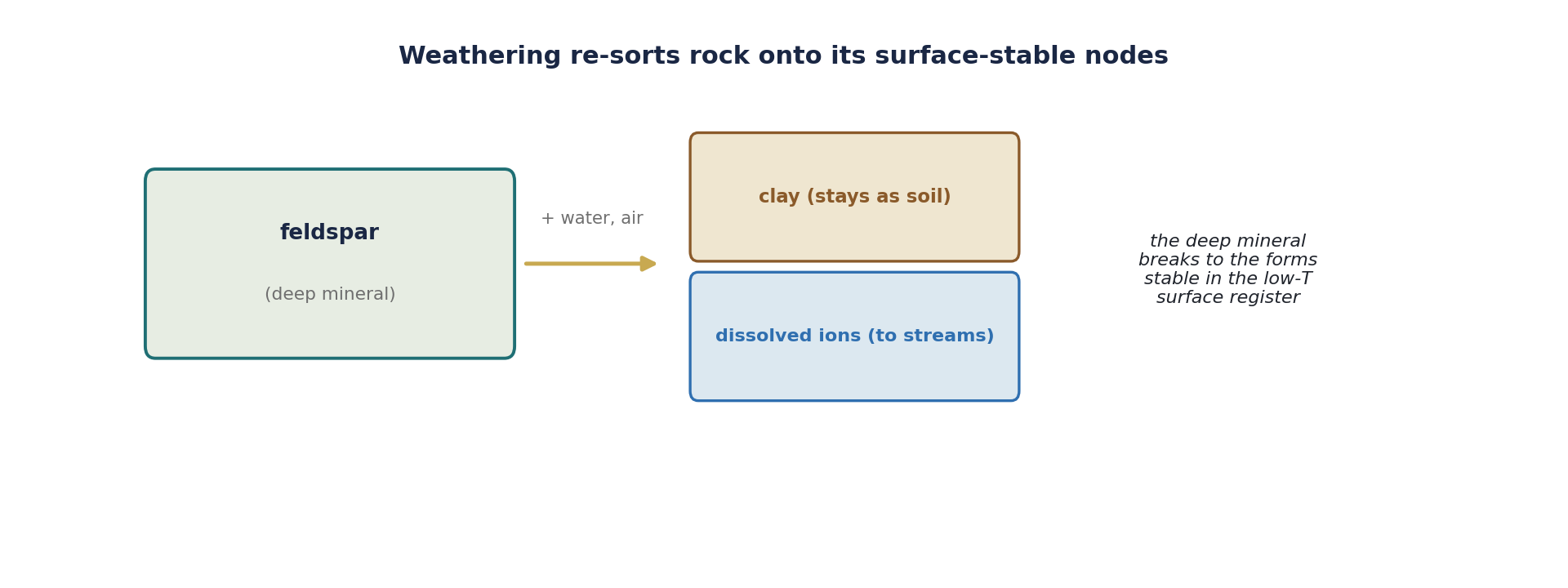
In the Force of Time chemical weathering is the register re-sorting. A deep mineral, out of register at the surface, relaxes onto the addresses that are stable in the sparse register: feldspar becomes clay, the dark minerals become iron oxides, and the elements that have no surface node — sodium, calcium, potassium — are released into solution because there is nowhere on the surface lattice for them to sit in the solid. Weathering is not destruction; it is re-sorting — the same register-relaxation that ran through every earlier chapter, now working at the surface to bring the rock into agreement with the density of the sky.
Why Rocks Break Down: Out of Register
Why should a mineral perfectly stable in the deep Earth fall apart at the surface? The standard answer is that it formed at high temperature and pressure and is simply out of equilibrium in the cool, wet, oxygen-rich surface. That is correct as far as it goes. The Force of Time says what ‘out of equilibrium’ means.
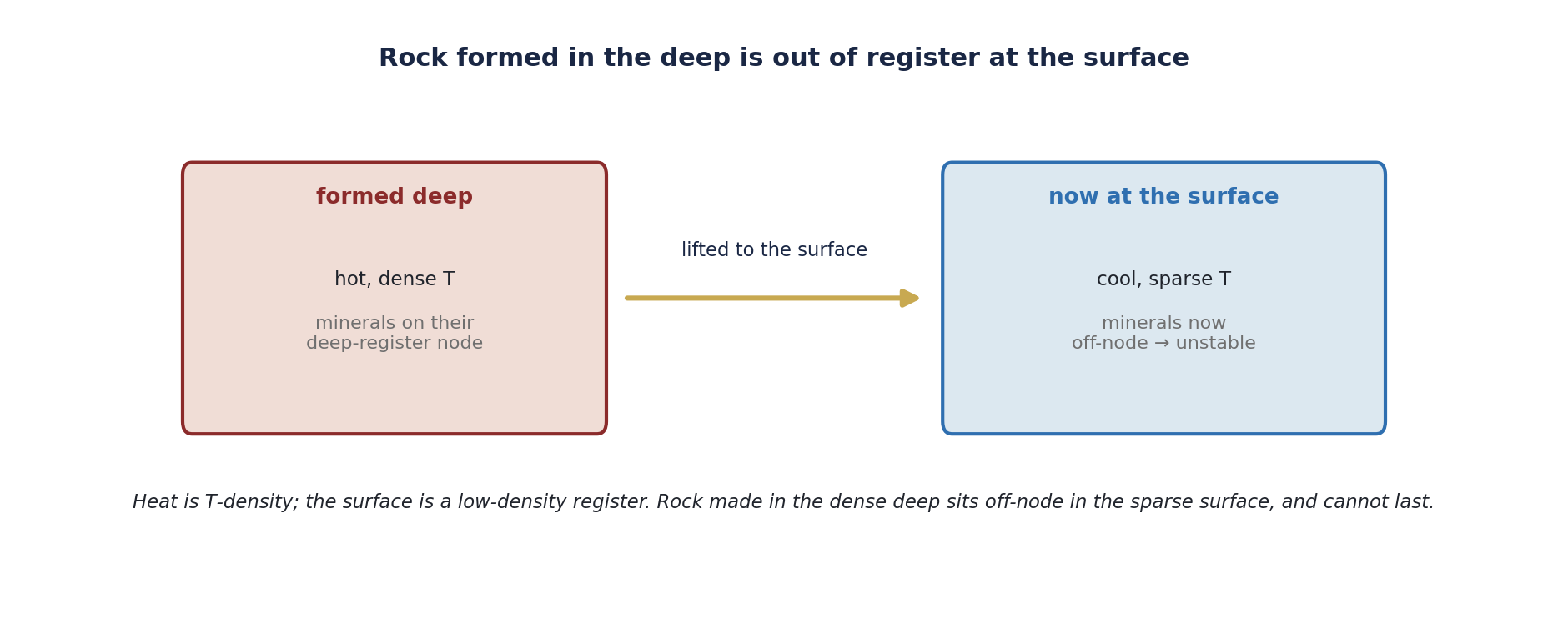
Heat is Τ-density. A mineral formed in the hot deep is built to a node of a dense-Τ register; the surface is a sparse-Τ register, and the mineral’s deep address is not a node there. It is off-node — strained, unpermitted — in exactly the sense that an unstable nucleus was off-node in the chapter on decay. And as there, an off-node configuration cannot endure: it must step onto a stable node, and that step is the weathering. Rock breaks down at the surface because it is out of register — made for one density of time and now standing in another — and the register will not let an off-node address last.
Soil: the Worked Layer of the Surface Register
Soil is what weathering leaves behind and life works over: a layer of broken rock, clay, and organic matter, laced with water and air and teeming with living things. It is neither rock nor mere dust but a distinct thing, structured into horizons, and it is the foundation of nearly all life on land — the medium in which plants root and from which the whole terrestrial food web draws.
In the Force of Time soil is the worked layer of the surface register — the zone where the re-sorting of rock, the flow of water, the breath of the air and the Τ-patterns of life all meet and mingle. It holds the surface-stable minerals the weathering has made, the clays that are the register’s new nodes; it holds the water that carries the freed elements; and it holds the living things that, as earlier chapters argued, are themselves Τ-patterns locked to the Earth’s register. Soil is where the surface register is most fully at work — rock, water, air and life brought into one thin, fertile band.
Streams: Carrying the Freed Elements to the Sea
What weathering dissolves, the rivers carry away. Every stream bears a load — elements in solution and fine particles in suspension — and delivers it, in the end, to the sea. The chemistry of river water, the total the continents shed each year, is one of the master balances of the surface Earth: the rate at which the land is being returned to the ocean.
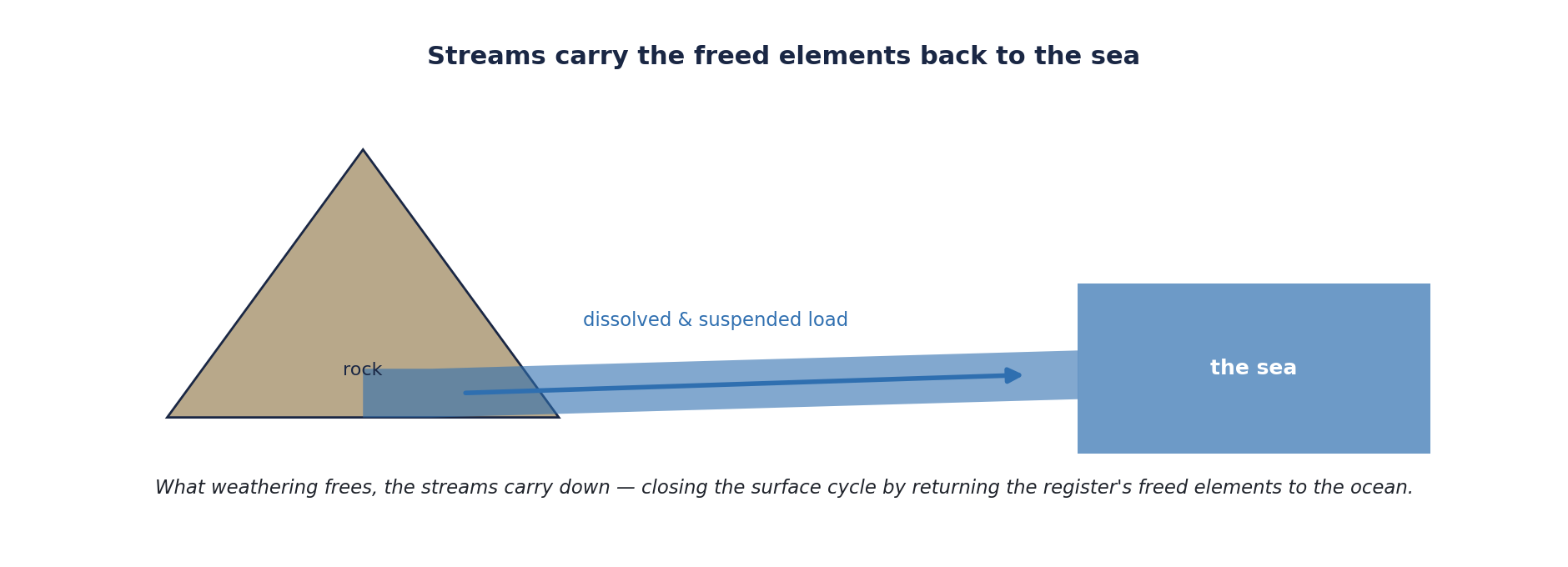
In the Force of Time the streams are the register’s carriers: the elements that weathering freed — those with no node to hold them in the surface solid — are swept into the water and borne downhill to the sea. The river is the return path of the surface cycle, taking what the land could not keep and delivering it to the ocean register, where, as the next chapter will show, it is taken up anew. The dissolved load of the world’s rivers is the tally of what the surface register is shedding — the off-node elements on their way home to the sea.
The Great Surface Cycle
Put the pieces together and a cycle appears. Rock is lifted to the surface; it weathers, making soil and freeing elements; the streams carry those elements to the sea; there they are taken into sediment, buried, and in time returned to the deep, to be made into rock again. The surface of the Earth runs this loop endlessly, and it is what keeps the land fresh, the soil renewed, the sea supplied.
In the Force of Time this is the register breathing at the surface, as the crust chapter found it breathing at the plate scale. Material is lifted from the dense deep, re-sorted at the sparse surface, carried to the sea, and drawn back down to be re-made — a continual re-sorting between the two densities of time. The great surface cycle is the register keeping the skin of the Earth in motion, forever bringing rock into agreement with the sky and returning it to the deep to begin again. Nothing is lost; everything is redistributed — the conservation of Τ, written across the whole face of the world.
Why This Should Matter to You
Weathering made the soil that grows your food and freed the elements your body is built from; the rivers that drain the land carry the very salts that make the sea the sea. The slow dissolving of rock is not decay but provision — it is how a planet of bare stone becomes a planet of soil and life. Every harvest is a gift of the weathered surface.
And it is all the register re-sorting. Rock breaks down at the surface because it is out of register — made for the dense-Τ deep, now standing in the sparse-Τ sky; it re-forms onto its surface-stable nodes as soil and clay; and the streams carry the freed elements to the sea. The land is forever coming into agreement with the register of the surface, and that coming-into-agreement is what feeds us. With the surface cycle read, we can follow the freed elements to their destination — the oceans, the register of water, where the last chapter of the Earth’s story is written.
The Numbers at a Glance
The processes of the surface and their Force-of-Time reading. Measured behaviour is left as measured; the right-hand column gives the register meaning.
| Process | What it is | The Force of Time reading |
|---|---|---|
| Weathering | rock breaks down | the register re-sorting at the surface |
| Why rock weathers | out of surface equilibrium | off-node: made dense-Τ, now in sparse-Τ |
| Chemical products | clays, iron oxides | the surface-stable nodes |
| Released elements | Na, Ca, K, silica in solution | elements with no surface node |
| Soil | broken rock + clay + life | the worked layer of the surface register |
| Streams | carry dissolved + suspended load | the register carrying freed elements to sea |
| River chemistry | what the land sheds | the off-node inventory in transit |
| The surface cycle | rock → soil → sea → rock | the register breathing between two densities |
References
- S. Daubney, The Universal Force of Time — Master Compendium v5, The Daubney Foundation (2026).
- W. M. White, Geochemistry, John Wiley & Sons, Chichester (2005; 2013 print ed.), Chapter 13.
- S. Daubney, Heat Is Time — Temperature as Τ-Density, The Daubney Foundation (2026).
- S. Daubney, The Force of Time — Where It Departs From Current Science, The Daubney Foundation (2026).
Open the full paper as a PDF ↗
This paper, and any information drawn from it, may be used freely provided the reference attribution to Stephen Daubney and The Daubney Foundation is recognised.